| Quantum Mechanics (nonrelativistic) in one dimension |
Wave-particle duality tells us that associated with any particle is a matter wave called the wavefunction. The wavefunction Y depends both on the position x and time t and it contains all the information about the properties of the particle. In other words, for any quantum system Y(x,t) determines the entire space-time behavior of the system. We have also seen it is not possible to determine the motion of a quantum system on the basis of classical mechanics (Recall Heisenberg's Uncertainty principle). The space-time behavior of these systems are determined by the laws of probability. As an example for an atomic electron, the probability of finding it at a point is determined by the square of the amplitude of the corresponding electron wavefunction. In general,
The probability that a particle will be found in the infinitesimal interval dx about the point x, which we denote as P(x) dx, is
P(x) dx = |Y(x,t)|2 dx. = Y*(x,t) Y(x,t) dx.
The wavefunction Y(x,t) is in general a complex function of x and t. P(x) is the probability per unit length, or the probability density. Because the particle must be somewhere along the x axis, the sum of the probabilities over all values of x must be 1:
Int_{-infinity}^{+infinity} |Y(x,t)|2 dx = 1.
This is known as the normalization condition.
Note that in quantum mechanics Y(x,t) is not a measurable quantity but |Y(x,t)|2 is.
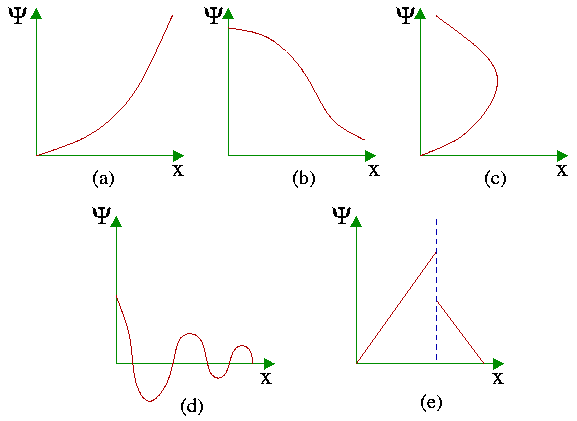
The wavefunction Y(x,t) is not completely arbitrary but should satisfy certain mathematical conditions:
As an example, let us consider the following set of wave-functions:
You may now ask, "How to calculate the wavefunction Y(x,t) for any quantum system?" Just like Newton's equation of motion in classical mechanics we also have a master equation known as 'The Schrödinger equation' in quantum mechanics. Let us now try to investigate how to calculate the wavefunctions for some simple cases using the Schrödinger equation.
Free particle wavefunction in one dimension:
A free particle is one which is moving freely (subject to no force). We have seen from de Broglie's theory that the wavepackets representing a particle can be built up by the superposition of waves of continuously varying wavenumbers k of appropriate amplitudes. For simplicity, we will consider one of the component waves. We can write the wavefunction of the component wave (in one dimension) as
Y(x,t) = A exp[i(kx - wt)], Eq. (1)
where k (=2p/l) is the wavenumber and w (=2pf) is the circular frequency of the wave. From de Broglie's theory,
p = h/l = hbar k, k = 2p/l. Eq. (2)
Here p is the momentum of the particle. For a free particle of mass m, the energy is
E = p2/2m = hbar2 k2/2m = hf = hbar w. Eq. (3)
Differentiating the wavefunction Y(x,t) once w.r.t time t, we get
dY/dt = -iwY. Eq. (4)
Similarly, differentiating Y(x,t) twice w.r.t x gives
d2Y/dx2 = -k2 Y. Eq. (5)
From Eqs. (4) and (5) we get,
i hbar dY/dt = ihbar (-iw)Y = hbar w Y
and
-(hbar2/2m)d2Y/dx2 = -(hbar2/2m)(-k2 Y) = (hbar2k2/2m)Y.
Then, using Eq. (3) we get,
ihbar dY/dt = -(hbar2/2m) d2Y/dx2. Eq. (6)
The above equation is the one-dimensional time dependent Schrödinger wave equation for a free particle of mass m.
Note: Rigorously speaking, the plane wave description is inappropriate as we know that a particle is represented by a wave packet. Such a wave packet can be represented by a sum of plane waves with different numbers. Because k is unrestricted, the sum actually is an integral and we write -
Y(x,0) = Int_{-infinity}^{+infinity} a(k) exp(ikx) dk,
where the coefficients a(k) are the amplitudes of the plane wave with wavenumber k. But it can be shown that the motion of the wave packet formed by the superposition of such component waves is also determined by the Schrödinger equation [Eq. (6)].
Schrödinger Equation in One Dimension:
The Schrödinger equation is the 'bread and butter' of quantum mechanics just like Newton's equation in classical mechanics. For a particle under a force F, the Schrodinger equation in general can be written as -
(-hbar2/2m) d2 Y (x,t) /dx2 + U(x) Y (x,t) = i hbar d Y (x,t)/dt, Eq. (7)
where, U(x) is the potential energy function derived from the force F (=-dU/dx). Eq. (7) is the time-dependent Schrödinger equation. If the particle has energy E, the time independent Schrödinger equation is
(-hbar2/2m) d2 Y (x) /dx2 + U(x) Y (x) = E Y (x). Eq. (8)
We will now use the Schrödinger equation to solve some simple problems (for different potentials U).
Free Particle In a Box:
This is one of the simplest problem where a particle is confined within a one dimensional box of width L. The particle can move back and forth freely (U=0) only in the x direction (in Region II). The geometry of the problem is shown below:
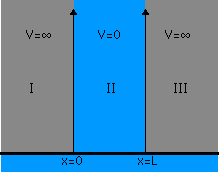
After rearrangement Eq. (8) can be written as
d2 Y (x) /dx2 = -k2 Y (x), Eq. (9)
where k2 = 2mE/hbar2. The solution of Eq. (9) (for the Region II i.e. for 0<x<L) is,
Y (x) = A cos(kx) + B sin (kx). Eq. (10)
A and B are two unknown constants to be determined from the boundary conditions at x=0 and at x=L. The wavefunction Y(x) should be continuous at x=0 and at x=L which mathematically means
Y(x=0) = Y(x=L) = 0. Eq. (11)
Using Eq. (11) we get A =0 , and
sin(kL) = 0 => sin(kL) = sin(np) => kL = np
=> k = np/L, n=1,2,3.... Eq. (12)
n is known as the quantum number which can take only integer values (For our problem n=0 is not allowed. If you consider the value n=0, the energy E will be 0 - substituting that in Eq. (9) yields the solution of the wavefunction to be Y(x) = Ax +B. It can be then shown easily that A=B=0 for the boundary conditions which thus imply that Y(x) = 0! This simply means that there is no particle and that doesn't make any sense.). Also we find that the particle energies are quantized and can only take restricted values.
En = hbar2 k2/2m = n2 p2 hbar 2/2m L2 = n2 p2 h2/(8mL2). Eq. (13)
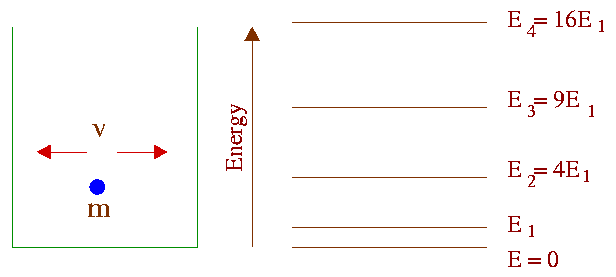
The lowest allowed energy is given by n=1 and is E1 = p2h2/(8mL2). This is known as the lowest energy state or the ground state. Classically the lowest energy state has zero energy but quantum mechanically the particle possess some energy even when it is at rest! This energy is also referred to as the zero-point energy. All other higher energy states (for n=2,3,4,..) are known as the excited states. In general En = n2E1. The excited states are shown in the Figure below.
The spatial part of the wavefunction has the form Yn(x)= A sin(npx/L). The constant A has to be determined from the normalization condition:
Int_{0}^{L} Yn(x) Y*n(x) dx = 1
=> A = (2/L)½.
Thus we get for the wavefunction of the free particle in a box of length L,
Yn(x) = (2/L)½ sin (npx/L). Eq. (14)
The wavefunction for different values of n are shown below. The probability |Yn(x)|2 is also shown in the figure below.
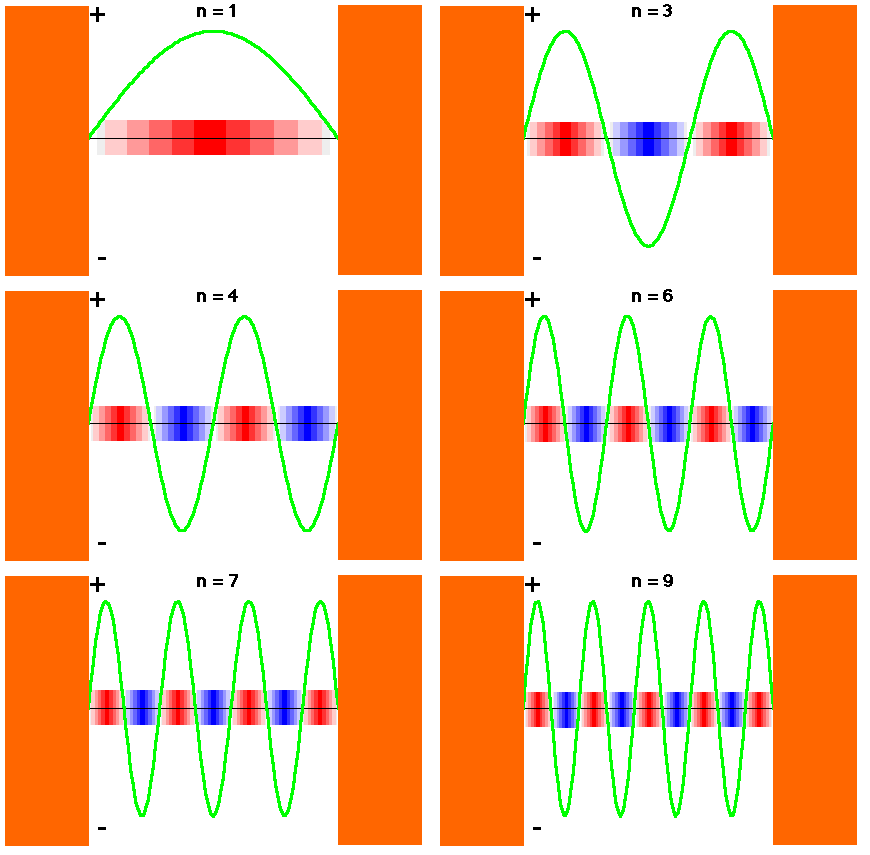
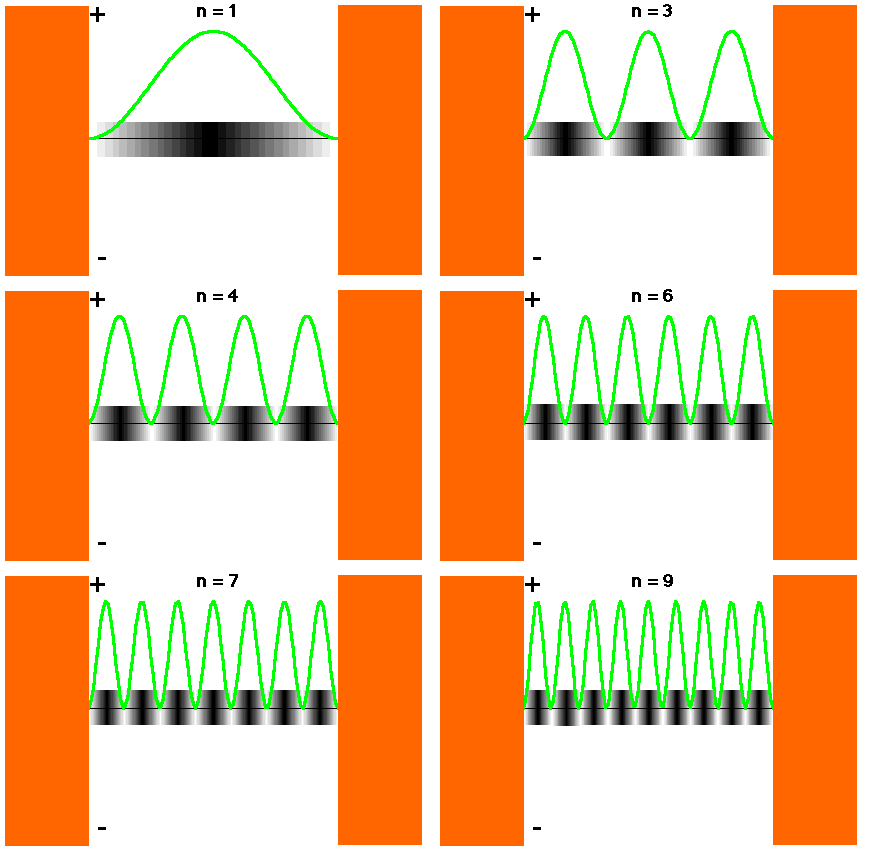
Wave Function Yn(x) Probability |Yn(x)|2
[The red (or black) and the white portion in the figure above shows the maxima and minima of the wave function and the probability]
Finite Square Well:
In the box potential discussed above, the walls on both sides of the box are infinite in length (which means infinite potential) which is not practical. A more realistic case is a finite barrier (or finite potential) on both the sides of the box. A classical particle with energy E greater than the potential U (in other words the barrier height) can escape from the box and can go to the outer region (Region I and III). Inside the box, the particle moves freely and happily but with a reduced kinetic energy (E-U). But classically a particle with E<U can never escape from the box and thus bound inside the box. But quantum mechanically there is some probability that the particle can be found outside the box (in region I and III). This is totally a quantum phenomena and can not be explained by any way classically. To understand this, we need to solve the time independent Schrödinger equation for three different regions.
Region I and III
The potential in both the cases U(x) = U. Thus the Schrödinger equation [Eq. (8)] takes the form after some rearrangement of terms,
d2 Y (x) /dx2 = a2 Y (x), for x<0 and x>L, Eq. (15)
where a2 = 2m(U-E)/hbar2. The term a2 is always positive (thus a is real) and the solutions to Eq. (15) decays exponentially as,
YI(x<0) = A exp (a x) for x<0,
YIII(x>L) = A exp (-a x) for x>L.
In Region II (i.e. 0<x<L) the solution is similar to Eq. (8)
YII (x) = C cos(kx) + D sin (kx), k2= 2mE/hbar2.
The coefficients A, B, C, and D can be determined from the boundary conditions at x=0 and at x=L.
The wavefunctions and the probability densities are plotted below for the three lowest energy states. We can see that there is a non-zero probability [ as |YI(x)|2 and |YIII(x)|2 is finite ] to find the particle in the region outside the well. The wavefunction penetrates the exterior region on a scale of length set by the penetration depth d given by
d = 1/a = hbar/[2m(U-E)]½.
The wavefunctions YI(x) and YIII(x) decays exponentially and finally vanishes beyond a length scale d from the walls of the well. Mathematically speaking,
YI(x) = 0 for x<-d; YIII(x) = 0 for x>(L+d).
The Quantum Oscillator:
The next nontrivial example is the linear harmonic oscillator. For an oscillator the particle is subject to a linear restoring force F=-Kx, where K is the force constant and x is the displacement [Example: mass on a spring]. The potential energy is then U(x) = kx2/2 = mw2x2/2. Substituting the expression for the potential in the Schrödinger equation [Eq. (8)] we get,
d2 Y (x) /dx2 = (2m/hbar2)[mw2x2/2 - E] Y (x), Eq. (16)
The solution to the wavefunction in Eq. (16) is nontrivial but we can make some guesses for the ground state wavefunction using symmetry principle. Because the potential is symmetric w.r.t x the ground state wavefunction should possess the following properties:
Based on these a good guess for the ground state would be
Y0 (x) = C0 exp(-a x2),
where C0 and a are constants. This form of the ground state wave function can be verified by explicitly solving the Schrödinger equation. From Eq. (8) we can now calculate the ground state energy (also known as the zero point energy) E0 which is (with a=mw2/2hbar),
E0 = hbar w/2.
In general, the wavefunction Yn (it depends on an integer n) and the energy can be calculated explicitly. The energy of the n-th excited state is given by,
En = (n+1/2) hbar w, n=0,1,2,3,.... Eq. (17)
The energy level diagram is shown below:
From the diagram above we see that the energy levels are equally spaced. The difference between any two successive energy states, say the nth and the (n-1)th is,
DE = En - En-1 = hbar w = hf. Eq. (18)
The wavefunctions for the ground state (n=0) and the first few excited states (n=1,2,3,...) are shown below:
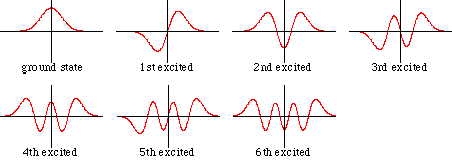
The probability densities for a few states are shown below. The dashed curves are the classical probabilities (for the same energies) which vary between two limits -A and A where A is the amplitude. Unlike the classical result there is a probability to find the particle beyond the classical limits (+A and -A). For smaller values of n, there is a big difference between the classical and the quantum probabilities. The disagreement between these two results improve for larger values of n as shown. This is also expected from the correspondence principle.
The following link also provides a nice interactive demonstration of the wavefunction of the quantum oscillator (Please ):
http://www3.adnc.com/~topquark/quantum/qhomain.html
Observable and Expectation Values:
An observable is any particle property that can be measured. For example, the position, momentum, kinetic, and potential energies of a particle are all can be measured and thus they are observable.
In quantum mechanics two distinct observable are associated with the wavefunction Y(x,t). For example, the energy E for stationary states are fixed by the quantum numbers labeling the wavefunction. Thus, every measurement of this quantity yields the same value. On the other hand for some observable like the position or the momentum the wavefunction Y furnishes only probabilities. In these cases we calculate the expectation values of the observable. As an example, the expectation value of the position is given by,
<x> = Int_{-infinity}^{+infinity} x |Y(x,t)|2 dx
In general the average value for any function of x, say f(x) is,
<f> = Int_{-infinity}^{+infinity} Y*(x,t) f(x) Y(x,t) dx. Eq. (19)
But the expectation value of the momentum (x-component for example) is,
<p> = Int_{-infinity}^{+infinity} Y*(x,t) (-i hbar) (d/dx) Y(x,t) dx. Eq. (20)
[Eq. (20) can be obtained from Eq. (19) if we identify p = -i hbar (d/dx). In fact this is the coordinate representation of the momentum operator p]
The quantum uncertainty DQ of any measurement of an observable Q can be calculated from the expectation values using following relation:
DQ = [ <Q2> - <Q>2 ]. Eq. (21)
Tunneling Phenomena:
Tunneling is a pure quantum phenomena which has no classical explanation. It has many wide spread applications from decay of black holes to nanodevices. Let us now investigate the problem in detail.
Consider a particle of mass m and energy E moving in a potential U in the region 0<x<L. The potential is zero everywhere else. The geometry of the problem is shown below:
We now divide the one-dimensional space in three regions -
Region I: V=0, for x<0;
Region II: V=U, for 0<x<L;
Region III: V==0, for x>L.
In the three regions, the wavefunctions will be represented by Y1(x), Y2(x), and Y3(x). The boundary conditions at x=0 and x=L are:
At x=0, Y1(x=0) = Y2(x=0), dY1(x=0)/dx = dY2(x=0)/dx.
At x=L, Y1(x=L) = Y2(x=L), dY1(x=L)/dx = dY2(x=L)/dx.
The initial condition is that the wave is incident in the region I from left to right. The energy E can be either less than or greater than the barrier height U. The interesting case is for E<U. Classically in this case the electron can not go to region III. But quantum mechanically the electron can tunnel through the barrier and can be found in region III. This phenomena is known as quantum mechanical tunneling.
Define, k2 = 2mE/hbar2, a2 = 2m(U-E)/hbar2. The solution of the time independent Schrödinger equation for the three regions are:
Region I: x<0; Y1 (x) = A exp(ikx) + B exp(-ikx); Eq. (22a)
Region II: 0<x<L; Y2 (x) = C exp(-ax) + D exp(ax); Eq. (22b)
Region III: x>L; Y3 (x) = F exp(ikx) + G exp(-ikx); Eq. (22c)
In Region I, the solution [Eq. (22a)] is a superposition of incident (with +ve wavenumber k) and the reflected wave (with -ve k). In Region III, we only have the transmitted wave travelling from left to right (with +ve k) - thus G=0 physically. There are now five arbitrary constants which can be calculated from the boundary conditions at x=0 and x=L.
Reflection (R) and Transmission (T) coeeficients are defined as:
R = [reflected part of (Y1*Y1)]/[ incident part of (Y1*Y1)]=|B|2/|A|2,
T = [transmitted part of (Y3*Y3)]/[ incident part of (Y1*Y1)]=|F|2/|A|2.
The reflection and transmission coefficients satisfy the relation R + T = 1. Solving the constants A, B, C, D, and F we get for the transmission coefficient,
T = [ 1 + U2/[4E(U-E)] sin h2 aL]-1. Eq. (23)
So quantum mechanically the particle can tunnel to region III. As E decreases below U, T monotonically decreases because of the factor E(U-E). Also as the thickness L of the barrier increases, sin h(aL) increases rapidly and hence T decreases.
For aL >> 1, sin h2aL -> exp(2aL)/4 >>1. In this case we get,
T = [16E(U-E)/U2] exp(-2aL). Eq. (24)
For a nice simulation on tunneling please visit the following website and then on the simulation there:
Quantum Mechanical Tunneling - A Simulation
Scanning Tunneling Microscope:
One of the most powerful microscope of today, the scanning tunneling microscope (STM) which has a resolution of 2 angstroms works basically on the principle of quantum tunneling. The functional details of the STM along with the physics is nicely explained in the following website (please ):
Scanning Tunneling Microscope - The Details
For some awesome pictures of surfaces taken by the STM please take a look at the following link:
IBM Scanning Tunneling Microscope (STM) Webpage
©Kingshuk Majumdar (2000)