

A spacetime diagram of the wave front produced by a stone striking a still water surface at the event P.


A: Inertial Observer
B: Noninertial Observer
C: Inertial Observer receding from A
D: Inertial Observer approaching A
| Introduction to Special Relativity |
(Based on Hermann Bondi’s k-Factor Approach)
Prepared by:
Manash Mukherjee and Kingshuk Majumdar
© Manash Mukherjee and Kingshuk Majumdar.
| Contents |
| 1. Basic Definitions |
1) Event: Any point in space at any instant of time is referred to as an event.
2) Spacetime: Spacetime is the collection of all events.
3) Spacetime is four dimensional: an event is specified by four numbers - one for the time and three for the spatial position.
4) Spacetime Diagrams are pictures of a sequence of events in spacetime. The following conventions will be used:
5) Inertial Observer: Of all possible motions of observers in spacetime, it is possible to distinguish in an absolute in an absolute sense (that is, without making any reference to the motion of other objects) a certain class of motions, usually referred to as "inertial" or "nonaccelerating." Within this class, there is no absolute way of distinguishing a preferred motion (for example, no inertial observer can be said to at "rest" in an absolute sense).
| a)The world line of an observers O1 who is "standing still". | |
|
|
(b)A spacetime diagram of O1 and another observer O2 who is moving past O1 with constant velocity. | |
| (c) A spacetime diagram of the wave front produced by a stone striking a still water surface at the event P. |
|
|
|
More
Examples of Spacetime Diagrams: A: Inertial Observer B: Noninertial Observer C: Inertial Observer receding from A D: Inertial Observer approaching A |
|
| 2. Fundamental Postulates |
I. The laws of physics are the same with respect to all inertial observers. No preferred inertial observer exists.[The Principle of Relativity]
II.The speed of light in vacuum has the same value c = 3 x10⁸ m/s with respect to all inertial observers.
| 3. Bondi’s k-Factor |
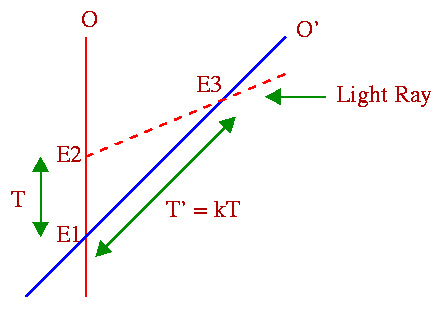
Inertial observers O and O’ pass each other at event E1. Observer O sends a light signal at event E2. O’ receives the signal at event E3. If the time interval from E1 to E2 is T as measured by O, then the time interval from E1 and E3 is T’ as measured by O’. It is shown below that
T' is proportional to T : T' = k T , where k>0 depends on the relative velocity of the pair of inertial observers.
Proof: T’ = k T
Let O" be the inertial observer who is at rest relative to O and whose worldline passes through event "3". Hence, two light signals sent by O at events 2 and 4 in the time interval T, are received by O" at events 3 and 5 in the same time interval T.
Now, the signal leaving O" at event 5 must be received by O’ at event 6 in the time interval T’ from event 3 since the triangles 123 and 356 describe identical physical structure according to the principle of relativity. Thus the time interval 2T (1 -> 4) on O’s clock implies a time interval 2T’ (1->6) on O’ .
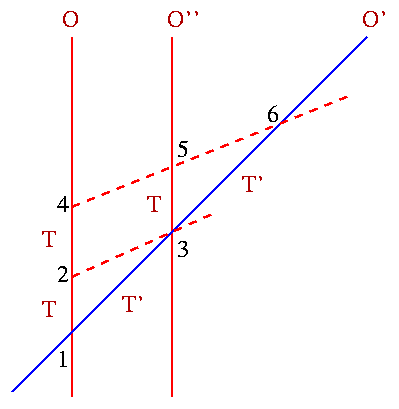
Note that any two light signals, time T apart, emitted by O will be received by O’ in the interval of kT, and the converse is also true according to the postulates of special relativity.
| 4. Determination of k-factor |
Ti -> time for ith event on O
T’i -> time for ith event on O’
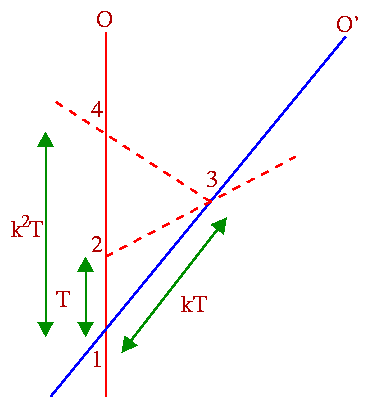
According to O, Event 3 occurs at the instant,
t = T2 + (T4 - T2)/2 = (T4 + T2)/2
= (k2 T+ T )/2 [ as T4 = k (k T) ]
= T (k2 + 1)/2
and at the position,
x = c (T4 - T2)/2 = c (k2 T- T )/2
= cT (k2 - 1)/2.
Thus, the velocity of O’ with respect to O is
v = x/t = c ( k2 - 1)/( k2 + 1), which implies
k = [ (c + v)/ (c - v)]½ >= 1 and k = 1 <=> v = 0.
Note that times t and t’ assigned to event 3 by O and O’ are different:
t = T ( k2 + 1)/2 and t’ = kT
Hence,
t = [(1/2)( k2 + 1)/k] t’ = g t’
where (Please read 'g' as 'gamma')
g = [(1/2)( k2 + 1)/k] = 1/(1 - v2/c2)½
| 5. Lorentz Transformations and Invariant Spacetime Interval |
Three inertial observers O, O’, and O" pass each other at event 1. O sends a light signal at event 2 which passes through O’ and O’’ at events 3 and event 4, respectively. Immediately after receiving the signal at event 4, O" sends another light signal which passes through event 5 on O’ and is received by O at event 6. Note that
Ti -> time for ith event on O ,
T’i -> time for ith event on O’ , and
hence,
T6 = k T’5 and T’3 = k T2.
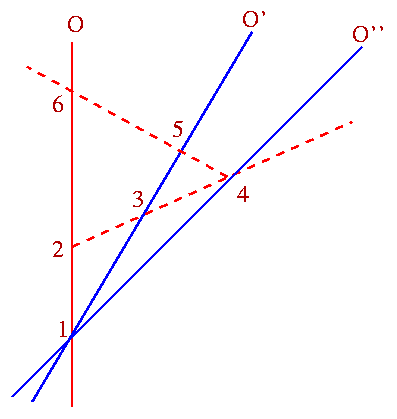
Now, consider the Event 4 which is described by O and O’ as follows:
Observer O:
x = c(T6 - T2 )/2 and t = T2 + (T6 - T2 )/2 = (T6 + T2 )/2
=> T6 = x/c + t and T2 = - x/c + t
Observer O’:
x’ = c(T’5 - T’3 )/2 and t’ = T’3 + (T’5 - T’3 )/2 = (T’5 + T’3 )/2
=> T’5 = x’/c + t’ and T’3 = - x’/c + t’
T6 = k T’5 => (x/c + t) = k (x’/c + t’)
T’3 = k T2 => (- x/c + t) = (- x’/c + t’)/k
Solving t’ and x’, and inserting k = [ (c + v)/ (c - v)]½, we have
t’ = g(t - v x/c2)= (t - v x/c2) /(1 - v2/c2)½ Eq. (1)
and
x’ = g (x - v t )=(x - v t )/(1 - v2/c2)½, Eq. (2)
where
g = 1/(1 - v2/c2)½ .
In our above derivation of Lorentz transformations (Eqs. 1 and 2) we only have x and t coordinates for simplicity. The observer O' is receding away from O in +x direction at a speed v (to be precise v = vx). In general, one can have all four coordinates (x,y,z,t) and the observer O' may move in any direction with a uniform velocity v [Here v is a vector having 3 components (vx, vy, vz)].
Note: Dimensions perpendicular to the velocity are not contracted.
Thus,
y' = y, Eq. (3)
z' = z. Eq. (4)
The above transformations between two inertial observers O and O' is known as Lorentz transformations (Eqs. 1-4).
Problem: Show that when v<<c, Lorentz transformations become Galilean transformations:
x' = x - vt
y' = y
z' = z
t' = t
Also, note that
-(ct)2 + x2 = -(ct)2 + x'2= L ,
where L is called invariant spacetime interval.
| 6. Velocity Addition |
O1, O2, O3 are inertial observers. Two successive light signals sent by O1 in the time interval T are received by O2 and O3 in the time intervals of k12T and k13T, respectively. Note that
k13T = k23 (k12T) = k12 k23 T
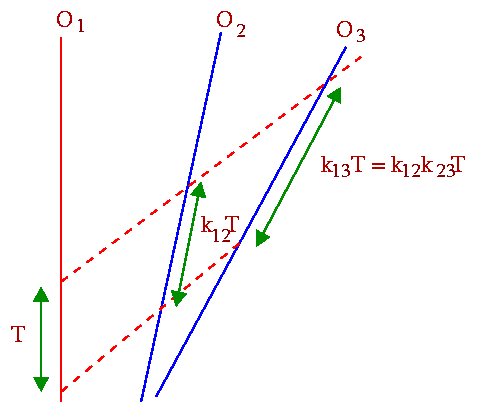
kIJ = kJI -> k-factor for a pair of observers (OI , OJ )
vIJ -> velocity of the observer OJ relative to the observer OI .
Now, using the relation vIJ = c(kIJ2 - 1)/ (kIJ2 + 1) , we have
k13 = k12 k23 => v13 = (v12 + v23)/( 1 + v12 v23/c2)
[Try to derive the above equation]
An important special case:
| If v13
= 0 , then(1)
k13 = 1
(2) 1 = k12 k23
(3) v23 = - v12 In the spacetime diagram below, k = k12 , and hence k23 = 1/k12 = 1/k. |
 |
Alternative Derivation of the velocity addition formula (using Calculus):
Recall Lorentz transformations:
x’ = (x - v t )/(1 - v2/c2)½,
t’ = (t - v x/c2) /(1 - v2/c2)½
=>
dx’ = (dx - v dt )/(1 - v2/c2)½
dt’ = (dt - v dx/c2) /(1 - v2/c2)½
Velocity of the object u'x, measured in the O' frame [one moving away with a velocity v in the x direction from the observer O]:
u'x = dx'/dt' = (dx-vdt)/[dt-(v/c2)dx] = [(dx/dt) -v ]/[1-(v/c2)(dx/dt)].
Thus we get:
u'x = (ux - v)/[1-(uxv/c2)],
Alternatively, when measured in the rest frame by O:
ux = (u'x+v)/[1+(uxv/c2)].
This expression is same as above if you identify v13=ux, v12=u'x, and v23=v.
Problem: Imagine two objects travelling towards each other at the speed of light. What is the speed of the second object as measured by the first object? If you use Galilean addition of velocities what do you get? Is there anything wrong with the answer? If you use the Lorentz velocity addition formula what do you get?
| 7. Consequences of Special Theory of Relativity |
(a) The relativity of simultaneity:
Two events which are simultaneous in one inertial system are not, in general, simultaneous in another.
A Thought Experiment:
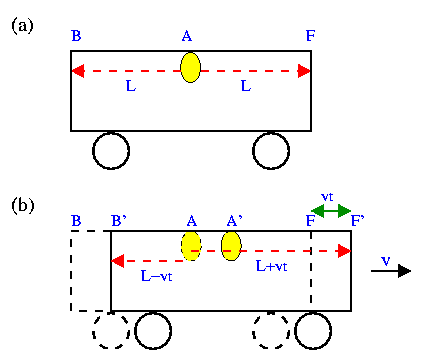
Consider the truck above in the picture moving smoothly at a constant speed v (so it's an inertial frame). In the very center of the car there hangs a light bulb (A). Imagine that the observer O' inside the car switches it on and the light spreads out in all directions. As the light bulb is equidistant from the front (F) and the back (B) end of the truck, the observer O' will find that the light ray hits the front and the back end at the same time (Two events are thus simultaneous to O'). However, to an observer O on the ground these same two events are not simultaneous. For as the light travels out from the bulb, the train itself moves forward, so the beam going to the back end has a shorter distance to travel than the one going forward [See Figure (b)]. Thus, according to observer O event B' occurs before event A'.
(b) Length Contraction:
L' = length of an object measured by an inertial observer at rest.
L = length of an object measured by an inertial observer moving with a relative velocity v in a direction parallel to its length
L = L'(1 - v2/c2)½
As (1 - v2/c2)½ < 1 (=1 when v=0), L < L' which implies that the length L measured by the observer moving with relative velocity v in a direction parallel to its length is shoter than the length L' as measured by the observer at rest. This effect is known as length contraction.
Justify the statement: "Moving objects are shortened."
Important Note: Dimensions perpendicular to the velocity are not contracted.
A Thought Experiment:
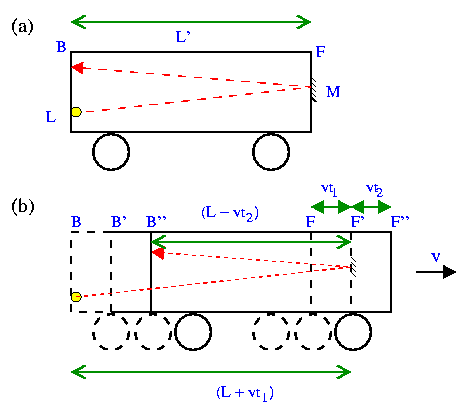
Imagine a lamp at one end of the car and a mirror on the other end. We now ask the following question. How long does it take for the light signal to complete the round trip (from the lamp to the mirror and back as hown in the figure above)?
For the observer O' in the car the answer is: Dt' = 2L'/c.
But for the observer O on the ground, it is little complicated. If the light takes time Dt1 to go from the lamp to the mirror and time Dt2 the return time then (see figure):
Dt1=(L+vDt1)/c, Dt2= (L-vDt2)/c.
Solving for Dt1 and Dt2 we get, Dt1=L/(c-v), Dt2=L/(c+v). So the round-trip time is:
Dt=Dt1+Dt2= 2(L/c) (1/[1-v2/c2]).
Again the Dt and Dt' are related via the time dilation expression, Dt' = (1-v2/c2)½Dt. Using this in the equation above yields,
L' = L/(1-v2/c2)½.
Conclusion: The length of the car is not the same when measured by an observer on the ground, as it is when measured by an observer on the car - from the ground point of view it is shorter.
(c) Time dilation:
Dt = time interval measured by the observer moving with respect to the clock
Dt' = time interval measured by the observer at rest with respect to the clock
(Please read 'D' as 'delta')
Then, from Lorentz transformation:
Dt = Dt'/(1 - v2/c2)½
As 1/(1 - v2/c2)½ >1 (=1 when v=0) , Dt > Dt' which implies that the time interval Dt measured by the observer moving w.r.t the clock is longer than the time interval Dt' as measured by the observer at rest w.r.t the clock. This effect is known as time dilation.
Justify the statement: "A moving clock runs slower than a clock at rest."
A Thought Experiment:
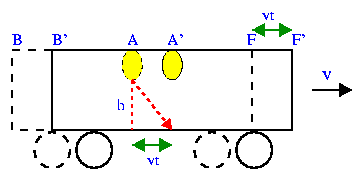
Consider a light ray that leaves the bulb and strikes the floor directly below. If the height of the car is h, the time for the light ray to hit the floor according to the observer O' inside the car is:
Dt' = h/c.
But to an observer O on the ground this same ray must travel farther because the train itself is moving. Thus for the observer O, the time the beam will take to hit the floor is:
Dt =[h2+(vDt)2]½/c
Solving for Dt, we have
Dt = h/[c(1-v2/c2)½] = Dt'/(1 - v2/c2)½
Thus the time elapsed between same two events - (a) light leaves the bulb, and (b) light strikes center of floor - is different for the two observers. Infact, the time interval recorded on the car clock, Dt' is shorter than the clock on the ground! An example of time dilation:Muons are unstable elementary particles produced by the collision of cosmic radiations in the upper atmosphere. They have a lifetime of only 2.2 microsecond (2.2 x 10⁻⁶ secs) and have a speed of 0.99c. With this speed they can travel only L=vt=0.99x2.2x10-6c=650m before they decay to electrons and neutrinos. So they cannot reach the Earth from the upper atmosphere where they are produced. But experiments show that a large number of muons do reach the Earth. This can be explained from the effect of time dilation. Relative to an observer on earth the muons have a lifetime t/sqrt(1-v2/c2)= 16 microseconds. So the average distance traveled as measured by an observer on Earth is 16 x 10-6 x 0.99c = 4700m (approx). This is a direct evidence for the phenomenon of time dilation.
| 8. Some more definitions: Proper length, Proper time |
(a) Proper length:
Defined as the length of an object measured by an inertial observer who is at rest with respect to the object.
(b) Proper time:
Defined as the time interval between two events as measured by an inertial observer who observes the events occur at the same point in space. That is, proper time is always the time measured by an observer moving along with the clock.
| 9. The Twin Paradox |
O1, O2, O3 are inertial observers such that
v12 = - v13
The worldline of O1 represents the earth-bound twin, A. Twin B leaves A at event 1 moving away from earth with constant velocity [by jumping into O2’s spaceship]. After a time interval of T at event 2, B turns back to meet A at event 4 moving with the same constant velocity as before [by jumping into O3’s spaceship]. At 2, twin B also sends a light signal which is received by A at event 3.
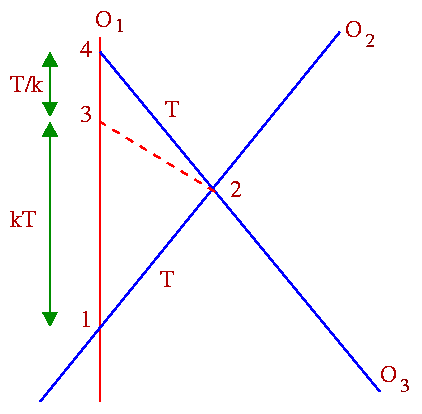
2T -> time interval from 1 to 4 according to the traveling twin B
Then, the time interval from 1 to 4 according to the earth-bound twin A must be (kT + T/k) such that
2T < (k + 1/k)T = T (k2 + 1)/k
[ since 1 < k and hence, 2k < (k2 + 1) ].
Question 1. Planet X is 12 Ly from Earth. Anna and Bob are both 22 years old. Anna travels to Planet X at 0.6 c, quickly turns around, and returns to Earth at 0.6 c. How old will Anna and Bob be when Anna gets back?
k = 2 and (k + 1/k)T = 2 x (12 Ly)/(0.6 c) = 40 y => 2T = 32 y
Anna’s age = 22 y + 32 y = 54 y, Bob’s Age = 22 y + 40 y = 62 y
| 10. Relativistic Doppler Shift |
Relativistic Doppler Shift is another important consequence of the time dilation effect. Consider a source of light waves at rest in frame O, emittting waves of frequency f and wavlength lambda as measured by O. The question we want to ask is: What is the frequency measured by an observer O' moving with a velocity v towards O?
As both these frames O and O' are inertial frames we can look at the problem from the point of view of the observer O'. He will consider himself to be at rest and consider the source O to be moving towards him at a velocity O. Say the time between the emission of two successive wave-fronts is T' as measured by O'. During this time front 1 (see figure) will advance a distance cT' from position 1 . In the same time, the light source will advance a distance vT' to the left of position 1. Thus the distance between successive wave fronts measured by O' will be lambda' = (c-v)T'. The frequency measured by O' is f'=c/lambda'=c/[(c-v)T']. Now using the time dilation expression where T is the proper time (the time between two events at the same place O)
T' = T/(1-v2/c2)½
=> f' = [(1+v/c)/(1-v/c)]½f . [f=1/T]
The frequency fobs observed by an observer approaching a light source in terms of the frequency fsource as measured in the source's rest frame is:
fobs = [(1+v/c)/(1-v/c)]½fsource
Alternative Derivation:
Using Bondi's k factor approach we have seen that the time interval T' measured by observer O' equal to (1/k) times the time interval T measured by the observer O, ie. T'=T/k (as the light waves are approaching towards the observer at rest rather than moving away from the observer as in case before). Now, k = [(c+v)/(c-v)]½ and considering that the frequency is inverse of the time period (i.e. f = 1/T) we get:
f' = [(c+v)/(c-v)]½f.
Application of Relativistic Doppler shift:
Red shift of absorption lines indicates that the distant galaxies are rapidly receding from us. Astronomer Hubble used this technique to confirm that most galaxies are moving away from us and that the Universe is expanding. This is one of the predictions of Einstein's general theory of relativity.
| 11. An Example of Spacelike Interval |
Question 2. According to Adam (A) on Earth, Planet X (uninhabited) is 5 Ly away. Beth (B) is in a spaceship moving away from Earth at 0.8 c. She is bound for Planet X to study its geology. Unfortunately, Planet X explodes (E). According to Adam, this occurred two years after Beth passed Earth. (Adam, of course, has to wait for a while for the light from the explosion to arrive, but reaches his conclusion by "working backward.") Call the passing of Beth and Adam event M.
(a) According to Beth, how far away is Planet X when it explodes?
(b) At what time does it explode?
Solution:
| tE = TP
+ (TQ - TP)/2 = TP + (t1 + t2)/2 Dt = tE - TM = (t1 + t2)/2 - (TM - TP) = (t1 + t2)/2 - t2 = (t1 - t2)/2 = 2 y Dx/c = (t1 + t2)/2 = 5 y t1 = 7 y , t2 = 3 y k = 3 , t1 = k t’1 => t’1 = 7/3 y , t2 = t’2/k => t’2 = 9 y (a) Dx’/c = (t’1 + t’2)/2 = 17/3 y and (b) D t’ = (t’1 - t’2)/2 = - 10/3 y Spacetime interval between events M and E is positive. |
 |