
|
|
You can learn a lot of Japanese in the classroom, but to truly experience it as a living language there is no substitute for spending time in Japan. There is no one single "right time" to go abroad to study, and different students will have different needs. Some students want to take as much Japanese as they can before they go in order to be better prepared, while others only want to learn the basics before immersing themselves and actively using the language. Whatever your particular style, though, the key to getting all you can out of the experience academically is good planning. While spending time immersed in Japanese culture and a Japanese language environment is naturally rewarding, you should also give thought to what you need to move your program of study forward. Be aware of the differing expecations of the various programs and keep in mind how they compare to your previous language learning here at Grand Valley. Be sure to consult with Padnos and with your professors while you are planning your study abroad in order to insure both that you will be able to test into the level of your choice and that the classes you take will transfer as you expect. Note also that, because GVSU does not currently offer language classes beyond the third-year level, any language classes above that level will transfer as JPN 380 credit.
Study abroad for GVSU students is arranged through the Padnos International Center, and there are three Japanese language programs with which Padnos has an institutional relationship. There is also a summer program to Japan led by GVSU faculty which is offered every other year. Each program has its own individual strengths and weaknesses, and it's important to choose one that works best for your needs. The chart below offers a quick comparison of the programs, and you can click on the name of any of the schools to jump to a more complete description of each program on the page below.
Program |
Location |
Semester |
Comments |
| GVSU Faculty-led | Tokyo/ Osaka |
Spring | 6-week Japanese theatre and language courses |
| Japan Center for Michigan Universities | Hikone | May, Summer, Fall, Winter, Full-year |
Very similar pace and content to Grand Valley Japanese classes Most other students also from Michigan |
| International Christian University | Tokyo | Full-year, Summer | Highest-level and most intensive language study available Includes wide range of non-language courses taught in English |
| Ritsumeikan Asia Pacific University | Beppu | Trimesters, Summer | International student body, with many from elsewhere in Asia Range of courses focusing on pan-Asian themes |
The advantage to taking classes at one of these universities is that students will continue to pay their tuition at the regular rate to Grand Valley rather than to the individual schools. This applies only to the regular semesters, though, and there is no corresponding relationship for summer study. However, Padnos is very flexible in terms of transfer credits and students are also welcome to study during the summer, or during the regular academic year at other institutions they find on their own, by dealing directly with the institutions themselves. They will retain student status (including access to e-mail and other GVSU resources) while they are studying abroad. Click below for a video with information about all the programs, with a particular focus on the faculty-led program, and general information on fellowships, financial aid, etc.
A more detailed outline of the three programs is below, but please note that both this and the information in the video is only for your reference. All three schools require a placement exam in order to enter the appropriate level, and completion of corresponding GVSU courses is no guarantee of admission to the next level of language study. For this reason, it is all the more important to consult with your professor about individual program expectations prior to going abroad. Click on the name of each program to link directly to each programs' website. See the Padnos International Center's study abroad website for detailed information on application, deadlines, transfer credits, scholarship opportunities, etc.
Grand Valley's faculty-led program is a six-week, six-credit program focused on active use of Japanese language and direct experience of Japan's theatrical traditions. Because we have no fixed Japanese home institution, we are able to be flexible in terms of location, dividing our time between Tokyo and Osaka and taking advantage of the resources available in both. All students will take two 3-credit courses: EAS 333 - Japanese Theatre, and JPN 285 - Japanese Language in Practice. The theatre course will focus on the major theatrical traditions of Japan, including noh, kyôgen, kabuki, and bunraku, but also more recent theatrical genres and aspects of performance in everyday life. Students will experience what they read first-hand by attending live performances of Japanese theater as well as sporting events, festivals, hands-on workshops, etc. The language component emphasizes making active use of whatever level of fluency the student has to complete concrete tasks, and can be geared toward students at any language level including absolute beginners. The two courses are fully integrated into the area in which we will be staying and focus on making the most of the Japanese study abroad experience. Because the faculty-led program consists of 6-credits of courses, students will retain their full-time student status and have access to financial aid and scholarship opportunities. Because the courses are in different areas, the study abroad trip will fulfill GVSU's General Education "Issues" requirement as well as the "World Perspectives" requirement. Students who have already completed their Issues requirement can instead have EAS 333 qualify for "Arts" General Education credit. A detailed description of the course can be found here and you can download the program flyer here. |
| The Japan Center for Michigan Universities was created by a consortium of Michigan state universities and grew out of the sister-state relationship between Michigan and Shiga prefecture. It is located in a small town in a very scenic rural area of Japan, in Hikone on the shore of Lake Biwa, and offers both Japanese language classes and a rotating selection of Japanese history, culture, literature and other courses taught by visiting scholars and professors at nearby Shiga university. Because it is based on the US academic schedule, it is easy to coordinate study abroad with the Grand Valley academic calendar. And because they use the same textbook series we do, it is also relatively easy to estimate a level appropriate to your skill. However, the pace is much quicker than at GVSU, moving through a year's worth of material in each of their fall, spring, and summer 8-week sessions. In addition, due to a strong focus on oral communication, Grand Valley students frequently place below their expected level and should plan accordingly. JCMU offers the widest range of possible schedules, and students may choose to study just for the summer, for a semester, or for a full year. In addition, they also offer short 2-3 week May short programs on a variety of topics each year, as well as spring courses in using Japanese in professions including comparative health care, environmental sciences, hospitality and tourism, and various business internships. |
|||||||||||||||
|
|
||||||||||||||||||
| International Christian University is located in Mitaka City, a suburban area on the western side of Tokyo. Of the three programs it offers the greatest opportunity both for high level and fast pace of language instruction.. Their standard Japanese class is more than twice the pace of a normal US Japanese class, covering a year's worth of material in a single 10-week trimester, but they also offer an intensive course which covers two of their standard language levels (4 semesters of Grand Valley language) in a single trimester... meaning it is actually possible to get 6 years worth of university level language study in a single year! This pace is certainly not for everyone, requiring a very strong commitment and intensive work on the part of the student, but even the regular pace of classes offers an opportunity to improve your Japanese dramatically in a relatively short time. Because ICU is on a trimester system that does not correspond well with our semester system, Padnos requires that students who wish to study at ICU do so for a full year (September through June) rather than only a semester. However, Padnos offers two $1,000 scholarships for language study at ICU each year and because they are studying for a year abroad, students are also eligible to apply for the extremely generous Barbra H. Padnos Scholarship. There is also a six-week summer program for those interested in a more limited commitment. ICU uses its own in-house series of Japanese language textbooks, so the content is significantly different from our curriculum (especially with regards to expectations about kanji), but the levels bascially correspond to our classes as indicated below. ICU also offers a wide range of classes in English on Japanese culture, history, literature, religion, etc., making it possible to build an individualized and truly interdisciplinary program focused on Japan. |
||||||||||||||||||
|
||||||||||||||||||
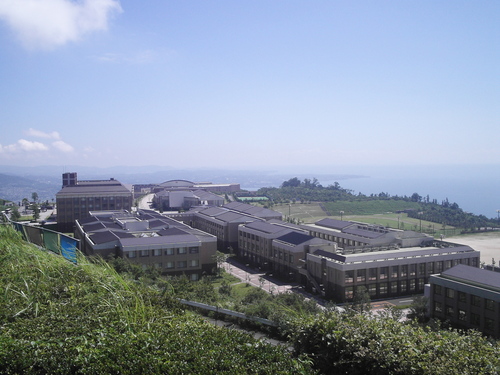
| The Ritsumekian APU campus is located on top of a mountain just outside the city of Beppu, on the southern island of Kyûshû, an area known for its hot springs and geysers. APU is very unusual among Japanese universities in being focused on the study of Japan in relation to the rest of Asia, and many students come from all around mainland Asia to study there. Because APU uses Genki for the first two language levels, the level is consistent with that for the first and second years of study at GVSU. Like the other schools, the pace is far quicker, with a year's worth of language covered in one trimester, or during the 9-week summer session. Because APU operates on the standard Japanese academic year, with trimesters from September to November, December to February, and April to June, it can be tricky to coordinate with the Grand Valley schedule, both in terms of scheduling and in terms of transfer credits. However, it offers an exteremely unique educational experience, both in terms of location and in terms of course content, with many courses in Asian geography, religion, contemporary issues, etc. offered in English. |
||||||||||||
|