When people think of Hedy Lamarr, they usually think of her career in
Hollywood. They might also think of the 1933 sensual film, "Ecstasy," that
sparked that career. However, most people would never think of the highly
secure way of communicating with radio waves known as Spread Spectrum.
To see why Hedy Lamarr is behind the creation of this revolutionary communications
technology, we must take a closer look at her life.
Hedy was born in Vienna, Australia, between 1913 and 1915 with the
full name Hedwig Eva Maria Kiesler. She started her movie career between
the ages of 15 and 17 in the movie, "Geld auf der Strasse." She married
six times in her life. It was in 1933 that Hedy married her first husband,
a man by the name of Fritz Mandl. Fritz was one of Europe’s largest armament
manufacturers. "He developed a reputation for selling bombs, bullets and
airplanes to Hitler and whoever else wanted to buy them" (Micro
Times). However, Hedy did not approve of her husband’s actions. Hedy
described Fritz as being extremely possessive. He would use her as a show
piece for his clients and the cream of Austrian Society. Fritz was so possessive
that Hedy was kept by his side during business meetings. It was at these
business meetings that Fritz and his researchers would discuss radio communication
and torpedeo warfare. "At the time, research was indicating that radio
waves were better than wire for controlling weapons such as torpedoes"
(Micro Times). For example, it would be difficult to have a wire long enouph
to connect the torpedeo to the launch station in order to control the manuvers
of the torpedeo. Even though Hedy had no understanding of the military
portion of these discussions, she had a mind capable of comprehending the
technical portions.
After four years of marriage, Hedy had had enough and left her husband.
It was in London that she met Louis B. Mayer of MGM, who arranged for her
to come to America shortly before World War II. When she was in America
she wanted to help the war effort. She did so by using her technical knowledge
that she learned in her husband’s business meetings to create a Secret
Communications System. By attending these meetings, Hedy learned that torpedoes
were controlled by radio signals. However, these signals could be jammed
by the enemy, making the torpedo inoperative. To protect these signals,
Hedy developed the idea of frequency hopping. As the name suggests, when
a message is sent it does not travel across one frequency as usual but
it jumps between frequencies. "The message would move so quickly across
the radio waves that anyone tuning in to a particular frequency would only
hear a blip, and would be unable to intercept the message" (Micro Times).
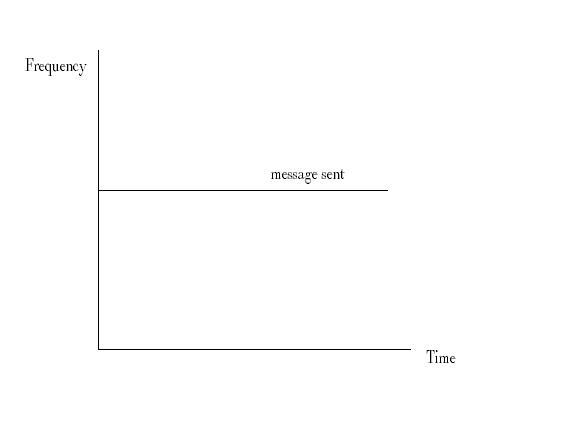
Suppose the message "message sent" is needed to be transmitted. The graph
below illustrates how a conventional radio wave would send the message.
Notice that only one frequency is used. Now compare this graph with the graph below, which illustrates frequenct hopping.
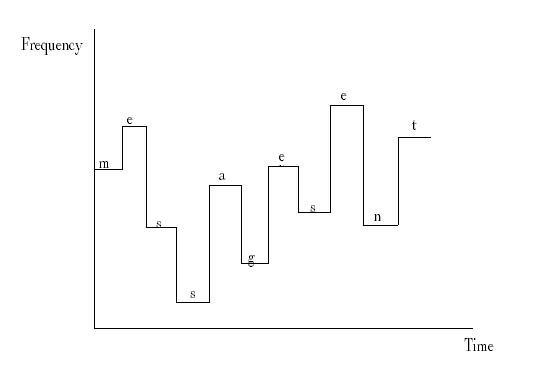
We can see from the graph above that even though the message is continuously sent, it jumps from frequency to frequency. The vertical lines represent a jump to another frequency. The horizontal lines represent the short period of time in which the message is being sent over a particular frequency. A transmitter that is fast hopper sends one character per frequency as displayed in the graph above. A slow hopper would send two or three characters per frequency.
To be able to utilize this new technology, the transmitter’s and receiver’s
frequency hopping must be synchronized. That is, they must be on the same
frequency at the same time. Hedy could not figure out how to make the synchronization
work, so she asked a musician named George Antheil for help.