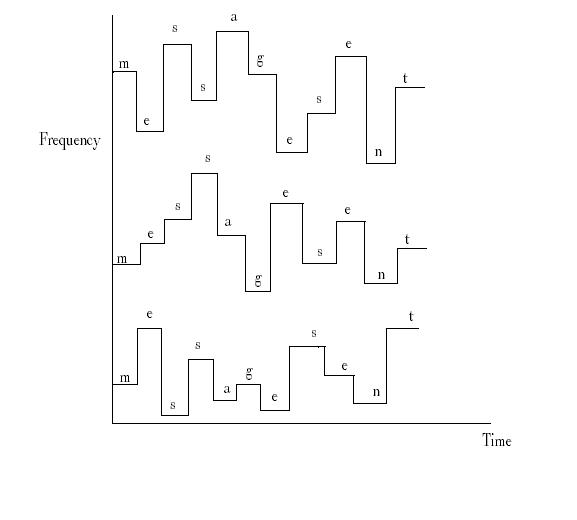
Spread Spectrum is a secure way to transmitt information by means of radio waves. This differs from the Secret Communications System developed by Hedy and George in that it no longer uses record strips to control the frequency hopping. Spread Spectrum uses what is know as pseudo-random noise codes, or PNcodes. These PNcodes determine the sequence of frequencies in which the data is transmitted. If the receiver knows the PNcode that the transmitter is using, then it can pick up the message. There are some established codes such as M-sequences, Walsh-Hadamard codes, Gold-codes, and Kasami-codes.
Another difference between the old Secret Communications System and the new Spread Sprectrum is that the latter not only uses frequency hopping, but also what is known as direct sequence. In direct sequence, the PNcode is multiplied by each of the characters in the message, whereas, in frequency hopping, the PNcode is multiplied by the whole message. The graph below illustrates direct sequence.
Notice that this graph is similar to the previous frequency hopping graph; however, in this graph the message is transmitted over numerous frequencies at once. This is a result of the PNcode being multiplied by each character of the message. Since the message is transmitted numerous times, as seen from the graph above, this reduces the amount of message lost due to interference. However, the redundancy of direct sequence causes a reduction in security as opposed to frequency hopping.
Even though direct sequence is less secure than frequency hopping, both are much more secure than using a fixed frequency. There are other advantage to Spread Spectrum. For example, as with Hedy and George’s Secret Communications System, it has good anti-jam performance. Another advantage is random access possibilities, that is messages can be transmited at any time. This differs from the Secret Communications System that needed to be started simultaneously. An additional benefit is that more people can use the same band of frequencies. Because of this, it is cheaper to use Spread Spectrum than tranditional communications using wire. "The key difference between wired and wireless implementations is that the former requires recurring monthly payments to the service provider, whereas the only recurring service fee for wireless links may be a [inexpensive] monthly maintenance cost" (Klein).