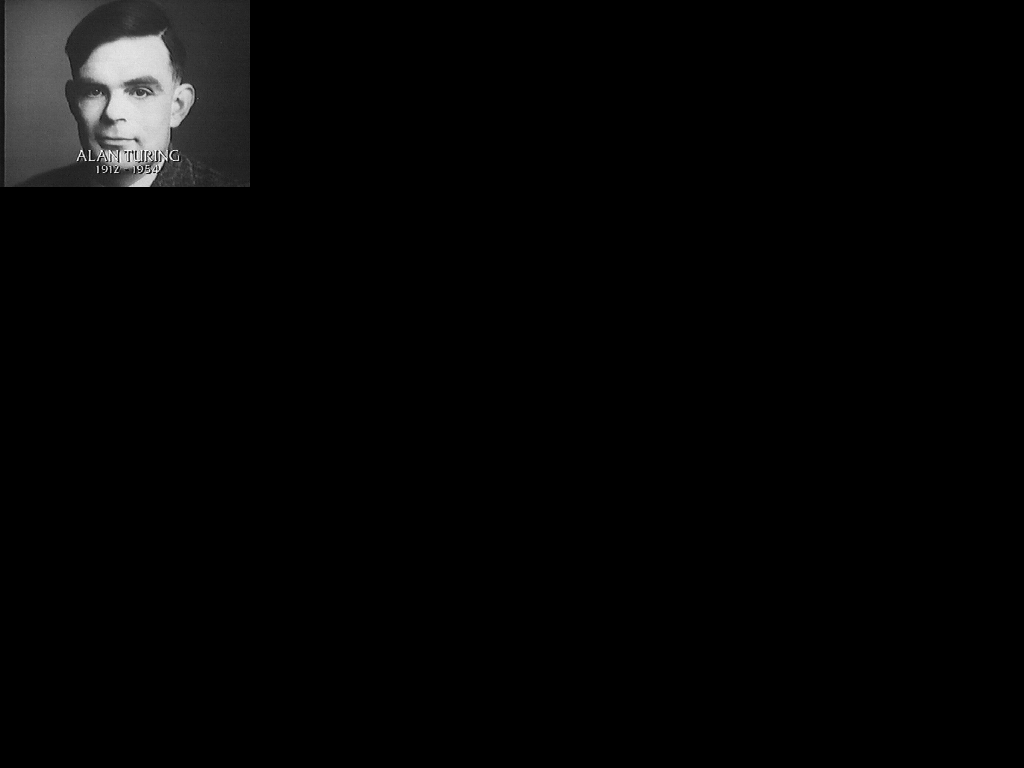
Alan Mathison Turing was born June 23, 1912 in a nursing home in Paddington, London to Julius Mathison and Ethel Sara Turing. In 1931, Turing won an entrance scholarship at King's college in Cambridge. He recieved his degree in 1934 followed by a M.A. degree from King's College in 1935, and a Smith's prize in 1936 for the work on probability theory. In September, 1936 Turing enrolled as a graduate student at Princeton University. His paper, On Computable Numbers... was published near the end of 1936. Turing obtained his Ph.D thesis through work on Ordinal Logic.
Returning to England and King's College in 1938, he was called on at the outbreak of World War II, to serve at the Government Code and Cypher School in Bletchley Park in Buckinghamshire. It was there that Turing led in the successful effort to crack the the German "Enigma" code, an effort which was central in the defeat of Nazi Germany.
After the war, Turing joined the National Physical Laboratory to work on the design of a computer.He continued his work at the University of Manchester after 1948. Turing's promising career came to a grinding halt when he was arrested in 1952 for "gross indecency". He then committed suicide in June of 1954 by eating a cyanide-poisoned apple.
Further Reding:
- The Alan Turing Homepage
- History of Mathematics archive - Alan Turing
- www.mojones.com/~seibel/resume/turing.html (Andreas Ehrencrona's Alan Turing page) -- dead link
David Hilbert, a German mathematician, posed a question of decidability called Entscheidungsproblem. He asked if in principle, there is any definite mechanical method or process by which all mathematical questions would be decided? Alan Turing answered this question with a paper called "On Computable Numbers with an Application to the Entscheidungsproblem." In this paper Turing introduced a concept for the Turing Machine. From this theoretical machine, modern theory of computation and computability has come.
A Turing Machine consists of the following: "(1) a finite set of tape symbols, including a subset of input symbols and distinguished blank symbol; (2) a finite set Q of states, including a distinguished start state q0 and two distinguished halt-states qY and qN; (3) a transition function.
Further Reding:
Alan Turing first proposed the Turing Test ins his article "Computing Machinery and Intelligence" published in Mind, Vol. 59, pp. 433-460 October, 1950. In this article, Turing considers the question, "Can machines think?" He proposes a test to answer that question as effectively as possible without precisely defining the terms "machine" and think."
In 1990 Hugh Loebner agreed with The Cambridge Center for Behavioral Studies to underwrite a contest designed to implement the Turing Test. Dr. Loebner pledged a Grand Prize of $100,000 for the first computer whose responses were indistinguishable from a human's. Each year an annual prize of $2000 and a bronze medal is awarded to the most human computer. The winner of the annual Loebner Prize Contest is the best entry relative to other entries that year, irrespective of how good it is in an absolute sense. Many of the programs entered in this contest are compared to ELIZA. Eliza was one of the first conversation programs, and was very effective because it plays the role of a Rogerian Therapist by turning your own words and phrases back at you.
One of the arguments against the Turing Test, is that if a candidate was a real person from a different culture, he might be considered a 'machine' (i.e. not intelligent) because of certain questions he wouldn't be able to answer, or would answer in an unxpected way. For example, the question, "Which side of the road do you drive on?" would be answered with "right" by an American, and "left" by a British subject.
Further Reding:
- The Turing Test Is Not A Trick:
Turing Indistinguishability Is A Scientific Criterion- Lecture ten : The Turing Test
- www.owlnet.rice.edu/~gouge/twinkie.docs/turing.html (T.W.I.N.K.I.E.S. Project Turing Test) -- dead link
Authors: Linda Lowden and Matt Jarchow
Last Modified: 17 April 1998