N-Channels
In the specific case with
fingerprints, instead of considering an image as a block of pixels, it is often
useful to use a method called n-channel, or signal. The most famous n-channel representation is the red-green-blue
(RGB). The channels break up
information into parts. As all the
channels are put together, the original representation becomes more
apparent. Channels can also be viewed
as layers. A good representation of
this is shown in Figure 8, which represents the RGB channel.
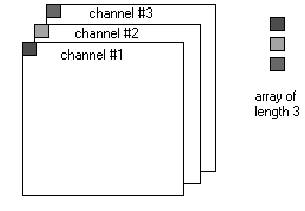
Figure 8. RGB Channel
Representation of a Signal.
There are good reasons why channels are used. One reason is that the functions used all
use the same process for gray-scale and true color image. Another is that it is easy to optimize the
algorithm for human perception. It was
stated earlier that the gray-scale is used for fingerprints, however the human
eye does not see changes in the gray-scale very easily. Therefore, it is often easier to get better
compression ratios by using weaker channels for chromatic components. With this type of channel, a greater
flexibility can be achieved by considering each wavelet frequency band as its
own color channel.
The YIQ system is the color
primary system adopted by National Television System Committee for color TV
broadcasting. The YIQ color solid is made by a linear transformation of the RGB
cube. The transition can be done using simple matrix algebra as shown in Figure
9. The A is known as the alpha channel
and is often dropped from the calculation.
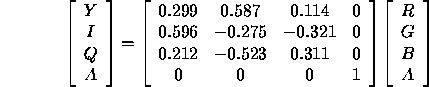
Figure 9. RGB to YIQ
Transformation Matrix.
The YIQ’s purpose is to
exploit certain characteristics of the human eye to maximize the utilization of
a fixed bandwidth. The human visual system is more sensitive to changes in
luminance than to changes in hue or saturation. Y is
similar to perceived luminance; Q and
I carry color information and some luminance information. The Y signal usually has 4.2 MHz
bandwidth, while I and
Q have different
bandwidths of 1.5 and 0.6 MHz, respectively.
Once they have the channels, the wavelets can be
applied to each channel separately.
Over the last few years, two types of wavelets have been found to yield
the best results when dealing with fingerprint image compression: The
Cohen-Daubechies-Feauveau and the symmetric Daubechies wavelet, often called
the symmlet. All of these wavelets are
approximately symmetric. Figure 9 is a
graphical representation of the father and mother symmlet wavelets. 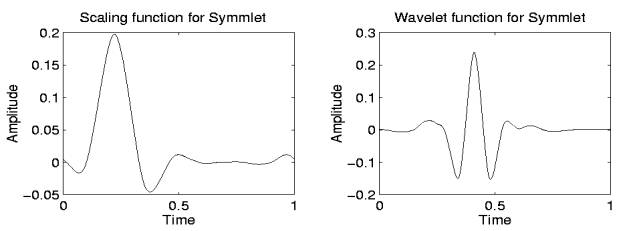
(a)
(b)
Figure 9. Daubechies Symmlet Wavelet. (a) Father (b) Mother
The Cohen-Daubechies-Feauveau and the symmetric
Daubechies wavelets are useful in fingerprint image compression because the
information content is never moved in the coefficient blocks during coding
using floating numbers, as opposed to channel-based coding of the image, which
uses bytes (values between 0 and 255) to code the coefficients. By representing coefficients using floating
numbers, it is possible to set a large number of them to zero.