The Unanswered Question

Tree Rings on a Lobster
Friday, December 28, 2012
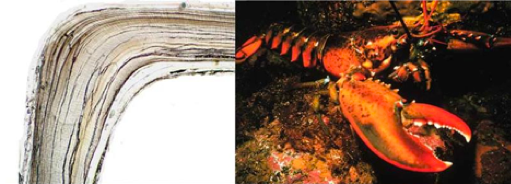
The question inevitably comes up from each new student to the lab, “how old is that crayfish?” And this is when I digress and waffle with an answer that involves projected growth curves based on each crayfish species, and their natural conditions such as water temperatures and food availability. By the end of my digression, I basically give an educated guess of the age of the crayfish I am holding, which ultimately is based on body length. So my answer may be something like approximately 3 years old +/ - 1 year, not exactly accurate or precise. So for the longest time in crustaceans this is what we did for age estimation, because no other definitive method was available.
Then low and behold, Raouf Kilada at the University of New Brunswick and colleagues recently came up with a method for aging crustaceans not previously done. For months they examined crustacean tissues under a microscope until they found what they believe to be definitive age bands, or crustacean ‘tree rings’ in the gastric mill of lobsters (see above image). The lobster ‘tree rings’ appear to be similar to the otolith structures used to age fish species (image on left). In fish, 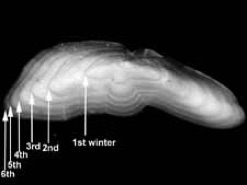 the otolith is a calcareous (i.e. calcium carbonate) structure in the inner ear used for balance. The structure grows each year and creates alternating light-dark bands. In bivalves (clams) the measurement of age can be done via the shells examining similar bands. In crustaceans, the markings or lines are also seen as dark-light bands but in the cuticle or the gastric mill (again image above). This alternating dark-light pattern is believed to represent changes in season growth. The researchers are confident that each dark-light pair represents one year.
In crabs, they found the bands in the eyestalks of the animal, suggesting variability in where these age bands could be found. Investigation into the gastric mill (image on right) and eyestalks of crayfish is likely 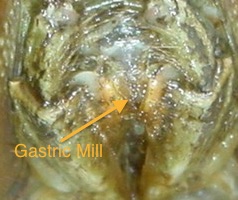 worthwhile to investigate and establish more reliable age determinations for crayfish. If found, we could do routine measurements of absolute age and compare with relative growth and mortality rates of crayfish. And since crayfish are considered a keystone species in many aquatic ecosystems, a clearer understanding of the age of crayfish in the wild would allow for better management practices and monitoring. At the very least, I could give a more accurate answer the next time a student asks, “what is the age of that crayfish”.
Growth bands (left) in the gastric mill, a toothlike digestive structure, of an American lobster (right). (Credit: Raouf Kilada, University of New Brunswick)