The Unanswered Question

Neuron Number
Tuesday, May 22, 2012
The question posed was “how many neurons are there in the human brain”?
Admittedly in class this has always been a quick answer for me that I did not contemplate upon much, nor did I ever consider the question overly interesting. I would just say around 100 billion (1012) neurons (heck, that’s the number used in Dee Silverthorn’s 2013 edition of ‘Human Physiology’; in fact this is the same number found in all of my textbooks in my office). Done. Question answered. Or so I have always thought.
Then I sat down in an evening this summer and read Stuart Firestein’s book ‘Ignorance: How it drives science.’ In his book, he describes his realization that the number is a tad off. Say around 20 billion neurons or so it is off! A neuroanatomist in Argentina, Suzana Herculano-Houzel, came up with an actual count of around 80 billion neurons, my new corrected neuron number for class. Perhaps more interesting is that the glia number out there in many texts is that of 10 times more glial cells than that of neurons. However, when Suzana’s group did their count of glia, they noticed the number was much closer to the revised number of neurons, which as Stuart Firestein says in his book, “In one fell swoop, we lost 120 billion cells in our brains!” Well, not actually lost them, but the numbers that have been cited in textbooks for years appear to have always been off. And once one textbook cited the neuron and glia numbers, following textbooks just copied and continued to pass on the numbers as fact in their subsequent editions.
So Issac Asimov was correct when he said, “a subtle thought that is in error may yet give rise to fruitful inquiry that can establish truths of great value.”
Note of interest related to neuroglia: In 1985, Marian Diamond published a paper entitled, “On the brain of a scientist: Albert Einstein.” In it she examined portions of Albert Einstein’s brain to see if there were more of the glial cells known as astrocytes and oligodendrocytes in his brain. From her data, Einstein's brain appeared to have more glial cells relative to neurons in all areas studied compared to her controls, but only in the left inferior parietal area was the difference actually statistically significant. But the inferior parietal area (a.k.a Geschwind’s territory) is involved in imagery and complex thinking (i.e. language and mathematical operations), which may have been meaningful for Einstein’s brain to operate the way it did. So it is possible that Einstein may have in fact had more glia than the average human, but his neuron number appears to have the same as everyone else (around 80 billion). Which raises the interesting question of glia’s role in memory and thought may be (see Douglas Fields book ‘The Other Brain’ for much more on neuroglia).
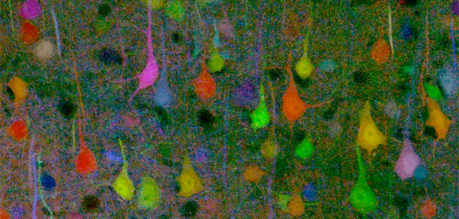
Seen here are neurons from the cerebral cortex (photo from Livet et al., Nature 2007). A genetic method was developed to label each individual nerve cell a different color (fluorescent proteins) to identify and track axons and dendrites over long distances.