The Unanswered Question

Sickle Cell Anemia
Monday, September 10, 2012

The NFL has begun their season and last evening the Pittsburgh Steelers played at the Denver Broncos. The large majority of media attention was on Peyton Manning’s comeback after four neck surgeries that ended with a one-level cervical anterior fusion procedure. This in and of itself is a topic worthy of discussion, but I wanted to spend a few minutes to instead discussing Ryan Clark of the Pittsburgh Steelers. Ryan Clark did not dress for the game last evening and also sat out when Pittsburgh played Denver in the playoffs last January (he has now sat out a total of four games in Denver).
The reason for Ryan Clark not playing in either recent game stems from a major health issue he had after a 2007 game in Denver, Colorado. The high altitude (i.e. reduced pO2), dehydration, and the extreme physical stress of the game triggered extremely painful and dangerous symptoms, normally only seen in those with sickle cell disease. Ryan in fact does not have sickle disease, but instead has ‘sickle cell trait’.
People with sickle cell disease inherit two sickle cell genes — one sickle cell gene from each parent. People with sickle cell trait, like Ryan Clark, inherit only one sickle cell gene from one parent. Typically, those with sickle cell trait never experience any symptoms associated with the blood disorder. But Clark did experience symptoms in 2007 — symptoms that nearly cost him his life. He became gravely ill and ultimately lost his spleen and gall bladder, along with the remainder of that football season, as a result. It is estimated that 2 million Americans carry one of the sickle cell genes.
Ryan’s sister-in-law died from complications of sickle cell disease in 2009 at age 27. This loss, coupled with the fact that one of his children also carries the sickle cell trait has fueled his passion to help find a cure. Ryan Clark and his wife Yonka have started the Cure League in partnership with the University of Pittsburgh's Vascular Medicine Institute and the Institute for Transfusion Medicine. The initiative aims to raise awareness, donations and support that will lead to better care and, ultimately, find a cure for this inherited blood disorder.
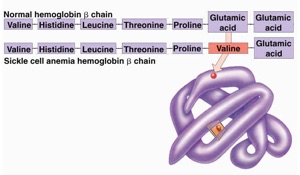
What we know is that sickle-cell anemia is caused by a mutation in the β-globin chain of hemoglobin, causing the hydrophillic amino acid glutamic acid to be replaced with the hydrophobic amino acid valine. The β-globin gene is found on chromosome 11. The association of two α-globin subunits with the two mutant β-globin subunits forms hemoglobin S (HbS). A person with sickle cell trait inherits one normal gene and one abnormal gene encoding hemoglobin S (hemoglobin genotype AS), which lessens the severity of the condition to the point that it is usually benign in most. But under low-oxygen conditions (being at high altitude, for example like in Ryan’s case), the absence of a polar amino acid in the β-globin chain promotes the non-covalent polymerization (aggregation) of hemoglobin, which distorts red blood cells into a sickle shape and decreases their elasticity.
The loss of red blood cell elasticity is central to the pathophysiology of sickle-cell disease. Normal red blood cells are quite elastic, which allows the cells to deform to pass through capillaries. In sickle-cell disease, low-oxygen tension promotes red blood cell sickling and repeated episodes of sickling damage the cell membrane and decrease the cell's elasticity. These cells fail to return to normal shape when normal oxygen tension is restored. As a consequence, these rigid blood cells are unable to deform as they pass through narrow capillaries, leading to vessel occlusion and ischemia.
The actual anemia of the illness is caused by hemolysis, the destruction of the red cells, because of their misshape. Although the bone marrow attempts to compensate by creating new red cells, it cannot match the rate of destruction. Healthy red blood cells typically live 90–120 days, but sickle cells only survive 10–20 days.
The Pittsburgh Steelers’ Ryan Clark does not have sickle cell disease, but instead he has sickle cell trait. So the question that consistently comes up for students is “why doesn’t he play when in Denver if he doesn’t have the disease?”