The Unanswered Question

The Ghost Pepper
Friday, September 20, 2013
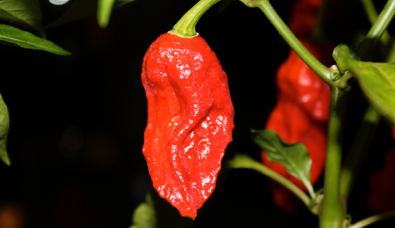
Recently one of my graduate students gave me a ghost pepper plant when she defended her thesis work. I’ve eaten the ghost pepper a couple of times now and even did so in a physiology class when discussing nociception (i.e. pain). One may think that I might eventually learn my lesson (or as my mother has said when I eat the pepper, “sometimes you can be the dumbest smart person I know”), yet I seemingly do not learn and continue to expose myself to this extremely spicy pepper. The question for today then, is “why do people eat this pepper or the even more spicier Trinidad Scorpion if it creates so much oral pain?“
Well the answer, like everything else involving human behavior, is complicated and not easily answered. Humans to our knowledge are the only animals that seek out spicy peppers in attempt to induce pain. Deer and rabbits for example, will not touch the hot peppers in my garden and in fact different animal repellents are based on concentrations of pepper compounds. They can be very effective deterrents for protecting plants around one’s household.
As for how and why we eat spicy peppers, conditioning via repeated exposure to spicy peppers is likely part of the answer and this seems to occur via a limited desensitization to capsaicin, the active component in a chili pepper. Since capsaicin is a member of the vanilloid family of molecules, it binds to a receptor on the tongue called the vanilloid receptor subtype 1 (VR1). Upon binding to the VR1 receptor, the sensation produced by the capsaicin molecule is the same sensation that heat would normally cause, which explains why capsaicin is a burning sensation. When scientists discovered that the VR1 receptor was a member of the larger family of TRP ion channels, the VR1 receptor was renamed TRPV1. TRP receptors are known to be sensitive to changes in temperature and are likely responsible for temperature sensation. The sensations produced by capsaicin is an accident of human physiology; we obviously did not evolve receptors to react to a compound that create no real damage. Capsaicin fools pain receptors whose real purpose is to register critical events, like damage to the skin and the inflammation.
The above explanation does not answer why we eat spicy food, but there is strong evidence that early learning and societal norms influence our likelihood to ingest spicier foods. Growing up in a culture where spicy food is the norm can greatly increase your fondness for spicy food, but again this is not a guarantee that one will like or dislike spicy foods. Which means that something else is affecting our spicy food inclinations. A recent study has suggested that those that eat extremely spicy foods are “risk takers or sensation seekers” and that this personality trait is one of the strongest behavioral indicators for spicy food preferences. Perhaps we seek out the painful experience of eating spicy chilies while consciously maintaining awareness that there is no ‘real’ danger to ourselves. After all, people seem to enjoy and actively seek out many sensations that appear dangerous such as riding on roller coasters or even skydiving, yet are relatively safe would greatly controlled risk. We humans are peculiar creatures in that we’ve taken a nerve response that normally signals danger and turned it into something pleasurable.
The ghost pepper, a.k.a. bhut jolokia, is the one of the spiciest (hottest) peppers in the world. It is reported to be about 400 times spicier than Tabasco sauce.