1.
Space-Time Physics
Check the 'cool'
animation mirrored in the following site. This is the best animation I found in the
internet on Special Theory of Relativity. Personally I like the flying clocks and the Barn
& Ladder simulations. Check out the wordline on your right. The Java tutor is also
quite helpful in explaining the physics. Play with the parameters - change the velocity,
switch frames - have fun.
http://www.its.caltech.edu/~phys1/java/phys1/Einstein/Einstein.html
Back
to top
2. Doppler Effect
The applet
below simulates the non-relativistic and relativistic
Doppler effect. Recall that for a light source (red dot) receding from an observer with a
speed v, the non-relativistic expression for the change in frequency is,
df/f=-v/c,
whereas the
relativistic expression is,
df/f
= [(c-v)1/2 - (c+v)1/2]/(c+v)1/2.
|
|
[This applet is written by W. Christian
and also can be found at http://webphysics.davidson.edu/Applets/Applets.html
]
Back to top
3. Time Dilation
 |
O (red) and
O' (blue) construct identical clocks, consisting of a light beam which
bounces off a mirror. Tick, the light beam hits the mirror, tock, the beam returns to its
owner. As long as O and O' remain at rest relative to
each other, both agree that each other's clock tick-tocks at the same rate as their own. |
 |
But now suppose O'
goes off at velocity v relative to O, in a direction
perpendicular to the direction of the mirror. As far as O' is concerned,
his clock tick-tocks at the same rate as before, a tick at the mirror, a tock on return.
But from the point of view of O, although the distance between O'
and his mirror at any instant remains the same as before, the light has further to go. And
since the speed of light is constant, O thinks it takes longer for clock
with O' clock to tick-tock than her own.
Thus O thinks the clock of O' runs slow relative to her
own. This is the effect of time dilation. |
[This applet is written by A. Hamilton
and also can be found at http://casa.colorado.edu/~ajsh/sr/sr.shtml
]
Back to top
4. Length Contraction
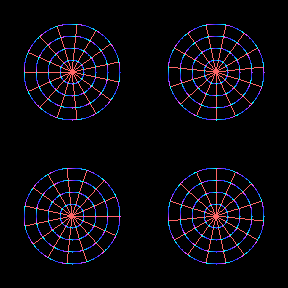 |
This is a wheel.
As the wheel rotates, the coordinates (x, y) of a point on the wheel relative to its
center change, but the distance r between the point and the center remains constantr2 = x2
+ y2 = constant .
More generally, the coordinates (x, y, z)
of the interval between any two points in 3-dimensional space change when the coordinate
system is rotated in 3 dimensions, but the separation r of the two points remains constant
r2
= x2 + y2 + z2 = constant . |
This is what a wheel looks
like moving at 87% of the speed of light. The wheel appears Lorentz contracted by a factor
of 2 along the direction of motion.
The bottom of the wheel, where it touches the road, is not moving, and is not Lorentz
contracted.
You might think that the top of the wheel would have to move faster than the speed of
light to overtake the axle moving at 87% of the speed of light; but of course it can't.
The wheel offers another example of the impossibility of completely rigid bodies in
special relativity. In the frame of reference of someone riding on the axle (but not
rotating), the rim is whizzing around and is Lorentz contracted, while the spokes are
moving transversely, and are not contracted. Something must give: the rim must stretch, or
the spokes compress. |
 |
[This applet is written by A. Hamilton
and also can be found at http://casa.colorado.edu/~ajsh/sr/sr.shtml
]
Back to top
5. Space-time Interval
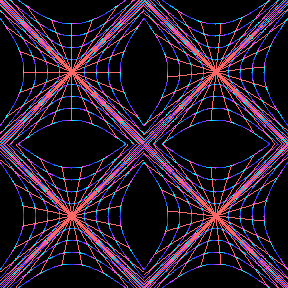 |
This is a spacetime wheel.
The diagram here is a spacetime diagram, with time t vertical and space x
horizontal.
As the spacetime wheel boosts, the spacetime coordinates (t, x) of a
point on the wheel relative to its centre change, but the spacetime separation s
between the point and the center remains constant s2 = - t2 + x2
= constant.
More generally, the coordinates (t,
x, y, z) of the interval between any two events in4-dimensional spacetime change
when the coordinate system is boosted or rotated, but the spacetime separation s
of the two events remains constant
s2 = -
t2 + x2 + y2 + z2 = constant.
The invariant spacetime
separation s between two events is a rock in the sea of relativity, a
quantity that remains the same for all observers, whereas time and space
themselves differ for different observers. As such, the spacetime separation s
is of fundamental importance in relativity. |
[This applet is written by A. Hamilton
and also can be found at http://casa.colorado.edu/~ajsh/sr/sr.shtml
]
Back to top
6. Other Cool Sites
These are the other cool sites I found in
the world wide web. I didn't check out the physics though. Check these out and enjoy. If
you find some interesting site on physics please let me know (Email me at king@physics.uc.edu ).
Back to top