Displacement is a display of projects that address the near vicinity
of the Alabama street studio site. The projects were done after
completing the historical and spatial research documented in the
placement
project.
In broad terms, the history of the world is a history of one people's
displacement after another. Through DNA strands and linked pottery
pieces, for instance, we can chart the travels of ancient tribal
groups from India to New Guinea or Samoa to Australia; through artifacts
and foundations the past is revealed in slow, transient motion.
Lack of resources, overpopulation, or the pressure of warring peoples
were, in previous generations, the primary instigators of displacement.
In truth, it is a common denominator in countries all over the world--in
America alone, we have witnessed the uprooting and migration of
Native Americans, African Americans, the middle-class, and the rural
poor among others. Displacement can be forced or chosen, fought
against or embraced, and it exists in contemporary America as a
subtle force, a result of the overwhelming power of technology and
mechanics.
In the late 1950's, a large section of the West Side of Grand Rapids,
Michigan, the home of Civic Studio, was displaced by the construction
of the Highways 196 and 131. Entire blocks of homes, businesses,
and churches were demolished in the name of "progress"
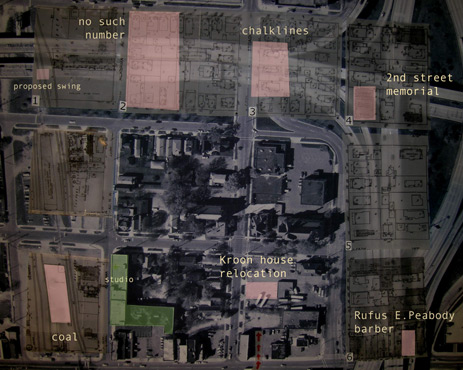
and a more efficient, Modern city. The projects collected in Displacement
aim to engage the themes of change, loss, and imagined possibilities.
And as you can see, the majority of images are the documentation
of projects conducted throughout the past couple of weeks. Blending
historical research and visual creativity the members of the civic
studio have developed work that is both sensitive to the existing
West Side neighborhood and cognizant of what existed before. Nina
Franz's "Coal" calls attention to the replacement of older
modes of technology, transportation, and energy production through
a contemporary method of advertising. "Untitled (No Such Number)",
a batch of letters that Meagan Luhrs sent to homes and addresses
that no longer exist, attempts to subvert existing governmental
structures (the Federal Postal Service), thought ultimately fails
in that all of the letters were returned. Workd by Lindsey Brashler
and Matt Winne reference the loss of a noted West Side business
location and reinvent history through the creation of Peabody's
Barbershop. Michelle Vondiziano, in "Chalk Construction",
takes a subtle, delicate approach to the absence of previously existing
homes in the WEst Side neighborhood by reconstruction their floor-plans
in orange chalk. Ryan Dittmer and Beth Fowler have delved deeper
into the reserach about their block and display their findings here.
Imagining possibilities for the landscape surrounding the expressway,
Paul Wittenbraker created images of proposed swings.
Each project displayed in "Displacement" is dependent
on and created from the research of the civic studio participants
that is specifically documented in the project "Placements".