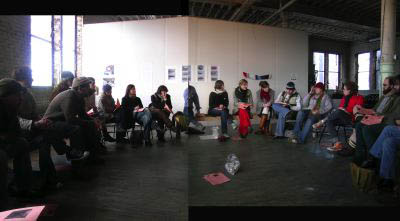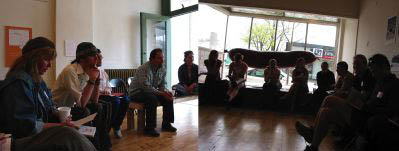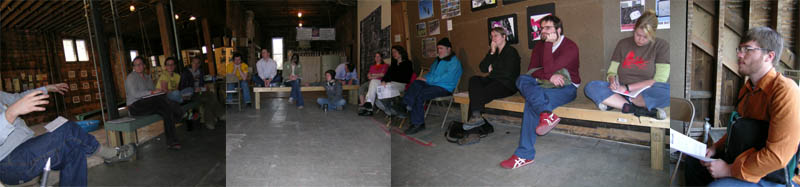
The quirks of the neighbourhood change the familiar into something specific to the area.
Objectification of a place can happen when you don't live there, i.e. tourism.
People find it hard to think of impermanence, everything is presumed to be concrete and forever.
Finding community and temporary space links to Miwon Kwon's criticism of temporary involvement.
"The world we share is visual material; artists are visual material people."
An unease is created by voyeristic observation of community for our pleasure/interest.
We need to accept a changing definition of community from project to project.
A community can be common interests or shared ideals.
Just thinking about community is important and valid.
There are many problems with definitive labels.
"We'll never know our impact [on the community] or hear all the conversations."
It has a unique character.
It seems to be built on nostalgia, trying to rebuild/return to its former glory.
Revitalisation only happens when attempting to regain something lost.
Not much pedestrian traffic.
A lack of people-oriented business, eg. department stores.
Creston used to be more cohesive; death of family-owned business (big companies are taking stores to the suburbs/strip malls)
"Tight knit community is the least ammount of distance between where people live and where they work."
Stilgoe talks about people moving to their own property, a move towards private living, cars, etc.
There is a breakdown of people knowing each other and making the effort to do so.
Routine vs. change.
"Community exists in moments, it is the chance interactions and engagements with people that equal community."
Some people never engage.
One reason seems to be the economic disparity (towne vs. club)
There is one than one neighborhood.
Economics can shape/force a community.
A return to the old way of selling soda,not competing with big business.
The 'E' really does make it fancy.
There were 35 flavors of soda and 9 diet ones indicating the closeness of the business to the people.
It was bought straight from the factory, reusable bottles were returned.
Problems were caused by selling in supermarkets and not getting the bottles returned.
Soda sold with 50's nostalgia, a marketing ideal.
Age old discussion about postmodernist reaction against modernism.
Presenting of a new brand's identity.
An ideal exists of the artist as a citizen, removing the institution.
New ideas are generated by the inclusion of more people, the difference between Civic Studio (and projects like it) and other studios.
Ties to the academic institution create the risk of group work turning into an assignment/delegation.
The importance of a common interest/commitment.
We have the freedom to engage in fluid ideas without a top down structure.
The general fear of not knowing what was going on was felt by many in the studio.
"That's the description of a cult, you dont know what it is but you're in it."
A risk was taken with a large class size.
There are issues concerned with local and global. You have to live in the community to really know it; outsiders see it differently.
People coming into the space activated the exhibition.
Beth Lively's final comment "you seem to get it."