History of Wavelets
From a historical point of view, wavelet analysis is
a somewhat new method. Although, within
the history of mathematics, the groundwork for what is now called a “wavelet”
dates back to the work of Joseph Fourier during the nineteenth century. Fourier laid the foundation with theories
of frequency analysis, which would later become significantly important and
influential in the study of wavelets.
Although wavelet theory had
already been discovered, it had never been recorded. The first mention of wavelets did not appear until 1909 in an
appendix to the thesis of Alfred Haar.
It was at this time that the focus of mathematicians turned from
frequency-based analysis to more scale based.
It was starting to become clear that an approach in measuring averages
and fluctuations between them at different scales.
It was not again until the
1930’s when several groups started researching the representation of functions
using scale varying basis functions.
One such researcher was a French geophysicist named Jean Morlet. He described an alternative to Fourier,
which described a signal, or function, as the sum of sine and cosine waves of a
certain frequency and amplitude. He
found that these waves work well with global information of the signal, which
was the average of the whole signal.
This average missed local features, which were important. Like cosines and sines, wavelets have frequency
and amplitude, but because of their small extension, they are able to describe
these local features of a signal. It
was beginning to become clearer that concepts of basis functions, particularly
scale varying basis functions, were the key to understanding wavelets. Other people working on wavelets included
Marr, Littlewood, Paley, and Stein.
Since these groups were working independently, their separate efforts
did not appear to be part of one coherent theory.
Not much was done for about
30 years until the 1960’s throughout the 1980’s when mathematicians Guido Weiss
and Ronald Coifman studied the simplest elements of a function space. These elements were atoms. Their goal was finding a common function and
assembly rules that allow the reconstruction of all elements of the function
space using the atoms. In 1980 Grossman
and again Morlet largely identified wavelets in the context of quantum
physics. It was this intuitive thinking
that sparked the next major wavelet movement.
Along came Stephane Mallat
in 1985 and provided additional support to wavelet theory when he included them
in his work in digital signal processing.
He discovered some very important relationships with orthonormal wavelet
bases. His work inspired others by the
likes of Y. Meyer who constructed the first non-trivial wavelet. Unlike the Haar wavelets, the Meyer wavelets
were continuously differentiable. While
this was a giant step, they did not have compact support. A few years later, Ingrid Daubechies used
Mallet’s work to construct a set of orthonormal basis functions, shown here in
Figure 1.
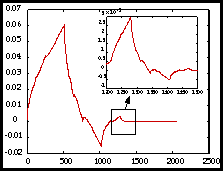
Figure 1. Daubechies Scaling Wavelet.
It is these basis functions
that have become the cornerstone of wavelets today. It is the focus of remainder of this paper to familiarize the
reader with the recent use of wavelets in fingerprint image compression for the
FBI.