Notes on the Writings of E. E. Cummings
by Michael
Webster
These notes are limited to elucidating allusions and / or
quotations which might puzzle that elusive
and very un-Cummings-like personage, the "general reader." I have
tried—not always successfully—to avoid the temptation to interpret
the poems. I have not annotated allusions that most literate
readers should know, nor have I deciphered all of Cummings'
dialect spellings. For some suggestions on interpreting Cummings'
visual and syntactic deformations, see "Deciphering
Cummings."
To find notes to specific poems, click on book titles
below, or
scroll down to individual first-line"titles" of poems,
highlighted in green. Notes to the poems begin with the
page number in Complete Poems
(Liveright, 1994).
|
Tulips & Chimneys
(1922 Manuscript)
The 1994 Complete
Poems publishes Cummings' original 1922
manuscript of Tulips
& Chimneys as established by Cummings'
editor, George James Firmage. When first published in
1923, Tulips and
Chimneys contained only 67 of the 104 poems in
the 1922 manuscript. As Richard S. Kennedy wrote: "For Tulips and Chimneys,
Thomas Seltzer had gingerly avoided the most experimental
of the poems and passed over those whose subject matter
might startle readers who were still shocked by a writer
like Theodore Dreiser" (Dreams
252). Later, "Lincoln Mac Veagh of the Dial Press looked
over the remaining poems and selected forty-one for a
published volume" (Kennedy, Dreams 252). This book, titled XLI Poems, was
published in 1925. Cummings gathered the remaining "most
startling" poems from the original manuscript, adding to
them some poems he had written recently. This group of
poems was privately printed, also in 1925,
to avoid censorship. These last naughty leftovers and
their new cousins Cummings entitled & [AND], using "the
ampersand which Seltzer had denied him in Tulips and Chimneys"
(Kennedy, Dreams
252-253).
3-7. "Epithalamion"
This poem was commissioned by Cummings' friend, mentor, and
patron, Scofield
Thayer, to celebrate Thayer's marriage to Elaine Orr,
June 21, 1916. Thayer paid Cummings the "extraordinary sum"
of $1000 for the poem. (See Kennedy, Dreams
111-113.) Alison Rosenblitt discusses the classical heritage
of this poem in her E. E. Cummings' Modernism and the
Classics (136-137).
(3) the god . . . whose cloven feet = Pan,
licentious woodland deity. A dryad is a wood nymph.
(3) that delicious boy = Adonis. one goddess
= Aphrodite (Venus).
Chryselephantine Zeus = statue
of Zeus at Olympia, “a giant seated figure, about
13 m (43 ft) tall, made by the Greek sculptor Phidias
around 435 BC.” The statue is called "chryselephantine"
because was made of gold (chrysós) and
ivory (elephántinos) panels molded over
"a wooden substructure." Cummings may also be making a
private reference to his own totem animal, the elephant.
(3) Nike = smaller sculpture of the winged goddess
of Victory held in Zeus'
right palm.
(3) diadumenos =
"diadem-bearer" [Greek], a figural type of the sculptor
Polykleitos (5th century BC) depicting "the winner of an
athletic contest at a games, still nude after the contest
and lifting his arms to knot the diadem, a ribbon-band that
identifies the winner."
(4) victorious Pantarkes = local hero Pantarkes of
Elis, who "won the boy's wrestling at Olympia in 436 BC,"
and who was a favorite of the sculptor Phidias
and reportedly the model for the sculpture of "a triumphant
athlete that stood at the base of the statue." Ancient
sources also claim that Phidias carved the words "Kalos
Pantarkes" ("Pantarkes is beautiful") on Zeus' little
finger.
(4) how fought the looser of the warlike zone =
Heracles, whose ninth labor required him to obtain the magic
girdle (“zone,” or sash) of Hippolyta,
queen of Amazons. Hippolyta was the only Amazon to marry:
she was the first wife of the hero Theseus, and, as the next
line says, mother of “tall Hippolytus.”
|
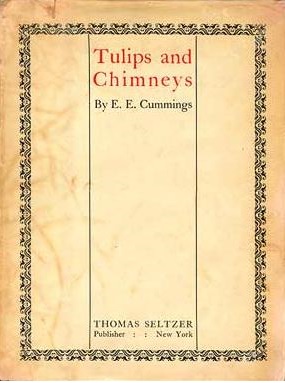
Dust jacket cover of Seltzer's truncated
first edition of Tulips
and Chimneys (1923)
|
3-7. "Epithalamion" [continued]
(4) Selene
= goddess of the moon, sister of the sun god Helios. Selene's
car = her chariot. We see depicted on the pedestal of the
statue of Zeus the moon sinking in the ocean while the sun rises
faintly in the east.
(4) Danae
= mother of the Greek hero Perseus and daughter of King Acrisius
of Argos. She was impregnated by Zeus, who visited her in the form
of a shower of gold.
(6) athanor = furnace used in alchemy.
(6) goddess = Aphrodite, whose crippled
thunder-forging groom is the blacksmith god
Hephaistos.
the loud lord of skipping maenads = the wine god Dionysos.
Discordia's apple refers to Eris, goddess of Strife, who
arrived uninvited at the wedding of Peleus and Thetis, and offered
a golden apple to the fairest goddess. "Three goddesses claimed
the apple: Hera, Athena and Aphrodite. They asked Zeus to judge
which of them was fairest, and eventually he, reluctant to favor
any
claim himself, declared that Paris, a Trojan mortal, would judge
their cases." At the famous scene known as The
Judgement of Paris, Aphrodite bribed Paris by offering him
the most beautiful woman in the world, Helen. Of course, Paris
chose Aphrodite as the winner of the beauty contest, thus setting
into motion the events that led to the Trojan War. the sacred
shepherd = Paris.
(7) the tall boy god of everlasting war = Ares, god of
war, who had an
affair with Cytherea, or Aphrodite.
8."Of Nicolette"
Richard S. Kennedy notes that this poem is
a "free translation of the sequence in Aucassin et
Nicolette in which Nicolette descends from her prison
tower." Kennedy further comments that the "obvious model
for the style is [Keats'] 'The Eve
of St.
Agnes' " (Dreams 76). Cummings' poem
romanticizes the prose description of the escape in the
medieval French chantefable, which mentions (in
Andrew Lang's translation) Nicolette's bruised and bleeding hands, her
difficulties in climbing out of the moat, and her fear of
"wild beasts, and beasts serpentine" (31-32).
9-19. SONGS
For an analysis of these
nine poems as "songs of death," see J. Alison
Rosenblitt's E. E. Cummings' Modernism and the Classics
(137-165).
15. "All in green went my love riding"
First published in The Harvard Monthly [62.1 (March 1916):
8-9] with the title "Ballad." On April 5, 1916, the founder and
editor of Poetry Magazine, Harriet Monroe, visited the New
England Poetry Club. Also invited was the recently founded Harvard
Poetry Society, whose members included S. Foster Damon, John Dos
Passos, and E. E. Cummings, then in the last semester of his MA
year at Harvard. In her account of the visit, Monroe says that
though she couldn't remember the names of any of the students who
attended, she vividly recalled several of the poems that they read
at the meeting, among them "a ballad of really distinguished
quality, showing a feeling for recurrent tragic rhythms, and a
delicate use of a varied refrain" ("Down
East" 89). This description sounds very much like "All in
green went my love riding," and since Cummings had published the
poem just the month before in the Harvard Monthly, it is
very likely that he read it at the meeting. Monroe concludes her
account by writing that she "could scarcely overpraise the work of
these students, or the enthusiasm which has carried them so far in
the one short year since their club was founded" (89).
Will C. Jumper argues that the persona (speaker) of the poem is a
woman. Other scholars (William Davis, Cora Robey, Barry Sanders)
see the speaker as male and the rider as female. In addition, they
debate
to what degree the rider in the poem may be equated with the
goddess
Artemis / Diana. Thomas R. Frosch asserts that "the critical
debate
about the gender of the speaker and 'my love' is unresolvable,"
while
noting further that "the uncertainty of gender in the poem"
extends to
the deer, first described as " 'Four red roebuck,' then becoming
'Four
fleet does,' and then becoming 'Four tall stags' " (67). In her
blog post
"E. E. Cummings'
'All in
green went my love riding'," Alison Rosenblitt notes that in
early drafts of the poem, "the rider is unambiguously male."
Forth went my lord
to hunt
Into the dawn my lord rode,
In green
And a merry deer ran before
Nevertheless, she concludes that "the poem as we have it, at
least if
considered outside of the 'Songs' context, is ambiguous as to the
gender
of speaker and beloved." Likewise, in her book E. E. Cummings'
Modernism
and the Classics, Rosenblitt sees the poem's
"evocation" of
Diana as deliberately "ambiguous" (155). She further notes in her
blog post
that this "rare exploration of gender ambiguity in Cummings
coincides with
a Swinburnian moment in his poetry." Both blog and book rather
convincingly
detail what Rosenblitt sees as echoes in the poem of Swinburne's "Itylus"
(Modernism 154). See also Gary Lane, I Am
(59-63).
Links:
16. "Where's Madge then,"
This poem echoes François Villon's "Ballade
des dames du temps jadis" (1462), which asks: "Tell me where,
in what country / Is Flora the beautiful Roman / Archiapiada or
Thaïs" (Villon 47; trans. Galway Kinnell).
17. "Doll’s boy ’s asleep"
According to Richard S. Kennedy, this poem was composed in the fall
of 1917, while Cummings was in detention in the Enormous Room at La Ferté Macé (Dreams 152). Alison
Rosenblitt notes that this poem is something of a reversal of "a
passage of desire from Walt Whitman's Song
of Myself (11.199-201)." (Modernism 157). She
quotes these lines from Whitman: "Twenty-eight young men bathe by
the shore, / Twenty-eight young men and all so friendly; /
Twenty-eight years of womanly life and all so lonesome."
19. "when god lets my body be"
According to Richard S. Kennedy, this poem was composed for Dean
Briggs' class in English Versification in the spring of
1916 (Dreams 92). Along with "little
tree" (CP 29), "the
bigness of cannon" (CP 55), "Buffalo Bill 's" (CP 90), "when
life is quite through with" (CP 11), and two others, "when
god lets my body be" was among Cummings' first published poems
in The Dial [68 (Jan. 1920): 24].
27. "in Just-"
goat-footed refers to Pan, Greek
woodland deity. In a blog post
at Harry Ransom Center, Jennifer [Alison] Rosenblitt comments on "The
goat-footed paganism of E. E. Cummings." For more commentary
on this poem, see "On
'in Just-' " at the MAPS site. See also Iain Landles'
deconstructive take on the poem in "An
Analysis of Two Poems by E. E.Cummings" [Spring 10
(2001): 31-43]. For responses to Landles, see R. A. Buck, "When Syntax Leads a Rondo with a Paintbrush: The
Aesthetics of E. E. Cummings' 'in Just-' Revisited." [Spring
18 (2011): 134-159] and Etienne Terblanche, "Oscillating
Center and Frame in E. E. Cummings's 'in Just- /
spring'." [The Explicator 73.2 (2015): 105-108] For a
consideration of the poem's paganism and its place in the five-poem
sequence "Chansons Innocentes," see J. Alison Rosenblitt's E. E.
Cummings' Modernism and the Classics (77-89).
Richard S. Kennedy reprints the first version of the poem (with
capitals begining each line and standard spacing of the free-verse
lines) in Dreams in the Mirror (97). He reproduces a photo
of
the typescript in E. E. Cummings Revisited (27). This first
version
of the poem, which was composed for Dean Briggs' class in English
Versification in the spring of 1916, started out like this:
In just-Spring
When the world is mud-luscious
The queer old balloon-man
Whistles far and wee,
And Bill and Eddy come pranking
From marbles and from piracies,
And it's Springtime.
(qtd. in Kennedy, Dreams
97)
In the summer and fall of 1916, while living at his parents' house
at 104 Irving Street, Cummings
began to restructure his free verse poems by eliminating
punctuation, using capital letters mostly for emphasis, and creating
radical line
breaks and non-standard spacings. To see a photo of Cummings' first
restructured draft of the poem, go to the Tulips &
Chimneys page at the Cummings Archive. For a
discussion of Cummings' revisions of "in Just-", see Michael
Webster's overview of the poet's work in A Companion to
Modernist Poetry,
"E. E. Cummings" (494-496). Compare the rather tame free verse of
the excerpt above with the revised
version of "in Just-" published in The Dial [68 (May
1920): 580].
28. "hist whist"
Links:
29. "little tree"
Links:
31. "Tumbling-hair"
This poem was first published in Eight
Harvard Poets (1917) under the title "Epitaph"
(10). Richard S. Kennedy notes that the poem is "about innocence
betrayed or the vulnerability of beautiful things, but it is
expressed by means of a classical subject, the abduction of
Persephone by Hades, and treated with the new technique he had
developed . . . . It is an image in action, presented with
elliptical brevity" (Dreams 108). Charles Norman notes the
likely allusion to Milton's lines in Paradise Lost:
"Not that fair field / Of Enna, where Proserpin gathering
flowers, / Herself a fairer flower, by gloomy Dis / Was gathered"
(IV. 268-71; Norman, Magic-Maker 39-40). See also the
discussion of the poem in J. Alison Rosenblitt's E. E.
Cummings' Modernism and the Classics (83-85).
32. "i spoke to thee" [Orientale I]
First published as "Out
of the Bengali " in The
Harvard Monthly 59.3 (December 1914): 85.
53. "Humanity i love you"
It is instructive to consider why Cummings placed this poem first
in a section called "La Guerre," poems about World War I. The
following passage from i: six
nonlectures seems relevant to the context of the poem:
Whereas—by the very act of becoming its improbably
gigantic self—New York had reduced mankind to a tribe of pygmies,
Paris (in each shape and gesture and avenue of her being) was
continuously expressing the humanness of humanity. Everywhere I
sensed a miraculous presence, not of mere children and women and
men, but of living human beings; and the fact that I could
scarcely understand their language seemed irrelevant, since the
truth of our momentarily mutual aliveness created an imperishable
communion. While (at the hating touch of some madness called La
Guerre) a once rising and striving world toppled into withering
hideously smithereens, love rose in my heart like a sun and beauty
blossomed in my life like a star. Now, finally and
first, I was myself: a temporal citizen of eternity; one with
all human beings born and unborn. (53)
the old howard = The Old Howard
Theatre, on Howard St. in Scollay Square, Boston. Long since
demolished by "illustrious punks of Progress" (CP 438), Scollay
Square and the Old Howard were for years "famous for supplementing
the curricula of Harvard students. 'Always Something Doing,
One to Eleven, at the Old Howard' read its ads in the Boston Globe, followed by
the titillating phrase, '25 Beautiful Girls 25' " (Park).
Links:
54. "earth like a tipsy"
once the discobolus of / one // Myron = most likely a plaster
cast of one of the surviving bronze copies of Myron's
famous statue of a discus thrower.
Alison Rosenblitt suggests that the poem "depicts a drunken earth
lurching around, breaking the artefacts of human civilization. This
seems like earth under cannon bombardment" ("a twilight" 249). She
further notes that both crucifix and discobolus are "two beautiful
naked or nearly naked male bodies, smashed up by the drunk cleaning
woman who is earth. These are not simply bodies, but specifically
male bodies created
through art. . . . Earth destroys, equally, a pinnacle of
ancient art and an image which lies at the heart of Christian art"
(252).
56. "little ladies more"
Even though all of its suggestive language is in French, this poem
was not able to be published in the original 1923 Tulips and Chimneys. It first
appeared in & [AND] (1925) and was later
reprinted as poem TWO IX in the book
is 5 (1926).
Mimi à / la voix fragile / qui
chatouille Des / Italiens = "Mimi with the fragile voice
who tickles Des Italiens." EEC remembers two prostitutes, Mimi and
(a few lines down) Marie Louise Lallemand, whom he and Slater Brown
picked up in May, 1917 while waiting in
Paris to be posted to their ambulance section (see Kennedy, Dreams 138-144). Des Italiens = the Boulevard
Des Italiens, on the two women’s regular beat "between the place de
la République and the place de la Opéra" (Kennedy, Dreams 141). putain = prostitute.
n'est-ce pas que je suis belle /
chéri? les anglais m'aiment / tous,les américains / aussi. . . .
"bon dos,bon cul de Paris" = aren’t I beautiful,
dear? the English love me all of them, the Americans too. . .
. "good back, nice Parisian ass"
Vierge / Priez / Pour / Nous)
= Virgin Pray For Us.
se promènent / doucement le soir
= walking slowly in the evening.
les anglais / sont gentils et les
américains / aussi,ils payent bien les américains = the
English are nice and the Americans too, they pay well the Americans.
voulez- / vous couchez avec /
moi? Non? pourquoi? = do you want to sleep with
me? No? why?
la / guerre j'm'appelle /
Manon,cinq rue Henri Monnier / voulez-vous couchez avec moi?
= the war I’m Manon, 5 rue Henri Monnier do you want to sleep with
me?
te ferai Mimi / te ferai Minette
= I will let you do Mimi I will let you do Minette. [Both Mimi and
Minette are pet names for a cat--i.e., “pussy.”]
si vous voulez / chatouiller / mon
lézard = if you’d like to tickle my crack.
j'm'en fous des nègres =
I'm crazy about black guys.
une boîte à joujoux = a box
of toys. [Also jouir = to
play.]
toutes les petites femmes exactes
/ qui dansent
toujours = all the little exact ladies who dance always.
dis-donc,Paris // ta gorge
mystérieuse / pourquoi se promène-t-elle,pourquoi / éclat ta voix
/ fragile couleur de pivoine? = tell me Paris, your
mysterious throat why does she walk you, why does your fragile
peony-colored voice burst?
63. "stinging"
In "Modernist Poetry and the Plain Reader's Rights," Laura
Riding and Robert Graves are probably correct in noticing an
allusion to Rémy de Gourmont's Litanies
de la rose (36) in the lines "silver // chants the
litanies the / great bells are ringing with rose." In The
Enormous Room, Cummings quotes from Gourmont's poems "Le
Verger" (57) and "Chanson de l'automne" (219). (See Thierry
Gillyboeuf 's "About Two French Verses
in The Enormous Room.") In addition, Cummings could
have read extensive quotations from Litanies de la rose in
Amy Lowell's volume Six
French Poets (1916). Riding and Graves seem put off by
the "technical oddities" of "stinging"--the lack of capital letters
and "spacing [which] does not suggest any verse form" (36). For
them, the poem is so fragmentary and "sketchy" that it "might be
made to mean anything" (36). They posit that any "precise meaning"
that the poem may have had was "lost . . .
while writing [it]." So they set out "to discover the original poem
that
was in the back of the poet's mind" (36), and do so by concocting a
15-line
poem that begins: "White foam and vesper wind embrace. / The salt
air stings my dazzled face" (37). They conclude, however, that their
rhymed and conventionally-spaced version is "banal" because it
introduces too "many superfluous words and images" (38). Writing
this supposedly more formal version of the poem causes them to laud
the "carefully devised dreaminess" (39) of Cummings' poem,
admitting that it is "intensely formal," although they are uncertain
whether
the "plain reader" is capable of applying the "critical effort"
necessary
to appreciate "stinging" as a poem (40).
Richard S. Kennedy reproduces a draft of the poem in his biography Dreams
in the Mirror, while reminding us that "stinging" is only one
of a large group of poems in conventional free verse on a list that
Cummings compiled in the summer of 1916 under the heading "D.S.N." (Dreams
97). (What the initials "D.S.N." might signify is unknown, but my
guess is that they probably stand for "Do Something New.") Unlike
Riding and Graves's alternate poem, the first version of "stinging"
is written in the standard free verse format of 1916--without
radical line breaks and with regular punctuation and initial
capitals.
Stinging gold
Swarms upon the spires,
Silver chants the litanies,
The great bells are ringing with rose—
The lewd fat bells.
And a tall wind
Is dragging the sea for a dream,
For soon shall the formidable eyes
Of the world be
Entered
With sleep.
(qtd. in Kennedy, Dreams 98)
For the final version, Cummings cut the last four lines of the draft
while making two crucial lexical alterations, substituting "with //
dream // -S" for "for a dream." Cummings deletes all punctuation,
along with the capital letters at the beginning of the lines, while
radically rearranging the spacing of the words in lines 1-7 of the
draft. To cite one example, the words "wind / Is dragging the sea
for a dream" (lines 6-7) are lengthened into seven lines, five
consisting of only one word and the last line with only the
hook-and-wave-pattern of a hyphen and capital S. The sky-wind
becomes taller and visually ripples the dream-waves.
67. "the hours rise up putting off
stars and it is"
Richard S. Kennedy notes that Cummings wrote the first version of
this poem "in November 1914, his senior year at Harvard" (Dreams
122). Kennedy reprints the first version, which is in long
free-verse lines reminiscent of Walt Whitman. The poem may also have
been influenced by Carl Sandburg's "Chicago,"
which first appeared in Poetry Magazine in March 1914. When
he revised the poem in 1916, Cummings cut out some
"sentimentalizing" and "social posturing" and added the lines in the
middle about "a frail / man / dreaming / dreams / dreams in the
mirror" (Dreams 123). Kennedy notes that by isolating the
words "dawn," "wakes," "the world," "man," "dreaming," and "dreams"
in lines of their own, Cummings emphasizes the "main theme" of the
poem: his notion of "dream" as a "vision of some ultimate reality
which is beclouded by the world" (Dreams 124).
68. "i will wade out"
This poem was first published in late 1917 as "Crepuscule"
[French for "Twilight"] in Eight
Harvard Poets (7). The compositor of the volume made a
number of errors in setting the type for this poem, creating
non-existent line breaks at "burn- / ing flowers" and "my / body."
In addition, as Richard S. Kennedy notes, the typescript of the poem
featured for the first time Cummings' lower-case "i"--but "this
little strartler was never published, for the copy editor apparently
took it as a typing error and corrected it" (Dreams 109).
71. "as usual i did not find
him in the cafés"
This poem "was originally entitled 'Arthur Wilson' after Cummings'
roommate in New York in 1917" (Kidder 39). The first part of the
poem depicts Cummings searching for Wilson at rush hour; the second
part depicts their apartment, with its crimson (the Harvard color)
quilt and EEC's "geometrical" paintings. (See Kennedy, Dreams
82, 139; Letters 13-14.) For more on Wilson, see https://winslowwilson.com/.
The syntax of the first sentence might be
clarified by a comma after "peregrinations" and a parenthesis around
"by inevitable tiredness of flanging shop-girls." Perhaps also the
nouns and verbs are arranged in German fashion, so that it is "the
street" that "furnished" and the twilight that "impersonally
affords."
flanging = "to furnish with a flange, a protruding rim,
edge, rib, or collar."
woolworthian pinnacle = the Woolworth
building, tallest before 1931. (See also 111. "at the
ferocious phenomenon of 5 o'clock" [CP1 201].)
73. [V] "Babylon slim"
"Pretty / Baby"
= song written by Tony Jackson, Egbert Van Alstyne (music) and Gus
Kahn (lyrics), published in 1916. The lyrics
of the song push the baby metaphor too far, as one can see by
the chorus:
Everybody loves a baby that's why
I'm in
love with you,
Pretty baby, pretty baby,
And I'd like to be your sister, brother, dad and mother too,
Pretty baby, pretty baby.
Won't you come and let me rock you in my cradle of love
And we'll cuddle all the time.
Oh, I want a lovin' baby, and it might as well be you,
Pretty baby of mine,
Pretty baby of mine.
84. "one April dusk the"
Ο ΠΑΡΘΕΝΩΝ = "O PARTHENON" or "The
Parthenon," the name of the restaurant.
89. "spring omnipotent goddess thou dost"
ragging the world --Robert Wegner writes, "I interpreted
the words 'ragging the world' as meaning clothing the world, that
is, urging the grass to grow, inducing leaves to emerge, buds to
bloom. Cummings had no objection to this ancillary reading, but
explicitly he wanted me to know that 'ragging, when I wrote
the poem meant turning to ragtime(music;)syncopating'" ("Visit"
68). See also EEC's poem "ta / ppin / g" (CP 78).
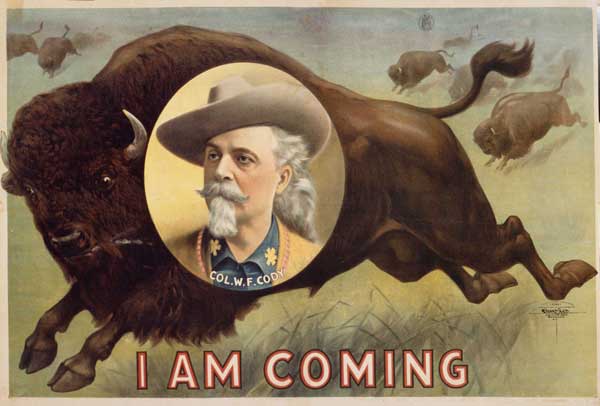
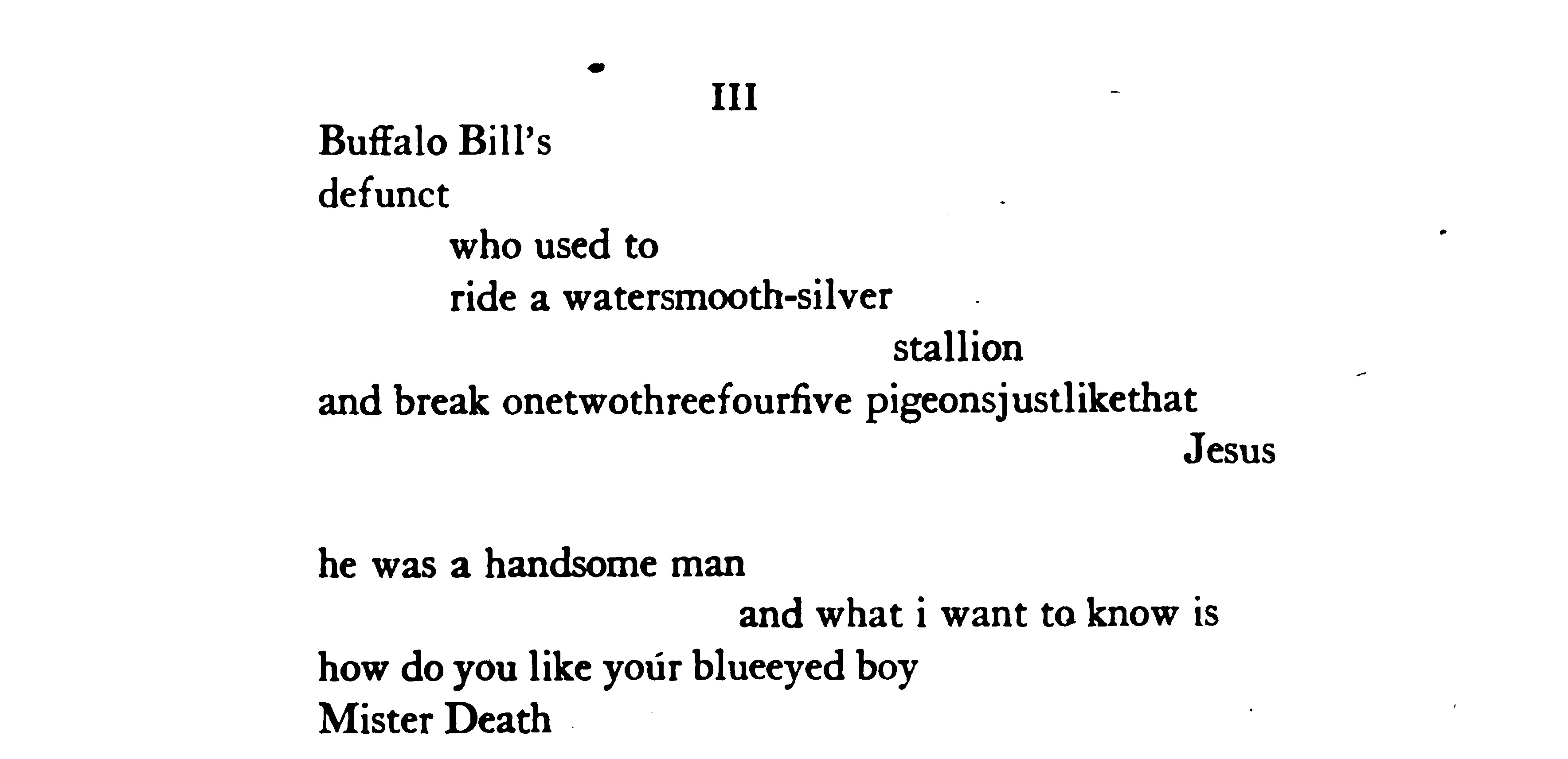
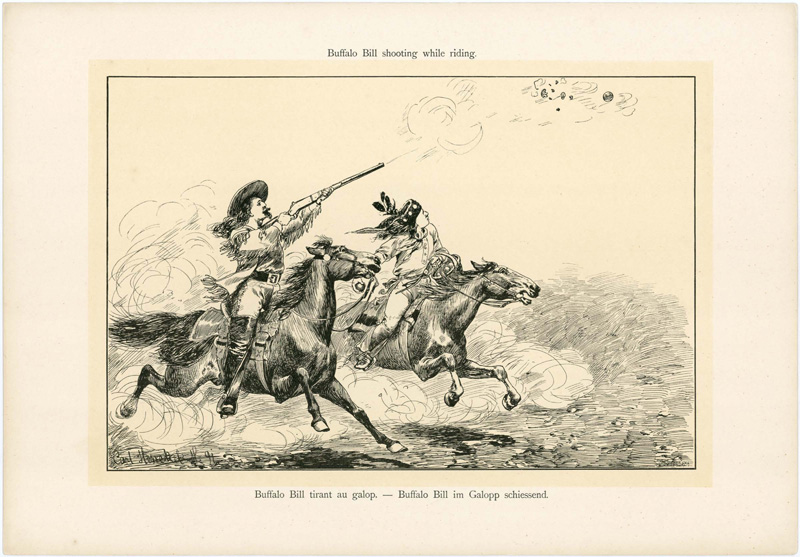
90. "Buffalo Bill 's"
Buffalo
Bill = William F. Cody
(1846-1917). Buffalo
Bill's Wild West Show enthralled audiences from 1883 to
1910. For criticism of the poem, see Thomas Dilworth's "Cummings's
'Buffalo Bill 's'," Rushworth M. Kidder's " 'Buffalo
Bill 's'—an Early Cummings Manuscript," and Etienne
Terblanche's "Is There a Hero in this Poem? E. E. Cummings's
'Buffalo Bill 's / defunct'."
Links:
96. "conversation with my
friend is particularly" (CP1 193)
Rushworth Kidder suggests that the friend is Scofield
Thayer, editor of the Dial
(39). For Thayer's views on Cummings' poetry, see James Dempsey's The
Tortured Life of Scofield Thayer (65-67).
98. "the waddling"
bloo-moo-n = a blue moon, cocktail
containing Tanqueray Malacca gin, Curacao liqueur, sweet and sour
mix, and pineapple juice, shaken with ice.
sirkusrickey = a circus rickey, cocktail containing gin, lime
juice, grenadine and club soda, over ice.
platzburg = though "Plattsburgh" is a town on Lake
Champlain in upper state New York, Cummings probably refers to an
alcoholic beverage.
hoppytoad = a hop toad,
cocktail containing rum, apricot brandy, and lime juice.
106. "riverly is a flower"
This poem apparently takes place in a graveyard, perhaps a
"post-impression" of the same [?] experience briefly alluded to in EIMI:
"And after Buffalo Bill(a graveyard 'New York' &)what fireflies
among such gravestones" (430/411).
110. "i was sitting in mcsorley's.
outside it was New York and beautifully snowing."
(CP1 96).
McSorley's is an ale-house at 15 East 7th Street in the East
Village, founded in 1854 and still in business. The bar used
to be for men only—women were first admitted in 1971.
Links:
|
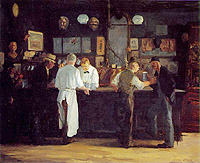
John Sloan, McSorley's Bar
(1912, Detroit
Institute of Arts)
|
 |
111. "at the
ferocious phenomenon of 5 o'clock" (CP1 201)
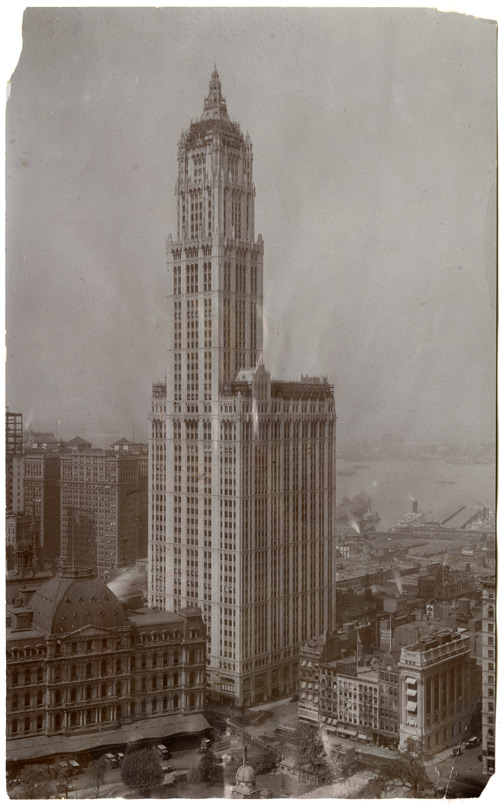
EEC goes to the top of the Woolworth
building to view rush hour. Milton Cohen writes that
"the poem's genius is . . . to find motion
in matter, describe matter in motion. Thus, for all its
towering verticality and perpendicular solidity, the
Woolworth Building is a 'swooping,' 'squirming'
'kinesis'." While Cohen agrees
at least partially with Richard S. Kennedy that "Cubism is
the
poem's rightful source" [see Dreams 181-182], he
also
notes that its "images (and the speaker with them) swoop,
rise,
and squirm, they surge with a dynamism closer to [John]
Marin's vibrant Woolworth
Building watercolors
than to Picasso's
static Houses at Horta" (PoetandPainter
177). John Marin wrote of his Woolworth Building
series:
I see great forces at work; great movements; the
large
buildings and the small buildings, the warring of the
great and small.… Feelings
are aroused which give me the desire to express the
reaction of these “pull
forces” .… while these powers are at work pushing,
pulling, sideways, downward,
upward, I can hear the sound of their strife and there is
great music being
played.
For a particulary "swooping" wartercolor in Marin's
series, see Woolworth
Building # 32. See also "as usual i did not
find him in the cafés" (CP 71).
At left: Woolworth
Building, 1913. Gelatin silver photograph. New-York
Historical Society
Links:
|
115. "the Cambridge ladies who live in
furnished souls"
Longfellow
= Henry
Wadsworth Longfellow (1807–1882), popular American
poet, author of inspirational poems like "A
Psalm of Life" and patriotic poems like "Paul
Revere's Ride."
Link: Text of "the
Cambridge ladies who live in furnished souls" (Poetry
Foundation)
116. "when i am in Boston,i do not speak" (CP1: 217)
When / In Doubt Buy Of = an electric sign, the rest of whose
message is
obscured by rooftops.
Kneeland, a street in downtown Boston;
hellas = Greece;
paklavaah meeah = my (?) baklava, a pastry described as
"indigestible honeycake" in line eight.
ΜΕΓΆ ΈΛΛΗΝΙΚΟΝ ΞΕΝΟΔΟΧΕΙΟΝ ΎΠΝΟΥ = "MEGA
HELLENIKON XENODOCHEION HUPNOU" = "Grand Greek Sleeping Hotel." No
doubt a ("cindercoloured little") black and white tourist photo on
the wall of the restaurant.
118. "ladies and gentlemen this little girl"
the Frolic or the Century whirl--These seem to be dances, but
The Frolic was also the name of a dance pavilion at Revere Beach north of
Boston.
119. "by god i want above fourteenth"
the singer = the Singer
Building, finished in 1908, demolished in 1967. For
approximately one year, it was the tallest building in the world.
121. "a fragrant sag of fruit distinctly
grouped"
swims to Strunsky's = "Strunksy
Restaurants: 19 W. 8th Street (from 1917) three restaurants in
one. On the first floor was Washington Square Restaurant, on the
lower floor was Washington Square Cafeteria and Greenwich Village
Cafeteria. (Also known as 'Three Steps Down')."
125. "god pity me whom(god distinctly has)"
fattish drone / of I Want a Doll = popular song from 1918 by
composer Harry Von Tilzer (1872-1946), and lyricists Eddie Moran (b.
1871) and Vincent Bryan (1883-1937). The song's
lyrics begin: "When I
was just a little kid I had a million toys / But when I saw a doll I
just went wild." The chorus
begins: "I want a doll, I want a baby doll to play with me."
139. "Thou in whose swordgreat story shine
the deeds" (CP1: 209)
This poem was first
published in late 1917 in Eight
Harvard Poets (3).
Froissart = Jean Froissart (1338-1410?), French historian,
author of The
Chronicles (1369-1410).
144. "this is the garden:colours come and
go"
In her memoir, Hildegarde Watson reports that in the summer of
1915, Cummings and her husband "motored to
Rochester [N.Y.] to the Watson house, where Estlin wrote the now
famous sonnet. . . . Mrs. Watson placed it in her guest book
where,
later, I came across it. It is arranged—and punctuated—differently
from the published version; there is no 'u' in 'color,' and there
are capitals at the beginning of each line!" (87). Here is the
first stanza of this sonnet as transcribed by Hildegarde Watson:
This is the garden. Colors come and go:
Frail azures fluttering from night’s outer wing,
Strong silent greens serenely lingering,
Absolute lights like baths of golden snow.
The poem appears
with the same punctuation and capitalization in Eight
Harvard Poets (1917). When the sonnet was published in
Tulips and Chimneys (1923), Cummings removed most capital
letters, retaining only those in words that begin sentences, along
with the two crucial capitals in the words "Death's" and "They."
He also made two simple changes in punctuation in the first
line--substituting a colon for the period after "garden" and a
comma for the colon after "go"--adding more momentum to a line
that nevertheless still lingers slightly.
160. [SONNETS--ACTUALITIES VII] "yours is
the music for no instrument" (CP1: 84)
rathe = "quick in action, eager, vehement" or "early"
(Heusser, I Am
175).
la bocca mia = "my mouth" [Italian]. Richard S. Kennedy
points out that this passage alludes to Dante, Inferno
V.136: "Francesca has told Dante that her love for Paolo began
when they were reading the story of Launcelot and Guinivere
together and suddenly 'la bocca mi bacio tutto tremonte' ([he],
trembling all over, kissed my mouth)" (Dreams 237-238).
According to Kennedy, like Paolo and Francesca, "the poet and his
lady risk all eternity for love" (238). But Heusser sees death as
the overwhelming threat in the poem.
Back to the list of books
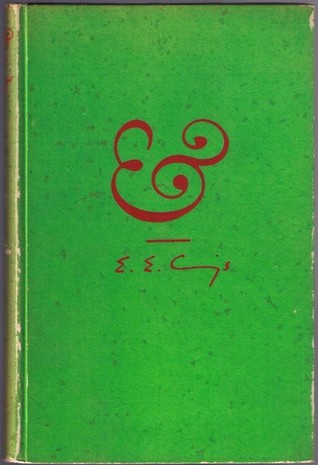
& [AND]
(1925)
The 1994 Complete Poems
publishes as &
[AND] only those
new poems that Cummings added to the poems left over from
the original 1922 Tulips
& Chimneys manuscript. Privately printed to
avoid censorship, this group of poems Cummings titled & [AND], in honor of "the
ampersand which Seltzer had denied him in Tulips and Chimneys"
(Kennedy, Dreams
252-253). [See the headnote to Tulips & Chimneys above.] At right:
cover of first edition of & [AND] (Note
capital letters in Cummings'
signature)
170. "—GON splashes-sink"
(CP1 169)
Three letters (G, O, and N) from a large illuminated sign
flash on the sink. What are the other letters of the sign?
Could it be CALGON?
j'en doute,) chérie = "I doubt it, dear" [French].
184. "I remark this beach has been
used too. much Too.
originally"
flatchatte ringarom a .s = "flat chattering
aromas."
c'est // l'heure // exquise = "it is the exquisite
hour" [French]. Isabelle Alfandary notes that this phrase
is the last line of poem 6 ("La lune blanche") in Paul
Verlaine's collection La Bonne chanson (1870).
i remind Me of Her —Alfandary also notes that the
English phrase is a literal translation of "je me la
souviens," a common French phrase that is not found in
Verlaine's poem. A more idiomatic translation would be: "I
remember her." (See Alfandary, E. E. Cummings
63-64.)
189. "suppose / Life is an old man"
(SP 117-118)
Life speaks French, of course: les / roses
les bluets = "roses, bachelor's buttons"; Les
belles bottes = "pretty bunches"; pas chères
= "not expensive."
|
|
192. "here is little
Effie's head" (SP 112)
In Spring 7, Alys Yablon notes that "Effie's name may
perhaps be a play on the word 'ephermeral'" (51).
The six subjunctive crumbs may be derived from Gilbert and
Sullivan's anti-feminist operetta Princess Ida.
In the operetta, the princess
of the title founds a college for women and vows that students and
faculty will shut themselves off from all contact with men. Lady
Blanche, the "Professor of Abstract Science" at the college,
expresses her ambition to overthrow Princess Ida in the following
way:
Oh, weak Might Be!
Oh, May, Might, Could, Would, Should!
How powerless ye
For evil or for good!
In every sense
Your moods I cheerless call,
Whate'er your tense
Ye are Imperfect, all!
Ye have deceived the trust I've shown
In ye!
Away! The Mighty Must alone
Shall be! (264-265)
At the conclusion of the play, when Princess Ida asks Lady Blanche
whether she would take her place should she resign, Blanche
responds:
To answer this, it's meet that we consult
The great Potential Mysteries; I mean
The five Subjunctive Possibilities--
The May, the Might, the Would, the Could, the Should.
Can you resign? The prince May claim you; if
He Might, you Could--and if you Should, I Would! (293-294)
For a discussion of Princess Ida in the context of its
source (Tennyson's The
Princess) and of attitudes towards women in the late
19th and early 20th centuries, see volume one of Sandra Gilbert and
Susan Gubar's No Man's Land: The War of the Words, pp. 3-23.
For another possible Cummings borrowing from Gilbert and Sullivan,
see "mr u will not be missed" (CP 551).
195. "i will
be"
dea d tunes
OR s-crap p-y lea Ves flut te rin g should read "dea d tunes OR s-cra p-y lea Ves flut
te rin g"-- EEC is writing "scrapy" not
"scrappy."
199. "gee i like to think
of dead . . ."
inti = intimate [adjective].
201. "(one!) // the wisti-twisti barber"
See Louis C. Rus, "Cummings' '(one!)'." Explicator
15 (Jan. 1956), item 40. Rus notes how the grammatical
ambiguities in the poem reinforce its message of oneness.
203. "O It's Nice To Get Up In,the slipshod
mucous kiss" (SP 75)
Richard S. Kennedy notes that the poem quotes from a popular song
sung by Harry
Lauder in the British music halls:
Oh, it's nice to get up in the
morning
When the sun begins to shine,
At four or five or six o'clock
In the good old summer time.
But when the snow is snowing,
And it's murky overhead
Oh, it's nice to get up in the morning,
But it's nicer to lie in your bed!
Kennedy quotes a slightly different version of the first stanza in Selected
Poems 73. Here's the complete performance (with
spoken interlude) of "It's Nice to Get
Up in the Morning But It's Nicer to Lie in Bed."
207. "the bed is not very big"
et tout en face = "and right in front" [French];
poilu = "hairy, shaggy, furry" [French]. Milton Cohen
suggests
that the gaslight clothes the crucifix on the wall "in a sensuous,
nappy
fur" (Poet 131). But the word poilu was also a
slang term
for French foot-soldiers in World War I.
208. "the poem her belly marched through me
as"
a trick of syncopation Europe has refers to James Reese
Europe (1880-1919), pioneer bandleader and jazz composer. Gilbert Seldes wrote in The Seven Lively Arts that Europe had "that
interior response to syncopation .
. . to the highest possible degree" (156). See 239. [ONE-XII] "(and i imagine"
216. "a blue woman with sticking out
breasts hanging"
Bishop Taylor = probably Mormon Bishop Thomas Taylor
(1826-1900). D. Michael Quinn writes: "On 26 July 1886, his
sixtieth birthday, the Salt Lake stake high council 'suspended'
Thomas Taylor as bishop of the Salt Lake City Fourteenth Ward. . .
. Three teenagers testified that while each was alone in bed with
Bishop Taylor, the bishop has used the young man's hand to
masturbate himself" (276-277). The polygamous Taylor further
testified at the church trial that he had not "practiced" such
acts since he was a teenager (presumably before he was married).
Quinn notes that "in his autobiography, however, Taylor later
described the charges as 'trumped up slander' " (277).
Back to the list of books
is 5 (1926)
On March 1, 1926, E. E. Cummings wrote to tell his publisher
that "after some weeks' work" his book is 5 was "finally
arranged. . . including . . . poems from my last book(AND)"
(Firmage, "Afterword"). In the same letter, Cummings assures
Horace Liveright that his personal typesetter S. A. Jacobs
would be in charge of setting up the book, since he
understands my arrangement.
. . which involves not merely complicated sequential
relationships between groups of poems which constitute the
whole,but definite numerical relationships—the total
number of poems having its precise significance just as
the number of poems in each subdivision has its precise
significance. (quoted in Firmage, "Afterword")
While Cummings' editor George Firmage has remarked that the
book seems to be structured in patterns of 4 and 5, he
offers no further elucidation of this statement. (However,
see dust jacket at right.) To the new poems in is 5,
Cummings added ten previously published poems from
& [AND]--eight
were from the original 1922 Tulips & Chimneys manuscript, and are
printed there in the Complete
Poems. Two of the added poems are from the new
poems printed in &
[AND] (1925).
The poems in is 5
are divided into five sections, numbered straightforwardly
enough, ONE, TWO, THREE, FOUR, and FIVE. Since they are
already printed in their original places in Tulips & Chimneys
and & [AND], the ten added
poems are not reprinted in the version of is 5 given in the Complete Poems. Below
is a chart listing the numbers of poems in the Complete Poems edition
and the numbers in the 1926 edition of the book. (The “+ 4”
in each count indicates that Cummings' poem number “ONE I”
consists of 5
sonnets, which Firmage counted as separate poems.)
| As published in is
5 (1926) |
As printed in Complete Poems
(1994) |
|
ONE
44 poems (40 + 4)
TWO 11
poems
THREE 10 poems
FOUR 18 poems
FIVE
5 poems
total:
84 + 4
|
ONE
38 poems (34 + 4)
TWO 10 poems
THREE 7 poems
FOUR 18 poems
FIVE
5 poems
total:
74 + 4
|
The following is a chart of the ten poems added to is 5 (1926), with a
corresponding column detailing their placement in the Complete Poems (1994):
| Poems added to is
5 (1926)
|
Complete Poems (1994) |
1. ONE, VII "the
waddling"
2. ONE, XVI "it started when Bill's chip let on to"
3. ONE, XXI "i was sitting in mcsorley's."
4. ONE, XXIV "Dick Mid's large bluish face without
eyebrows"
5. ONE, XXXIII "Babylon slim"
6. ONE, XXXVI "ta" |
1. Tulips:
"Portraits"
XXVI (CP 98)
2. Chimneys: Sonnets—Realities XIII (CP127)
3. Tulips: Post Impressions VIII (CP 110)
4. Chimneys: Sonnets—Realities XX (CP 134)
5. Tulips: "Portraits" V (CP 73)
6. Tulips:
"Portraits"
IX (CP 78)
|
| 1. TWO, IX "little
ladies more" |
1. Tulips: "La
guerre"
IV (CP 56)
|
1. THREE, IV
"impossibly"
2. THREE, V "inthe,exquisite;"
3. THREE, VII "Paris;this April sunset completely
utters" |
1. & A:
Portraits II (CP 191)
2. Tulips: "Portraits" XVIII (CP 87)
3. &
A: Post Impressions III (CP 183)
|
|
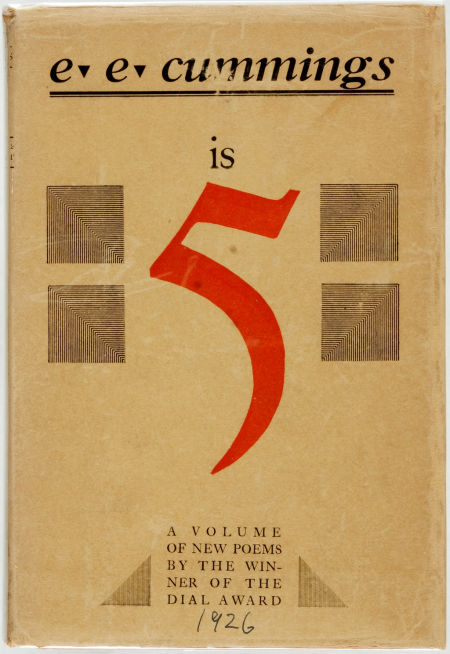
Dust jacket of is 5, designed
by S. A. Jacobs
|
Cummings added two satirical sonnets to section ONE, bringing to
four the number of sonnets between the five
each that begin and end the volume. There was
already one quasi-sonnet in section ONE, "poets yeggs and
thirsties," and in section TWO, the famous " 'next to of course god
america i" (CP 267). In the notes that follow, the Roman numeral
after each capitalized section number corresponds to the numbers
given in Complete Poems.
As the charts above indicate, because no poems were added to
sections FOUR and FIVE, these sections retain the numbering of the
original volume.
225. [ONE I] III. GERT "joggle I think will do
it although the glad"
a Beau Brummell = a cocktail consisting of 1 oz. bourbon, 1/2
oz. Prunella, 1 oz. orange juice, and 1/4 tsp. sugar.
"gimme a swell fite = give me a swell fight.
Rektuz,Toysday nite = Rector's, Thursday night. Rector's
= restaurant in the theatre district frequented by the nouveau
riche.
where uh guy gets gayn troze uh lobstersalad = where a guy
gets gay and throws a lobster salad.
228. [ONE II] "Poem,Or
Beauty Hurts Mr. Vinal" (SP
152).
These notes are greatly indebted to Lewis H. Miller's
"Advertising in Poetry:
A Reading of E. E. Cummings' 'Poem, or Beauty Hurts Mr. Vinal'," Word
&
Image 2 (1986): 349-362. Cummings' poem was first published
in
December 1922, in the little magazine S4N (Firmage, Bibliography
48). Cummings' title refers to a poem by Harold
Vinal (1891-1965) called "Earth Lover," from his first book,
White
April (1922), published in the Yale Younger Poets
Series:
EARTH LOVER
Old loveliness has such a way with me,
That I am close to tears when petals fall
And needs must hide my face against a wall,
When autumn trees burn red with ecstasy.
For I am haunted by a hundred things
And more that I have seen on April days;
I have held stars above my head in praise,
I have worn beauty as two costly rings.
Alas, how short a state does beauty keep,
Then let me clasp it wildly to my heart
And hurt myself until I am a part
Of all its rapture, then turn back to sleep,
Remembering through all the dusty years
What sudden wonder brought me close to tears.
—Harold Vinal
In the 1920's, Vinal was editor of Voices, a long-lived
poetry quarterly that was "radically
defunct" only in the sense that it did not publish modernist
poetry--at least not in 1922. Cummings himself later published a
poem in Voices: “after screamgroa” (CP 656) [Voices
137 (Spring 1949): 18] (cf. Firmage 58). In 1945, when the Poetry
Society of America presented Cummings with its Shelley Memorial
Award, the prize was announced by the Society's president, Mr.
Harold Vinal (Kennedy, Dreams 405).
Boston
Garter: In pre-elastic days, men used garters to keep
their socks up.
Lydia E.
Pinkham: Manufacturer of cure-all remedy for "women's"
ailments. Her "Vegetable Compound" was a mixture of roots, seeds,
and 18% alcohol.
Just Add Hot Water And Serve -- From a Campbell Soup ad.
merde = shit [French].
God's / In His andsoforth: "God's in his heaven -- / All's
right with the world" (Robert
Browning, Pippa Passes).
Turn Your Shirttails Into Drawers: Parody of ad for Imperial
"Drop Seat" Union Suit, long underwear with a buttoned seat panel.
A- mer i ca,I love, You = "America,
I Love You" (1915), popular song with words by Edgar Leslie
and music by Archie Gottler. As one can hear from this recording of
the song by Dan Levinson and His Canary Cottage Dance
Orchestra, Cummings' punctuation and spacing of the words imitates
the tune and rhythm of the chorus: "America, I love you! / You're
like a sweetheart of mine! / From ocean to ocean, / For you my
devotion, / Is touching each bound'ry line. / Just like a little
baby / Climbing its
mother's knee, / America, I love you! / And there's a hundred
million others like me!" In his essay on Gaston Lachaise (1920)
Cummings wrote of a critic who could "comfort himself with the last
line of that most popular wartime song, America I Love
You which goes, 'And there’re a hundred million others like
me' " (Miscellany 23). See also " 'next
to of course god america i"
(CP 267) and "little joe gould has lost his teeth and
doesn't know where" (CP 410).
littleliverpill- / hearted: Refers to ads for Carter's
Little Liver Pills.
Nujolneeding- Nujol
was a widely advertised laxative.
There's-A-Reason:" Slogan for Grape Nuts cereal and Instant
Postum, a coffee substitute containing no caffeine.
Odor? / ono. Odo-ro-no
was a "toilet water" sold to prevent "excessive perspiration."
comes out like a ribbon lies flat on the brush: Slogan for
Colgate's Ribbon Dental Cream.
For on-line criticism of this poem see "On
'Poem, Or Beauty Hurts Mr. Vinal'" at the MAPS site.
|
230. [ONE-III] "curtains part"
Kirkland Street in Cambridge, Mass., just down the
street from Cummings' boyhood home at 104 Irving Street.
Professor Royce = Josiah
Royce (1855–1916), Professor of Philosophy at Harvard
College in Cummings' youth. In six nonlectures, EEC
writes, "I myself experienced astonishment when first
witnessing a spectacle which frequently thereafter repeated
itself at professor Royce's gate. He came rolling peacefully
forth, attained the sidewalk, and was about to turn right
and wander up Irving, when Mrs Royce shot out
of the house with a piercing cry 'Josie! Josie!' waving
something stringlike in her dexter fist. Mr Royce politely
paused, allowing his spouse to catch up with him; he then
shut both his eyes, while she snapped around his collar a
narrow necktie possessing a permanent bow; his eyes
thereupon opened, he bowed, she smiled, he advanced, she
retired, and
the scene was over" (25). See also six nonlectures
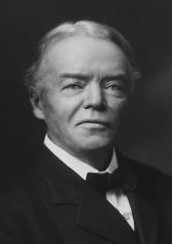
29-30. Photo of Josiah Royce, with bow tie, at left. |
231. [ONE-IV] "workingman with hand so
hairy-sturdy"
en amérique on ne boit que de Jingyale = "in america they
only drink Ginger ale" [French]. Cummings is probably remembering
the final panel of a wartime Krazy
Kat cartoon (09/29/1918) in which Ignatz Mouse introduces a
temperance
singer: "Brother Benjamin will now sing, "The rouge on father's
beezer
he now gets from Jingy Ale." Both Herriman
and
Cummings conflate the ginger ale of temperance (or prohibition) with
the
"Jingo ale" of excessive patriotism. [See the note below on "Over
There"
and " 'next to of course god america i" (CP 267).]
kaka = crazy, crappy.
 over there, over there = Part of
refrain of George M. Cohan's popular song "Over There,"
praising American troops going to fight "over there" (in Europe) in
World War I. Cummings' reference turns on its head the line from the
song, "And we won't come back 'till it's over over there." For
complete score and lyrics, click on image at right. For the complete
lyrics and three audio versions of the song, see the "Over
There" page at FirstWorldWar.com. "Over There"
on You Tube: (versions sung by Nora Bayes
and Arthur
Fields)
over there, over there = Part of
refrain of George M. Cohan's popular song "Over There,"
praising American troops going to fight "over there" (in Europe) in
World War I. Cummings' reference turns on its head the line from the
song, "And we won't come back 'till it's over over there." For
complete score and lyrics, click on image at right. For the complete
lyrics and three audio versions of the song, see the "Over
There" page at FirstWorldWar.com. "Over There"
on You Tube: (versions sung by Nora Bayes
and Arthur
Fields)
all the glory that or which was Greece = garbling of E. A.
Poe's lines from "To Helen"--"Thy Naiad airs have brought me home
/ To the glory that was Greece, / And the grandeur that was Rome."
grandja / that was dada? Dadaism was a nihilistic anti-art
movement begun in Zürich, Switzerland during World War I. By 1926,
when Is 5 was published,
the dada movement was a spent
force. For the Dada movement's influence on Cummings, see
Tashjian, Skyscraper Primitives (165-187). For doubts
about Dada's influence on EEC, consult Cohen, PoetandPainter
(48; 248) and Webster, Reading Visual Poetry after
Futurism (115-134).
what's become of Maeterlinck refers to the symbolist poet
and playwright Maurice Maeterlinck (1862-1949), author of the
plays Pelleas and Melisande (1893) and The Blue Bird
(1905). In 1922, Maeterlinck published a sequel to The Blue
Bird called Les Fiançailles, but in later life his
attention had turned increasingly away from drama towards
scientific and occult topics. This line and the next also parody
the first lines
of Browning's "Home Thoughts from Abroad": "Oh to be in England /
Now that April's there." (See the note for "MEMORABILIA.")
ask the man who owns one --advertising slogan for Packard
automobiles.
232. [ONE-V] "yonder
deadfromtheneckup graduate of a"
nascitur = the third person singular present indicative of
the verb nascor, meaning that "he / she / it is being
born, arises, originates, begins, is produced, springs forth,
proceeds, grows, is found" [Latin]. cf 262. "voices
to voices,lip to lip" and Him
III.vi (132 / 126).
233. [ONE-VI] "Jimmie’s got a goil"
234. [ONE-VII] "listen my
children and you"
listen my children and you / shall hear = the first line
of "The
Landlord's Tale. Paul Revere's Ride" by Henry
Wadsworth Longfellow (1807–1882), popular
American
poet. The contrast between the intrepid hero Paul Revere
and Mr. Do-nothing is evident.
(eheu / fu / -gaces Postu- / me boo // who refers to Horace,
Odes, II.14:
Eheu fugaces, Postume, Postume,
labuntur anni nec pietas moram
rugis et instanti senectae
adferet indomitaeque morti:
"Ah, Postumus, Postumus, how fleeting / the swift years--prayer
cannot delay / the furrows of imminent old-age / nor hold off
unconquerable death."
235. [ONE-VII] "even if all desires things
moments be"
ou sont les neiges... part of the refrain from the "Ballade
des dames du temps jadis" [Ballade of the Dead Ladies] by François
Villon (1431-1464?): "Mais ou
sont les neiges d'antan?" [But where are the snows of
yesteryear?].
Satter Nailyuh = Saturnalia, Roman festival held at the
winter solstice; a time of license. The holiday season, as seen by a
denizen of New York during prohibition. (Viz.: "in dem daze kid
Christmas / meant sumpn".)
237. [ONE X] "nobody loses all
the time"
McCann He Was A Diver =
Irish-American song with the following lyrics, as recorded by
musicologist J. D. Robb (1892-1989). The recording is part of the
John Donald Robb Archive at the University of New Mexico's Center
for Southwest Research.
McCann,
he was a diver, and he worked beneath the sea,
Off a Jersey pier, off a Jersey pier.
O'Reilly worked the pump above, his hand upon the line,
Pumping atmosphere, pumping atmosphere.
One day McCann was walking on the bottom of the sea.
He met a mermaid and she said, "McCann," she said, said she:
"You look just like a devil-fish and will you marry me?"
"Oh ho!" says McCann, says McCann, "Pull me up O'Reilly where it's
dry,
For I met a lady down below, and she has a fishy eye.
Oh, she's looking nice and neat
But bedad she has no feet—
Pull me up O'Reilly where it's dry."
Of course, this movement up from the sea bottom is the opposite of
Uncle Sol's mechanical movement down into the earth.
239. [ONE-XII]
"(and i imagine"
As Norman Friedman notes in Spring 3 (1994):
124-125, this poem depicts a nativity scene.
angels with faces like Jim Europe = James Reese
Europe (1880-1919), jazz bandleader and composer who worked
in Paris during World War I. Friedman writes: "Alan Rich, in
New York Magazine for June 12, 1978, says James
Europe was 'a promising black composer who was murdered (by
the drummer in his band) in 1919' (81). . . James Lincoln
Collier, in The Making of Jazz (Delta, 1978), says,
'James Reese Europe, the kingpin of the Clef Club,' was
among 'the first American black musicians of this period to
reach Europe...as military bandsmen accompanying the
American Expeditionary Force in the First World War" (314).
Collier, readers of this Journal may recall, is a nephew of
William Slater Brown, Cummings' companion in The
Enormous Room. The plot thickens! Marshall W. Stearns,
in The Story of Jazz (NAL Mentor, 1956, 1958),
praises Europe: 'The earlier minstrel-concert-vaudeville
orchestras of Wilbur Sweatman, Will Marion Cook, and James
Reese Europe (the favorite of dancers Vernon and Irene
Castle) were gradually supplanted [and diluted] by Vincent
Lopez, Ben Selvin, Earl Fuller (with Ted Lewis), and Paul
Whiteman, who supplied the 'new' jazz music, polished up for
dancing....Lt. James Reese Europe...might have been the
Negro Paul Whiteman if he had lived...' (113, 117). Leonard
Feather, in The Encyclopedia of Jazz (Crown
Bonanza Books, 1960), has an entry on James Reese Europe: b.
1881, d. 1919, 'stabbed to death in a night club
altercation' " (211).
Friedman further notes that the poem was first
published "in 1922, in Secession (48). This
nevertheless also dates the poem after Europe's death in
1919, which gives special poignancy to the reference, if
indeed Cummings wrote it after Europe died. The effect
remains, however, of the transcendent presence of the
angels, in the midst of this coarse and mundane setting,
being imaged via the epiphany of Jim Europe."
For more information on Jim Europe, click
on the image and links at right, and / or consult Reid
Badger's excellent A
Life in Ragtime: A Biography of James Reese Europe
(New York: Oxford UP, 1995).
Additional Links:
|
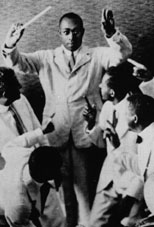
Jim
Europe's "Hellfighters" Band
(with RealAudio clips)
Songs of
James Europe
James Europe
Biography
Military
Music: Sousa and the Hellfighters
Europe
Gravesite
Order Jim Europe CD
from Inside Sounds /
Memphis Archives
PO Box 171282
Memphis, TN 38187
Phone: 800-713-2150
Memphisarc@AOL.com
|
243. [ONE-XVI] "why are all these pipples
taking their hets off?"
The first line imitates the diction of Krazy
Kat, Cummings' favorite cartoon character. See Taimi Olsen's
article, " 'Krazies...of indescribable
beauty': George Herriman's 'Krazy Kat' and E. E. Cummings."
the famous doctor who inserts / monkeyglands = Serge Voronoff
(1866-1951). For all the interesting details, see Thierry
Gillyboeuf, "The Famous Doctor Who
Inserts Monkeyglands in Millionaires" Spring 9 (2000):
44-45.
246. [ONE-XIX] "she being Brand"
Consult Fred Schroeder's "Obscenity and Its Function in the Poetry
of E. E. Cummings," as well as Barry Marks, E. E. Cummings
(74-75), Karen Alkalay-Gut, "Sex and the Single
Engine: E. E. Cummings' Experiment in Metaphoric Equation" [Journal
of Modern Literature 20 (1996): 254-258], and especially
Lewis H. Miller. Jr.'s
"Sex on Wheels: A Reading of 'she being
Brand / -new'," [Spring 6 (1997): 55-69].
thoroughly oiled the universal / joint --a
necessary operation with early motor-cars. For
a discussion and illustrations, see Miller 60-61.
slipped the / clutch --like flooding the carburetor and
"somehow" getting into reverse, this is a beginner's mistake.
i touched the accelerator --Miller writes that "the
reference to the accelerator is not to the foot pedal but to the
button-tipped hand throttle," which beginners were advised to use
"for the first few days until the other details of driving had
been mastered" (62-63).
248. “oDE” [ONE-XXI]
toothless . . . bipeds . . .
hairless--EEC may be referring here to a famous anecdote
concerning the philosopher Diogenes the Cynic (412-323 BC): "Plato
had defined Man as an animal, biped and featherless, and was
applauded. Diogenes plucked a fowl and brought it into the lecture
room with the words 'Here is Plato's man' " (Laertius 138). The
chagrined Plato supposedly then added to his definition, "having
broad flat nails."
249. "on the Madam's best april the"
[ONE-XXII]
According to Robert Wegner, ["A Visit with E. E. Cummings" Spring
5 (1996): 59-70] Cummings told him that this poem's "words are
spoken by an illiterate Irish woman" (64). The woman is apparently
a "cook."
252. "than(by yon sunset’s
wintry glow" [ONE XXV]
by the fire's ruddy glow /
united--Cummings may be referring to the sentimental
Victorian poem "Sitting
by the Fire" by Henry Kendall (1841-1882): "Gleesome
children were we not? / Sitting by the fire, / Ruddy in its glow,
/ Sixty summers back— / Sixty years ago."
it isn't raining rain, you know
= parody of the refrain of the popular song "April
Showers" (1921), with music by Louis Silvers and lyrics by
B. G. DeSylva: "Though April showers / May come your way, / They
bring the flowers / That bloom in May; / And if it's
raining, / Have no regrets; / Because, it isn't raining rain, you
know, / It's raining violets." This
song was one of Al Jolson's big hits. Gilbert Seldes wrote in The Seven Lively Arts:
“I have heard him [Al Jolson]
sing also the
absurd song
about "It isn't raining rain, It's raining violets" and remarked
him modulating that from sentimentality into a conscious bathos,
with his gloved fingers flittering together and his voice
rising to absurd fortissimi and the general air of kidding the
piece” (194-195).
254.
"MEMORABILIA" [ONE-XXVII]
These notes are indebted to three items in The Explicator,
all entitled "Cummings' MEMORABILIA": Clyde S. Kilby, 12 (1953),
item 15, Cynthia Barton, 22.4 (Dec. 1963), item 26, and H. Seth
Finn, 29.5 (Jan. 1971), item 42. See also Curtis Faville's blog
entry: "Believe
You Me Crocodile—Eigner Cummings The Typewriter & A
Poem." The title refers to Robert
Browning's poem "Memorabilia,"
which begins, "Ah, did you once see Shelley plain?" This poem was
written after Cummings toured Venice with his parents in late
July, 1922 (Kennedy, Dreams
242).
stop look & / listen = slogan posted on railway
platforms.
Venezia = Venice; Murano = town near Venice where
glass objects d'art are made
nel / mezzo del cammin' = "midway in the road [of our
life]" --Dante, Inferno I.1.
the Campanile = bell-tower
in the Piazza San Marco, Venice.
cocodrillo-- = "a
large stone crocodile which is part of a statue of St.
Theodore on a tall column overlooking the Piazza San Marco"
(Barton). Baedekers = travel guides.
de l'Europe // Grand and Royal = names of hotels in Venice.
their numbers / are like unto the stars of heaven --After
Abraham showed his faith in the Lord by being willing to sacrifice
his only son Isaac, an angel promised to multiply his "descendants
as the stars of heaven" (Genesis 22: 17). See also Genesis 15:
1-6.
Ruskin = John
Ruskin (1819-1900), author of The Stones of Venice
(1851-53).
thos cook & son British travel bureau with offices
throughout Europe: the company issued travelers' checks and
organized tours.
(O to be a metope / now that triglyph's here) Parody of the
first lines of Robert Browning's "Home
Thoughts from Abroad": "Oh to be in England / Now that
April's there." H. Seth Finn suggests that with this
exclamation, the speaker longs for "a meaningfulness
in life which would place him in the universe with the same
comfortable
precision with which a metope fits between two triglyphs in the
Doric
order."
Clyde Kilby writes that a metope and triglyph "are architectural
terms and describe a portion of
a Doric frieze, the metope being the decorated section between the
triglyphs." They are usually placed horizontally in alternation on
the lintels of Greek buildings like the Parthenon. (See this
photo of metopes and triglyphs on the Parthenon.) The
triglyph consists of three vertical lines contained within the two
horizontal lines of the lintel. Lou Rus has suggested that the
metopes should be seen as the open "space for creating a
new art," which exactly corresponds with the etymology of the
word. The Greek metope means "between or amidst the opae
or tie-beams (rafters)." Vitruvius explains when that ancient
carpenters "cut off the projecting ends
of the beams" the butt ends flush with the wall "had an ugly look
to them, [so] they fastened boards, shaped as triglyphs are now
made, on the ends of the beams, where they had been cut
off in front, and painted them with blue wax" (107). Vitruvius
says further: "The Greeks call the seats of tie-beams and
rafters όπαί [opae],
while
our people call these cavities columbaria (dovecotes).
Hence, the space between the tie-beams, being the space between
two 'opae,' was named by them μετόπη [metope]" (108). "Seat" must be where the beams
cross another member, creating an opening or space between the
beams. The Greek word ope, opai means just what
it sounds like, "open, openings." These empty spaces were often
filled with art--little bas-relief sculptures, for example. So "to
be a metope" could mean to be in that space where new art is
created, to be alive art and not dead (and misunderstood) history.
It could also mean, simply, "to be art"--to be those little
sculptures rather than a rigid and decorative triglyph (three
stiff virgins?) at
the end of a beam. The "marriageable nymph[s]" do seem
to approach art as decoration or fashion, knick-knacks for their
future homes in "Cincingondolanati": viz. the mention of the
tourist-trade glassworks at Murano, and this prattle: "look /
girls in the style of that's the / foliage what is it didn't
Ruskin / says about you got the haven't Marjorie / isn't
this well-curb simply darling" (255). On the other hand, what is a
metope if not decoration on a building?
By once again referring to Browning at the end of the poem,
Cummings conflates a reverence for past culture (Shelley) with
nostalgia for one's homeland. In Browning's "Memorabilia,"
the unnamed person who once "saw Shelley plain" is moved to
laughter at Browning's reverence for such casual contact with the
great. Browning's poem ends with an account of the speaker finding
a moulted eagle feather on the moor and then saying (perhaps
self-deprecatingly or sheepishly), "Well, I forget the rest." As
if to say that carrying on Shelley's spirit (the feather) is more
important than waxing nostalgic over past greatness? And / or that
one can emotionalize too much about items of "memorabilia" (the
feather again)? Clearly, the "dollarbringing virgins" are
nostalgic for a past that they experience incompletely, much as
Browning lacked real experience of Shelley. Perhaps Cummings is
saying that the virginal metopes have been penetrated only by
useless half-baked knowledge (represented by the upright
triglyphs, i. e., "Education," "thos. cook & son"), thus
missing real experience and lacking ability to express what
knowledge they do have.
256. "a man who had fallen among thieves"
[ONE-XXVII] (SP 130-131)
Refers to the story of the Good Samaritan (Luke 10: 25-42). [leal
= "loyal"] Lou Rus (letter, July 22, 1998) suggests we read this
poem in the light of a passage from Henry David Thoreau that
occurs towards the end of the first chapter of Walden ("Economy"):
"I never dreamed of any enormity greater than I have committed. I
never knew, and never shall know, a worse man than myself."--a
statement often quoted
with approval by EEC. Cummings usually quotes this passage to Ezra
Pound when EP is ranting about the necessity of knowing economics
and changing the world (cf. Pound / Cummings 140-143; 145;
364-365 and Selected Letters 243). In a similar vein, Ann
R. Morris has suggested that the subject of the poem "is not man's
social responsibility but rather every man's potential divinity"
(39). Other poems describing homeless people in various states of
inebriation are: "a)glazed
mind layed in a / urinal" (CP 388), "grEEn's
d" (CP 534), "a gr // eyhaie" (CP 705), and
"s.t:irst;hiso,nce;ma:n" (CP 710). This list is by no means
exhaustive. EEC
also wrote at least two poems about panhandlers: "but mr can you
maybe listen there's" (CP 314) and "'right here the other night
something / odd" (CP 800).
259. "poets yeggs and thirsties" [ONE-XXXI]
yegg = a beggar, lowlife ne'er-do-well, a thief.
See Robert Wegner's "Where are the Yeggs of Yesteryear?" in Spring
5 (1996): 55-58.
262. "voices to
voices,lip to
lip" [ONE XXXIII]
each dream nascitur,is not made = "each dream is born,is
not made." nascitur = "to be born; to rise, begin,
originate, be produced, spring forth, proceed, grow, be found"
[Latin]. cf. 232. [ONE-V] "yonder deadfromtheneckup
graduate of a" and Him
III.vi (132 / 126).
265. "the season
'tis,my
lovely lambs," [TWO I]
Sumner
may refer to William
Graham Sumner (1840-1910), Yale Professor, Social Darwinist, and advocate
of laissez-faire economics. More likely, Cummings refers
to John S. Sumner, "executive
secretary of the
New York Society for the Suppression of Vice" (Daniels 81).
In 1922, fearing seizure and prosecution by Sumner, the publisher
Horace Liveright had several phrases and words cut from Cummings'
war memoir The Enormous Room without the poet's approval
(see Gerber, "Season" 178-179). Sumner is satirized in Act II of
Cummings' play Him as "John Rutter,
President pro tem. of the Society for the Contraception of Vice"
(54).
The Volstead Act was passed to enforce the 18th Amendment
of the Constitution, the famous Prohibition of alcoholic
beverages. The Act went "into effect on January 16, 1920"
(Kennedy, Dreams 211).
Mann's righteousness "U. S. Rep. J. R. Mann gave his name
to the White Slavery Act of 1910,
popularly known as the Mann Act. It decreed fines and imprisonment
for persons transporting 'any woman or girl' across state lines
for the
purpose of prostitution or 'any other immoral purpose.' Young men
at Harvard, which Cummings entered in 1911,
saw this law as an impediment to extracurricular romance" (Gerber,
"Season" 177-178).
the Honourable Mr.(guess), probably Charles R.
Forbes, one-time deserter and head of the Veterans' Bureau
under President Harding. Forbes was in charge of the "Government's
work for those disabled war heroes in whose behalf
every public man considered it his duty to shed a public tear.
Forbes held office for less than two years, and
during that time it was estimated that over two hundred million
dollars went astray in graft and flagrant waste
on the part of his Bureau" (Allen 124). Forbes was sent to
Leavenworth Prison in 1926, the same year which saw the
publication of this poem in Is 5.
266. "opening of the chambers
close" [TWO II]
opening of the chambers =
"rentrée des Chambres" [French]. EEC is translating the common
phrase for the (re)opening of the French parliament.
microscopic pithecoid President
= Raymond
Poincaré (1860-1934), in 1923 the "Président du Conseil" or
Prime Minister, seen here as pithecoid,
or apelike; monkeylike.
tribune = "a raised
platform for a speaker;
a dais, rostrum, or pulpit," but also in ancient Rome, "any of
various administrative officers, esp. one of 10 officers elected
to protect the interests and rights of the plebeians from the
patricians."
Peacepeacepeace . . . pronounced
// by the way Pay = an inter-lingual pun on paix, the French word for
"peace." EEC refers to
the Ruhr
crisis
of 1923, when France
occupied the Ruhr region of Germany in order to force the Germans
to make reparations payments demanded by the peace Treaty of
Versailles. Jacques Demarcq notes that the word "Pay" may also be
a "translation of the French 'ça
paie!' which means 'it's funny/a laugh'."
anthropoid = "belonging
or pertaining to the primate suborder Anthropoidea, characterized
by a relatively flat face, dry nose, small immobile ears, and
forward-facing eyes, comprising humans, apes, Old World monkeys,
and New World monkeys."
extremely artistic
nevertobeextinguished fla / -me . . . souvenir of the in spite
of himself fa / -mous solder minus his na- / me = the
eternal flame at the French Tomb of the Unknown Soldier beneath
the Arc de Triomphe. The tomb was dedicated on November 11, 1920.
The flame was lit and dedicated on November 11, 1923.
|
male and female / created He // them –from
Genesis 5:2. [For "then" read "them." Though all editions of
this poem read
"then," EEC’s source, the King James Bible, reads "them,"
which seems preferable.]
And every beast of the
field = Genesis 1:19: "And out of the ground the
Lord God formed every beast of the field, and every fowl of
the air; and brought them unto Adam to see what he would
call them: and whatsoever Adam called every living creature,
that was the name thereof." Jacques Demarcq points out that
through a pun on "Elysian Fields," or the Champs Elysées, EEC
reduces to "beasts" those upper class men and women
strolling along this grandest of boulevards leading to the
Arc de Triomphe, site of the French tomb
of the Unkown Soldier. (See pithecoid and anthropoid above.) Demarcq further
comments that the mocking tone of the poem is
quite similar to that of "French anarchist newspapers of the
time." Many thanks are due to M. Demarcq for his help with
this note.
The comic rhyme line-breaks in the poem create several nonce
words: "-me" and "me" [EEC strolling among the beasts of the
field?] and "-mous" [mouse—a smaller beast of the field] and
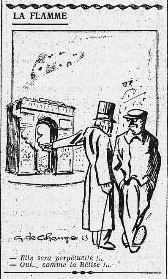
"-nous" ["mind" (Greek)]. “Beast” [bête] and nous [mind] both seem to fit the cartoon,
titled "La Flamme,"
from the French Communist paper l’Humanité,
November 12, 1923. [Plutocrat (pointing to the eternal
flame): "Elle sera
perpétuelle!" ("It will be eternal!"). Worker to
plutocrat: "Oui . . .
comme la Bêtise!" ("Yes, like Stupidity!")]
|
267. " 'next to of course god america i" [TWO III]
america i / love you = a reference to "America,
I Love You" (1915), popular song with words by Edgar Leslie
and music by Archie Gottler. See also "Poem, Or
Beauty Hurts Mr. Vinal" (CP 228) and "little
joe gould has lost his teeth and doesn't know where" (CP
410). The chorus is as follows:
America,
I love you!
You're like a sweetheart of mine!
From ocean to ocean,
For you my devotion,
Is touching each
bound'ry line.
Just like a little baby
Climbing its mother's knee,
America, I love you!
And there's a hundred million others like me!
oh / say can you see by the dawn's
early = the first words to the U.S.
national anthem, the "Star
Spangled Banner."
land of the pilgrims' . . . my /
country 'tis of = quotations
from the patriotic song "My
Country 'Tis of Thee" (also known as "America"), lyrics by
Samuel Francis Smith (1808-1895):
My country, 'tis of thee,
Sweet land of liberty,
Of thee I sing:
Land where my fathers died,
Land of the pilgrims' pride,
From every mountain side
Let freedom ring.
by jingo by gee by gosh by gum = near-verbatim quote of a
line from
the novelty song Oh
By Jingo! (1919), with music by Albert Von Tilzer and lyrics
by Lew Brown. The first two lines of the chorus are: "Oh! by Gee!
by Gosh, by Gum, by Juv-- / Oh by Jingo, won’t you hear our
love." Links: a performance
of the song by Margaret Young and sheet
music (IN Harmony). A jingo is also "a person who
professes his or
her patriotism loudly and excessively,
favoring vigilant preparedness for war
and an aggressive
foreign
policy."
Many have
pointed out that they did
not stop to think they died instead echoes Tennyson's
"The
Charge of the Light Brigade":
Their's not to make reply,
Their's not
to reason why,
Their's but
to do and die:
Into the
valley of Death
Rode the six hundred.
Links: Cummings reads " 'next
to
of course god america i"
(Poetry Archive; BBC).
Online
criticism of " 'next to of
course god america i" (MAPS )
Text
and study questions for " 'next to of course god america
i" (WMU)
272. "come,gaze with me upon this
dome" [TWO-VIII]
this dome / of many coloured glass —Cummings wrote to D.
Jon Grossman that this line is taken from Percy Shelley's elegy
for John Keats, Adonais,
stanza 52, line 3. The first part of the stanza reads:
The One remains, the many change and pass;
Heaven's light forever shines, Earth's shadows fly;
Life, like a dome of many-coloured glass,
Stains the white radiance of Eternity,
Until Death tramples it to fragments.—Die,
If thou wouldst be with that which thou dost seek!
Amy Lowell, a great admirer of John Keats, titled her first book of
poetry A Dome of Many-Coloured Glass
(1912).
unto whom duty whispers low
= "So nigh is grandeur to our dust, / So near to God is man, / When
Duty whispers low, Thou must,
/ The youth replies, I can."
–Ralph Waldo Emerson, "Voluntaries"
(1863), an elegy for Robert Gould Shaw and the regiment of
African-American soldiers he commanded, the Massachusetts 54th.
273. "16 heures" [TWO IX]
Among Cummings' papers at the Houghton Library at Harvard
University are conserved some clippings from the Parisian
Communist newspaper l’Humanité
(Saturday
and Sunday,
October 27 and 28, 1923) that describe a demonstration for
the Catalan anarchists "[Lluís] Nicolau and [Pere] Matteu .
. . condemned to death by the new Spanish government for
their supposed participation in the assassination of
[Eduardo] Dato."
Saturday's paper appeals to workers to demonstrate at the
Spanish Embassy at "16 HEURES" [4 p.m.], publishing a map
showing the location of the Spanish Embassy on Ave. Kleber
(near the Place de l’Etoile). Sunday's paper reports that a
"veritable army of cops [flics]
and municipal guards--around 5 to 6,000--were mobilized
around the Spanish Embassy." Furthermore, from the Ave.
Kleber the cops formed "an
uninterrupted chain, all the way to the place du
Trocadéro." Dressed "in their workclothes," some
demonstrators "wore helmets [and] some were disabled
veterans [anciens combatants mutilés]." The paper
describes various police charges at the crowd, with many
arrests, saying that "a large number of comrades were
brutalized." Among the
examples of police brutality recounted are: "A child of 13
was literally beaten and trampled to the point of death,"
and "a handicapped veteran was thrown to the
ground and seriously wounded." The article ends with what it
calls a "significant detail: not a single soldier among the
police!"
16 heures / l'Etoile
= 4 p.m. at the Place
de l'Etoile in Paris, or "Star Plaza," where 12
streets converge upon a huge traffic circle with the Arc de
Triomphe at the center.
flics = cops
[French].
"allezcirculez" =
"move on, move on" [French]. |

l’Humanité, 27
Oct. 1923 (from Gallica, the
online repository
of the French National Library)
|
275. "my sweet old etcetera" [TWO
X]
wristers = a kind of
fingerless mitten.
For an extensive comparison of this poem with more patriotic poems
of the period, see Tim Dayton's " 'Wristers
Etcetera': Cummings, the Great War, and Discursive
Struggle" (Spring 17 2010).
Link: WWI propaganda poster:
"Knit
Your Bit"
281. "will out of the kindness of their hearts
a few philosophers tell me" [THREE V]
Apparently located in Portugal, the place called Calchidas
is depicted in an ink drawing by
Cummings. On the back of this sketch is
a draft
of this
poem. (See "Travels
Abroad" at Ken Lopez's Paintings
of E. E. Cummings site.)
291. "since feeling is first" [FOUR VII]
And death i think is no parenthesis: John
Lennard points out a possible allusion to these lines of Andrew
Marvell's "To His
Coy Mistress": "The grave's a fine and private place, /
But none, I think, do there embrace" (233).
303. "after all white horses are in
bed" [FIVE-I]
See "my sonnet is A light goes on in" (CP1 171) which depicts the
poet living below a stable: "The horses sleep upstairs. / And you
can see their ears. Ears win- // K,funny stable. In the morning they
go out in pairs: / amazingly,one pair is white" (CP 171).
305. "along the brittle treacherous bright
streets" [FIVE-III] (SP 66)
"Ici?" French--"Here?"—"Ah, no, my dear, it's too cold."
chevaux de bois = "wooden horses."
Back to the list of books
W [ViVa] (1931)
309. W [ViVa]
An online exhibit at the Harry Ransom Center Library in
Austin, Texas, catalogues the signatures on a door that used
to be in the Greenwich Village Bookshop, circa 1920-1924.
The signature
page of S. A. Jacobs, Cummings' personal typesetter,
reproduces a July 16, 1931 letter from Jacobs to Cummings
about printing the title page of ViVa. Those patient
enough to figure out how the slide show on this page works
will be rewarded with a photo of the letter from Jacobs to
Cummings and with the photo of the title page of W [ViVa]
reproduced here. Jacobs' letter complains bitterly of the
difficulty in getting this title page to look right: "the
photo engraver has failed me utterly: for three times in
succession he made the reversed plate of VV wrong--not as
ordered by you or me or [with] any sign of intelligence in
himself. . . . I am rejecting the work as not satisfactory."
(The writing in pencil at the top of the letter is Cummings'
draft of a telegram responding to Jacobs.)
The curious title of this collection of poems, W,
represents two overlapping V's, which refer to "a graffito
commonly found on southern European walls, meaning 'long
live,' as in 'Viva Napoli' or 'Viva Presidente Wilson' "
(Kennedy, Revisited 76). In critical and in ordinary
discourse, the title is pronounced "Viva" and is written as
"ViVa"--with two capital V's. When both titles are
used, the pronounceable title is written in brackets: [ViVa].
In her article "The Modernist
Sonnet and the Pre-Postmodern Consciousness," Gillian
Huang-Tiller notes that the VV slogan "probably stems from 'Viva
V.E.R.D.I.' or Viva Vittorio Emanuele Re D’Italia,
[Long live Victor Emanuel, King of Italy], slogan for
patriotic Italians of the nineteenth century" (170).
In Dreams in the Mirror, Richard S. Kennedy says
that ViVa "contains seventy poems; every seventh
poem is a sonnet, except that the last seven poems are all
sonnets" (319). This description is in general quite
correct, but,
as Huang-Tiller points out, Kennedy then makes an
interesting and perhaps productive error. He writes: "That
makes a total of fourteen sonnets, corresponding to the
fourteen-line stanza of the sonnet" (Dreams 319).
Actually, as Huang-Tiller astutely notes, "the
structure of the collection is
not a neat 7 + 7—there are nine
embedded sonnets, not seven." She further
comments: "Kennedy apparently follows what his experience of
the sonnet tells
him should be in the text, rather than what is
really in the text" (164). So the order of the
poems in the text follows this mathematical pattern: 6 - 1 -
6 -
1 - 6 - 1 - 6 - 1 - 6 -1 - 6 - 1 - 6 - 1 - 6 - 1 - 6 - 1 - 7
= 70 poems. Or: 7 x 9 = 63 + 7 = 70.
What might this not-quite-sonnet pattern of sonnets tell us
about Cummings’ intentions? Huang-Tiller speculates that
perhaps "Cummings has another design in mind, as the nine
embedded sonnets (each the seventh poem) along with the
final set of seven sonnets could signal a perfect ten: 9
sonnets + 1 set = 10" (164). In the afterword to his
translation of No Thanks, Jacques Demarcq sees ViVa
as having a structure of ten weeks, "six poèmes et le
dimanche un sonnet" [six poems and the Sunday of
a sonnet] ("Un tournant" 112). This would make the final
seven sonnets of ViVa a week of Sundays. In EIMI (published two years after
ViVa), Cummings tells us that he was born on a Sunday
(91/89), and several commentators have noticed that EIMI
begins and ends on a Sunday (May 10 and June 14). Each
chapter narrates one day, so the chapters follow a pattern
similar to the one in ViVa, except that the implied
days of the week metaphor is made explicit. EIMI has
six Sundays with six days between each of them, making a
total of five weeks and 36 days. [See EIMI
note 91 / 89.]
For more on Jacobs and Cummings, see Walker Rumble's short
piece "Reclaiming S. A. Jacobs:
Polytype, Golden Eagle, and Typographic Modernism" as
well as Rumble's recent article from Spring "The Persian Typesetter: S. A. Jacobs, E.
E. Cummings, and the Golden Eagle Press."
A slightly expanded version of this note has been posted on
the EEC
Society Blog.
|
Title page of W [ViVa],
designed by
S. A. Jacobs.
|
311. [I] ",mean-"
Robert Beloof and Barry Marks see this poem as portraying "the
experiences during one evening and one morning of children and
adults who live in an apartment hotel [a pension]" (Marks
49). The reader should look within the text for the
fragmented words "humanity" and "putrescence." The
word credo is better read as an English noun than as a
Latin verb. The phrase fais do do is French baby-talk for
"go to sleep." Perhaps also fais do
can be taken to mean to "make dough" or "make money" (Marks
51).
Rather than a colon, the punctuation mark at the end of the last
line should probably be a semicolon (as in the first edition, the
typescript edition, and in Poems 1954).
312. [II] "oil tel duh woil doi sez"
An American soldier in a French bar, sometime after World War I.
For an excellent exposition and interpretation, see Larry Chott, "The Sight of Sound: Cummings' 'oil tel duh
woil doi sez'," Spring 6 (1997): 45-48.
"oil tel duh woil doi sez," transliterated into more-or-less
standard English:
I'll tell the world I says
do you understand me as he's pulling his moustache,I
don't give a shit I says. Tom
I don't want to do it, but I got to
break youse,that's what he says to me. (Now I ask you
wouldn't that make your arse turn
green? I'll say so.)—Who'll
spare a Lucky? Thanks kid. Merci.
My jack's all gone. For Christ sake
ain'tnobody gotnothin'toplay?
HEY
yousewiththepermanentwave and theukeorsomethingorother
giveusatuneonthefuckin'thing
Notes:
- I got to / break youse = "I've got to demote you (or
discharge you)." The narrator Tom is either discharged from the
army or demoted all the way down to private (the lowest rank in
the army).
- a Lucky = Lucky Strikes, an (American) brand of
cigarette.
- My jack's all gone = "My money's all gone."
- thepermanentwave = refers to any sculpted female
hairstyle, held in place by hair-spray.
- theuke = "the ukulele," a Hawaiian musical instrument
that looks like a four-stringed very small guitar.
313. [III] "the surely // Cued"
Richard S. Kennedy writes that in this poem, "Cummings
describes one of his own Futuristic canvases, such as 'Noise Number 13' " (Dreams
319).
314. [IV] "there are 6 doors"
smokes three / castles = British cigarette brand.
317. [VII] "Space
being(don't forget to remember)Curved" (SP 159-160)
Among other topics, the speaker of this poem discusses the
curvature of space, one aspect of Einstein's theory of relativity.
See Richard B. Vowles, "Cummings' 'Space being . . . Curved'." Explicator
9.1 (1950), item 3. At the end of The Explicator 9.5
(March, 1951), after item 37, the editors print this interesting
response from Cummings:
Dear Sir--
please let your readers know that the author of
"Space being(don't forget to remember)Curved"
considers it a parody-portrait of one scienceworshipping
supersubmoron in the very act of reading(with
difficulties)aloud,to another sw ssm,some wouldbe
explication of A.Stone&Co's unpoem
--thank you
E. E. Cummings
December 11 1950
earth's most terrific / quadruped = the elephant,
Cummings' favorite animal, his "totem." See the cover of Spring
4 for a characteristic Cummings sketch of an elephant. Also
reproduced on the Cummings Images
page. [See
also "pity this busy monster,manunkind," (CP
554) and "noone and a star stand,am to am" (CP
721).] For on-line criticism of
this poem see "On
'Space being(don't forget to remember)Curved'" at the MAPS
site.
319. [IX] "y is a WELL
KNOWN ATHLETE'S BRIDE"
The protagonists of this poem, y and z, (the "2 boston / Dolls")
are Josephine Rotch (Mrs. Albert Bigelow) and Harry Crosby, a
minor poet and patron of the arts who spent much of the
20s in Paris. On December 10, 1929, after meeting Mrs. Bigelow at
the New York apartment of a friend, Crosby shot her and then
himself. See Geoffrey Wolff's biography of Crosby, Black Sun
(1976) and chapter VIII of Malcolm Cowley's Exile's Return. William
Carlos Williams also wrote a poem, "The Death of See," about this
sensational murder-suicide (see
Collected Poems Vol I, 416-417). Link: "Harry
Crosby" page at the MAPS site, including "A
Biographical Essay."
hoe tell days are // teased = the Hotel des Artistes on West 67th Street, site of the murder-suicide.
322. [XII] "poor But
TerFLY"
This poem presents a satiric, fictionalized account of the career
of EEC's first wife Elaine Orr (also from Troy, New York), leaving
out her involvement with the poet. (See Kidder, Introduction
88-89).
 poor But TerFLY
= popular song, with music by Raymond Hubbell and lyrics by John
Golden. The song was first performed on Broadway in the musical
revue The Big Show, August 31, 1916. William
Slater Brown (who is "B" in The
Enormous Room) remembered meeting Cummings in 1917 on
a boat to France where both were going to serve in the
Norton-Harjes Ambulance Corps: "Cummings found a piano somewhere
and sat down and played "Poor
Butterfly" with all sorts of trills in a rather satiric way"
(quoted in Collier 128). This song
seems to have been a staple of Cummings' repertoire in those
years. Richard S. Kennedy reports on a late night outing
in 1916: "At one point, [S. Foster] Damon went to the piano and
rolled out a polonaise and Cummings followed the
act with "Poor Butterfly" (Dreams 89). The lyrics
of the song tell of a Japanese woman (the "Butterfly") who learns
from a visiting sailor to "how to love in the
'Merican way." The sailor leaves her, but she waits faithfully for
him, for "once Butterfly gives her heart away, / She
can never love again; she is his for aye." To view a reproduction
of the sheet music and complete lyrics of "Poor Butterfly,"
click on the image above.
poor But TerFLY
= popular song, with music by Raymond Hubbell and lyrics by John
Golden. The song was first performed on Broadway in the musical
revue The Big Show, August 31, 1916. William
Slater Brown (who is "B" in The
Enormous Room) remembered meeting Cummings in 1917 on
a boat to France where both were going to serve in the
Norton-Harjes Ambulance Corps: "Cummings found a piano somewhere
and sat down and played "Poor
Butterfly" with all sorts of trills in a rather satiric way"
(quoted in Collier 128). This song
seems to have been a staple of Cummings' repertoire in those
years. Richard S. Kennedy reports on a late night outing
in 1916: "At one point, [S. Foster] Damon went to the piano and
rolled out a polonaise and Cummings followed the
act with "Poor Butterfly" (Dreams 89). The lyrics
of the song tell of a Japanese woman (the "Butterfly") who learns
from a visiting sailor to "how to love in the
'Merican way." The sailor leaves her, but she waits faithfully for
him, for "once Butterfly gives her heart away, / She
can never love again; she is his for aye." To view a reproduction
of the sheet music and complete lyrics of "Poor Butterfly,"
click on the image above.
(flesh is grass) = Isaiah 40:6: "All flesh is grass / and
all its beauty is like the flower
of the field. / The grass withers, the flower fades, / when the
breath of the Lord blows upon it."
the way of(all / flesh is grass) refers to satirical novel
The Way of All Flesh (1903) by Samuel Butler. See 390. [7]
"sonnet entitled how to run the world)" (SP
104).
eloping to Ire(land = EEC's first wife Elaine, who
announced that she wanted a divorce after
meeting the Irishman Frank MacDermot on board ship to France. See
Kennedy, Dreams 249-265.
grass widow / er A "grass widow" is a woman who is
divorced or
separated from her husband, or a woman whose husband is
temporarily absent.
The phrase was also used for the mother of an illegitimate child.
In its
earliest sense of "unwed mother," the phrase may allude to the
site of illicit liaisons: a bed of straw or grass. Here,
however, the "grass widow
/ er" is male--Frank MacDermot (cf. Cohen, "The
Lily
Maid" 144).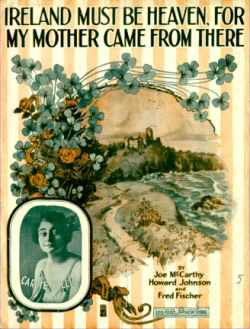
my // MotH . . . (Er / camef / romth / AIR —The end of the
poem quotes from another popular song of 1916, "Ireland
Must Be Heaven, for My Mother Came from There" (Fred Fisher,
music; Joe McCarthy, Howard Johnson, lyrics). The chorus (as sung
by Charles Harrison in
this recording from the Library of Congress) is as follows:
Ireland
must be Heaven,
For an angel came from there,
I never knew a living soul
One half as sweet or fair,
For her eyes are like the starlight,
And the white clouds match her hair,
Sure, Ireland must be Heaven,
For my mother came from there.
323. [XIII] "remarked Robinson Jefferson"
These notes are indebted to Donald R. Read, "E. E. Cummings: The Lay
of the Duckbilled Platitude," Satire Newsletter 3 (1965):
30-33. Read contends that Cummings' poem "is consistent with the
thought" of the first lines of Robinson Jeffers' poem, "Shine,
Perishing Republic" (pub. 1918 and 1924): "While this America
settles in the mould of vulgarity, heavily thickening to empire, /
And protest, only a bubble in the molten mass, pops, sighs out, and
the mass hardens."
Injustice Taughed = Chief Justice of the Supreme Court and
former President William Howard Taft, appointed to the court in
1921 by Warren G. Harding.
Wouldwoe = President Woodrow Wilson.
Lydia E. McKinley = conflation of Lydia E.
Pinkham, marketer of patent
medicine for women, and President William McKinley.
Buch = James Buchanan, President who preceded Abraham
Lincoln.
C.O.D. abbreviation for "cash on delivery" or "collect on
delivery." Formerly, the term "cod" meant "bag," and by extension,
"scrotum" (cf. "codpiece"). It is also British schoolboy slang for
"joke."
inley = "in [Robert E.] Lee."
Clever Rusefelt = conflation of Grover Cleveland and
Theodore Roosevelt.
Theodore Odysseus Graren't = "Theodore Roosevelt and
Ulysses S. Grant are not Odysseus."
he ant = "he is an ant" or "he ain't" --has no rights, is
not considered human.
Sitting Bull's T.P. = "teepee and toilet paper" (Read 32).
Sitting Bull
(1831-1890) was a noted native American (Lakota) chief, holy man,
and war leader.
duckbilled platitude refers to the duckbilled platypus, a
semiaquatic, egg-laying mammal.
Lays aytash unee = "les États-Unis" [French] or the United
States. As Read points out, "lays" no doubt has a sexual
connotation here. Perhaps unee = "un-E. E.," or "not E. E.
Cummings"?
325. [XVI] "tell me not how electricity or"
ludendorff = Erich
Ludendorff (1865-1937), German general in World War I, later
a Nazi party member and fervent anti-communist. In 1925, he was
dumped by
Hitler as candidate for President in favor of an even more
illustrious general, Paul von Hindenburg. See also http://spartacus-educational.com/FWWludendorff.htm.
Krassin probably refers to Leonid
Borisovich Krassin (spelled also Krasin, 1870-1926),
early Bolshevik, revolutionist, bomb-maker, counterfeiter,
engineer, and later diplomat for the nascent USSR. His wife
published his papers posthumously in English as Leonid
Krassin, His Life and Work (London, 1929). See Timothy Edward O'Connor, The
Engineer of Revolution: L. B. Krasin and the Bolsheviks,
1870-1926 (Boulder: Westview Press, 1992). Both Krassin
and Ludendorff were sidelined by their respective parties, but
perhaps the bomb-maker is seen more sympathetically here than the
general.
327. [XVII] "FULL SPEED ASTERN)"
m // usil(age)ini = Mussolini + musilage [a kind of glue] +
age.
hutchinson says = Whoever he is, Hutchinson is
quoting some additional lyrics to Cole Porter's 1928 hit tune,
"Let's Do It (Let's Fall in Love)":
Sloths who hang down from the twigs do it
Though the effort is great
Sweet guinea pigs do it
Buy a couple and wait
"religion is the opium of the people"
"Marx OKs J. P. Morgan rumor."
"Je(what)hovah ([Herbert] Hoover) in big combine with Babbitt."
Babbitt = philistine title character of 1922 novel by
Sinclair Lewis.
UNCOMMONWEALTH OF HUMANUSETTS = deformation of "Commonwealth of
Massachusetts." HUMANUSETTS = Human essence? Human uses? Human
nuisance?
328. [XVIII] " 'Gay' is the captivating
cognomen of a Young Woman of cambridge,mass."
paper sailors—argonauta
argo = a cephalopod mollusc of the genus Argonauta.
Wikipedia notes: "The female of the species, like all argonauts,
creates a paper-thin eggcase that coils around the octopus much like
the way a nautilus lives in its shell, hence the name paper
nautilus." The argonaut was formerly thought to use its shell as a
sail.
out of Briggs = LeBaron
Russell Briggs (1855-1934), Dean of Men at Harvard, as well as
President of Radcliffe College from 1903 to 1923. In his senior year
(1914-1915), Cummings took Briggs' Advanced Composition course.
Richard S. Kennedy writes that "Briggs
was no doubt the best-loved professor in the Harvard yard. He was a
very kind, gentle, gracious human being," who, like Cummings, was
"slight of build, very boyish in appearance," and who, also like
Cummings, "had attended Cambridge Latin School and went on to study
Greek at Harvard" (Dreams 69).
by Kitty): most likely George
Lyman Kittredge (1860-1941), an imposing Harvard professor and
Chaucer and Shakespeare scholar. Cummings took Kittredge's course
that intensively studied six Shakespeare plays. Kennedy writes:
"most student recollections depict him in the classroom as playing a
well-rehearsed role of omniscient scholar: an imperious eagle-eyed
old man hurling penetrating questions or answering queries with
authoritative scorn as he lifted his well-trimmed white beard in the
air" (Dreams 63).
the nearest l = the nearest "el," i.e., the nearest elevated
train station.
helen moller / dancers: See Moller, Helen C. Dancing
with Helen Moller: Her Own Statement of Her Philosophy, and
Practice, and Teaching Formed Upon the Classic Greek Model, and
Adapted to Meet the Aesthetic and Hygienic Needs of To-day.
Ed. Curtis Dunham. Intro. Ivan Narodny. New York: John Lane, 1918.
330.
[XX] "but granted that it's nothing paradoxically enough beyond
mere personal"
believing science=(2b)-n = believing in science is
equal to “to be” to the power of the minus nth degree.
331. [XXI] helves surling out of eakspeasies
per(reel)hapsingly
stuck thumblike into pie: cf. "Little Jack
Horner":
Little Jack Horner
Sat in the corner,
Eating a Christmas pie;
He put in his thumb,
And pulled out a plum,
And said, "What a good boy am I!"
332. [XXII] "Lord John Unalive(having a
fortune
of fifteengrand"
Lord John Unalive remains (as yet) unidentified. Any suggestions?
keltyer = "culture."
333. [XXIII] "buncha hardboil
guys from duh A.C. fulla"
hardboil-- In EIMI,
while translating the phrase "spare nothing" from Louis Aragon's
poem "The Red
Front," Cummings comments: "Nyet. Hardboiledness is dull"
(146/143).
A.C. Rushworth Kidder
writes that the poem depicts "a bunch of rowdies from the Athletic
Club beating up a sentimental drunk" (Introduction 91). However, Larry Chott once
mentioned in conversation that "A. C." stands not for "Athletic
Club," but "Ambulance Corps." Certainly “A. C.” seems a more usual
abbreviation for the former. The speaker's mention of a "busted
harmonica" may remind readers of another scapegoat who is
tormented by thugs, Surplice, who in The Enormous Room is
able to play a harmonica that no one else can (194-195). However,
the speaker of this poem glories in war in a way in which Surplice
surely would not.
334. [XXIV] "from the cognoscenti"
In a letter to Norman Friedman, dated "June 25 1955" and published
in Spring 14-15 (2006), Cummings notes that the last two
words of the poem are an anagram for "charles darwin" ("Letter"
148). Combining the first and last lines forms the statement "from
the cognoscenti of charles darwin," thus making the poem some sort
of comment on evolution. What sort of comment is up to the reader
to decide.
cognoscenti = "those in the know" [Italian].
pseudo . . . podia = Literally, "fake foot"
[Greek]. In his Critique of
Love (1929) psychiatrist Fritz Wittells observes:
Freud compares the libido with the
pseudopodia of unicellular animals, which attempt to encircle a
particle, and imbibe it as food. They strike out boldly to seize
the objects, but if they meet with resistance they withdraw within
themselves and encyst. When we suffer defeats we withdraw into our
shell. In the beginning we
are narcissistic, later we extend the libido to objects, and still
later our narcissism may be intensified by bitterness or
discouragement. (141-142)
Wittels was Cummings' psychoanalyst, and EEC owned and annotated
a copy of this book.
radarw leschin = anagram for "charles darwin."
335. [XXV] "murderfully in
midmost o.c.an"
(See Wegner, Poetry and Prose 13-14 and Kidder, Introduction
91-92.) EEC skewers the mystery writer S. S. Van Dine, who, under
his real name, Willard
Huntington Wright, had written Modern
Painting: Its Tendency and Meaning (1915), a book
much-cherished and well-annotated by the young Cummings. Van Dine's
sleuth was named Philo Vance, hence philophilic, or
"Philo-loving."
o.c.an--Wegner ingeniously
suggests that Cummings indirectly associates Van Dine "with that
eighteenth-century faker, James Macpherson, through the phonetic
allusion to Ossian
('o.c.an')" (13).
write = right, Wright. dine = Van Dine, dying.
Kidder points out that EEC "must have been offended by the fall of
an idol" (92). For Wright's influence on EEC, consult Kennedy, Dreams
80; 94-95 and Cohen, PoetandPainter 120-122.
336. [XXVI] "ohld song"
In a letter to Norman Friedman, dated "June 25 1955" and published
in Spring 14-15 (2006), Cummings says the poem presents
"the 'problem of' human 'identity' via one housefly. Compare Him
Act I Scene 4(mirror speech)" ("Letter" 148).
337. [XXVII] "the first president to be
loved by his"
them Yapanese Craps-- On his way back from a trip to
Alaska, President Warren G. Harding fell ill "from eating crab
meat on the presidential boat" (Allen 112). Further stricken at
San Francisco, the president "died suddenly--on August 2, 1923--of
what his physicians took to
be a stroke of apoplexy" (Allen 111). After Harding's death,
numerous members of his administration were revealed to have
engaged in graft and corruption. (see notes for
265 "the season 'tis,my lovely lambs,").
Knowledge of these impending scandals probably hastened the
president's death. A journalist later quoted Harding as having
said, "My God this is a hell of a job! I have no trouble with my
enemies. . . . But my damn friends, my God-damned friends . . .
they're the ones that keep me walking the floors nights" (quoted
in Daniels 102).
Cummings' criticism of presidential solecism was not limited to
Harding. In 1927, EEC told a man on
the street interviewer from the New York Daily News that
"The most wonderful thing that President Coolidge did was to
confuse the
whole country about the true meaning of a simple English sentence.
'I do not choose to run' sounds simple, but nobody in the country
except the President knows what it means" (quoted in Norman 230).
345. [XXXV] "what is strictly fiercely and wholly dies"
This poem is a portrait of Scofield
Thayer, former owner and editor of the Dial and Cummings' patron,
mentor and friend, who suffered a mental breakdown in 1926. The
sonnet was probably written shortly after Cummings' October 1930
visit to Thayer in Worcester, MA (cf. Sawyer-Lauçanno 308).
Cummings often drew pencil portraits of Thayer, and like his
drawings, the poem emphasizes Thayer’s “tiny, bow mouth” (Cohen, Poet 41). [See for example,
this pencil
portrait or this oil portrait
now at SUNY Brockport.] Cummings writes that Thayer's mouth
"reacts . . . to dreamings more than truth untrue" while the
"illustrious unknown" hovers
at his "lean lips" as Thayer's spirit stoops and
examines "fearingly and tenderly // a recent footprint in the sand
of was)".
Moving from "is" to "was," from head to foot, from Thayer's
parrot-like "preening solemnity" to his effort as Crusoe to
connect with another's or his own humanity, the poem sees the
death of
Thayer's (or someone's or anyone's) "IS" or "i" as
isolating and lonely, like Crusoe on his island.
Compare to an earlier Cummings poem about Thayer (also a
portrait, also mentioning his aesthetic mouth): "conversation with
my friend is particularly" (CP 96). [For Thayer's views on
Cummings' poetry, see James Dempsey's The Tortured Life of
Scofield Thayer (65-67).]
346. [XXXVI] "sunset)edges become swiftly"
inverno = "winter" [Italian]. The word may also suggest inferno,
"hell" or "fire."
349. [XXXIX] "An(fragrance)Of"
An opening flower seen as music or perhaps music seen as a flower.
The words inside
the parentheses refer to "fragrance," while the
words outside the parentheses stress the visual rather than the
olfactory aspect of the flower.
un deux trois = "one,
two, three" [French].
der / die = masculine and
feminine definite articles in German--also puns in English:
"there" and "die."
Given the phrases "one, two, three" and the "quickly Not," perhaps
the music stops briefly. Perhaps also the repeated "An" refers to
Cummings' wife at the time, Anne Barton Cummings. (Contrast the
lower case definite German articles with the uppercase indefinite
English article "An.")
356. [XLVI] "i met a man under the moon"
the
pincian = hill in the northeast section of Rome.
The Pincio
Gardens were designed in 1809-1814 by Giuseppe Valadier.
Perhaps this / wall refers to the Aurelian wall (270-273
AD).
360. [L] "when hair falls off and eyes blur
And"
Instant . . . Pills for Ills: EEC is probably echoing
advertisements in general rather than any one in particular. He may
have seen something like this article from Popular Science,
published in July 1931, three months before ViVa was
published: "Thousands
of Pills for Human Ills Turned Out Each Minute by Whirling
Machines" [Popular Science (July 1931): 62.]
367. [LVII] "somewhere i have never
travelled,gladly beyond"
For an analysis of the poem using "temporal poetics," see Richard D.
Cureton's "Cummings and Temporality."
Back to the list of books
No Thanks (1935
Manuscript)
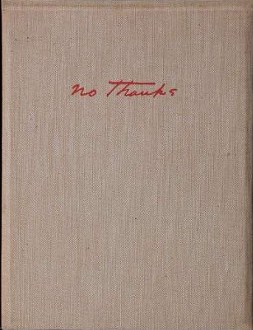
No Thanks is dedicated to the 13 publishers who
rejected the volume. The names of the publishers are
arranged on the page so that they form the shape of a loving
cup--or perhaps a funeral urn. The book was privately
published by Cummings' personal printer S. A. Jacobs, with
Cummings' mother Rebecca Haswell Cummings providing the
funds for publication. Cummings acknowledges her help with
this notice at the end of the book: "AND THANKS TO R. H. C."
|
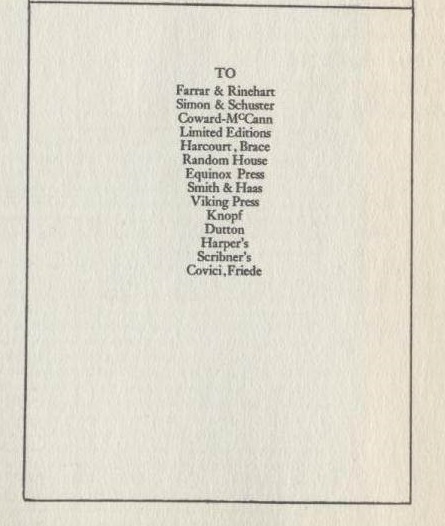
|
383. [2] "moon over gai"
gai = Ge = “Earth” [Greek]. See Him, Act III.,
scene 5 (129 / 123): Gay may change = “Ge (Earth) may change” [Greek].
gai / té = "gaieté" or "gaîté," French for frivolity or
gaiety. The poem depicts the moon rising over the Paris
neighborhood of Montparnasse. The
Rue de la Gaîté, long the site of theatres and variety shows, runs
just to the west of the Cimetière de Montparnasse, between the
Avenue du Maine and the Boulevard Edgar Quinet.
the moon over death over edgar = the moon over the cemetery
and the Boulevard Edgar Quinet. To the east, at denfert,
or the Place Denfert-Rochereau, is an entrance to the catacombs,
where the bones of millions of dead Parisians were relocated when
the cemeteries became too crowded. The square is commonly referred
to as Place Denfert, a
pun on its old name, the Place
D’Enfer (Hell Square).
the liontamer nearby hieroglyphs
/ soar dip / dip: Jacques Demarcq notes that until 1939
the Place Denfert-Rochereau hosted a Festival of the Lion de
Belfort, with horse-riding, lion-taming, and other animal acts.
The "Lion of Belfort" refers to a statue
in the square, honoring Pierre Denfert-Rochereau, the French
general who led the defense of the town of Belfort during the
Franco-Prussian War (1870-1871). Perhaps Cummings indicates that
the changing now of Parisian sub-lunar life tames memories of war
and death?
387. [4] "i /
(meet)t(touch)"
The "jeff dick / son" mentioned at the end of this poem was a
boxing promoter in
Paris. Unscrambled, the last lines read "jeff dickson fecit
mcmxxxii" or "Jeff Dickson made [promoted this fight in] 1932."
See Kidder, Introduction 107. A misprint appears in the
newest Complete Poems
(1994): lines 3-4 of stanza nine should read: "iS ar(ise)wi /
lt(wit(hprettyw)ith)mr." (Cummings is writing "wi / lt"--not "wi /
it.")
388. [5] "a)glazed mind
layed
in a / urinal"
Notice the parentheses around the first and last letters of the
poem.
stetti = "steady."
390. [7] "sonnet entitled
how
to run the world)" (SP 104)
Here is Cummings' "paraphrase" of lines 6-8:
G . . . never be guilty of self-pity;if you once had a
little but now have least,forget
the earlier time gladly;& when you have least,remember gladly
the time when you had most
H . . . treat your true(highest)self as something sacred--never
flaunt it in public,like a flag,for everyone to see (Letters
271).
grass is flesh --inversion of Isaiah 40:6: "All flesh is
grass / and all
its beauty is like the flower of the field. / The grass withers, the
flower fades, / when the breath of the Lord blows upon it." Cummings
writes:
lines 9 10 11 say that the subject of the sonnet's 2nd
part is not "flesh is grass"(i.e.
living is dying)as the Bible tells you, but dying is living("grass
is flesh") (Letters 271).
Interested readers will want to consult Cummings' entire commentary
on this poem (Selected Letters 270-271). (See also 322. [XII] "poor But TerFLY")
392. [9] "o pr"
unde negant redire quemquam = "whence, they say, no one
returns" [Latin]. Catullus,
poem 3, in which the poet mourns the death of his mistress'
pet sparrow, who has gone to the underworld, never to return.
Sheridan Baker notes that the missing "o" refers not only the
baseball but also very probably to "the little white ball that
used to bounce along from word to word of the songs flashed-on at
the lower edge of moving picture screens, a line at a time,
marking the beat for the audience to join in the chorus" (232).
See Sheridan Baker, "Cummings and Catullus" Modern Language
Notes 74 (1959): 231-234. See also Richard D. Cureton's
"Visual Form in E. E. Cummings' No Thanks" and Cummings's
discussion in i: six nonlectures (50).
Links:
393. [10] "little man"
For a reading of this poem, see Etienne Terblanche, "
'The plum survives its poems:' Meditative Space in the Poetry of
E. E. Cummings and Wallace Stevens" (163-164).
394. [11] "ci-gît 1 Foetus(unborn to not die"
ci-gît = "here lies" [French].
Jacques Demarcq suggests that the "Foetus" is Elaine’s second
husband Frank Mac Dermot, and the "Ghost" (despite being referred
to as "himself") is Elaine--or perhaps Love--("come summer puts
on fur"), and the "Man" is Cummings, who gave his consent to an
annulment of his first marriage--another failure, but he has
nothing else to give these undead people. (For the story of the
break-up of Cummings' first marriage, see Kennedy, Dreams 249-280.)
395. [12] "why why"
Martin Heusser sees this poem and "one's not half two. It's two
are halves of one:" (CP 556 ) as alluding "to Aristophanes' myth
of the split sexes" (I Am
61--cf. Plato's Symposium
189a-193e). In a letter to Norman Friedman, dated "June 25 1955"
and published in Spring 14-15 (2006),Cummings writes:
this poem says(if I remember my
zoology)that nothing is more,or less,significant than if I
pick up the You of an angleworm from the ground where
he-she squirms(instead of e.g. stepping on him). Vide dictionary
"metameric","homonomous","heteronomous" ("Letter" 149)
who's myself's Antimere =
"a term used in biology to designate 'a part or division
corresponding to an opposite or similar part in an organism
characterized by bilateral or radial symmetry.' An antimere forms,
in other words, a natural correspondence or complementary part to a
given body or part of a body; a natural opposition or half. In the
context of Cummings' question, the term is synonymous with the
'soul-mate' or 'other' which the self needs in order to achieve its
potential completeness" (Heusser, I
Am 62). Heusser further comments: "The issue of the
relation self-other as an enactment of the myth of Aristophanes is
taken up again
in lines thirteen and sixteen in 'metameric me' and 'metameric You.'
The term 'metameric,' like 'antimere' is culled from biology. A
metamere is defined as 'one of s a series of homologous body
segments' . . . . In variation and elaboration of the notion of the
other as a natural correspondence, self and other are here treated
as inherently identical elements of the same body. In addition,
however, the self is characterized as 'heteronomous,' the other (the
'You') as 'homonomous.' Both these terms are also biological termini technici. In a strictly
etymological sense, the latter means 'subject to the same or
a constant law,' the former the opposite, i.e., 'governed by
a different law'" (62-63).
396. [13] "r-p-o-p-h-e-s-s-a-g-r"
For Cummings' comments on the poem's construction, see the Page proof for "r-p-o-p-h-e-s-s-a-g-r". See
more drafts and page proofs of "r-p-o-p-h-e-s-s-a-g-r" on the "Drafts from No
Thanks" page (scroll down) at the Cummings Archive. This poem
has occasioned quite a bit of comment over the years. For commentary
on the poem, see Richard D. Cureton's "Visual Form in E. E.
Cummings' No Thanks," Max Nänny's "Iconic Dimensions in
Poetry," Etienne Terblanche's E. E. Cummings: Poetry
and Ecology (49-54), and Aaron Moe's Zoopoetics: Animals
and the
Making of Poetry (77-82).
Links:
397. [14] "mouse)Won"
This poem is in many ways the opposite of "r-p-o-p-h-e-s-s-a-g-r,"
which "is about unaccountable life and uncontainable movement,
while ["mouse)Won"] is about a motionless, dead mouse who is
wholly contained, wrapped in a leaf and placed in the earth"
(Webster, "The New Nature Poetry and
the Old" 114).
398. [15] "one nonsufficiently
inunderstood"
Norman Friedman translates the last lines as "I want to say right
here and now that my jack [money] rides with you—Very Sincerely,
I" (Art 77).
401. [18] "this little / pair"
This poem is a modern Mother Goose rhyme, complete with magical
transformations. It parodies two nursery rhymes:
a) There was a
little man,
Who wooed a little maid,
And he said, "Little maid, will you wed, wed, wed?
I have little more to say,
So will you, yea or nay,
For least said is soonest mended, -ded, -ded, -ded."
The little maid replied,
"Should I be your little bride,
Pray what must we have for to eat, eat, eat?
Will the flame that you're so rich in
Light a fire in the kitchen?
Or the little god of love turn the spit, spit, spit?"
b) Mary, Mary, quite contrary,
How does your garden grow?
With silver bells and cockleshells,
And pretty maids all in a row.
where / flesh is heiry montparnasse = combination of "the
thousand natural shocks / that flesh is heir to" (Hamlet III,
i, 62-63) and "flesh is [hairy] grass" (Isaiah 40:6). See 322 [XII]
"poor But TerFLY" and 390 [7] "sonnet
entitled how to
run the world)" (SP 104).
is goosed by raspail = the boulevards Montparnasse and
Raspail cross in the 6th
arrondissement in Paris. Americans in the Twenties congregated "in a
cluster of sidewalk cafés along the Boulevard Montparnasse" (Wickes
151).
In 1925, Sinclair Lewis wrote of one of these cafés, the Dôme: "It
is, in fact, the perfectly standardized place to which standardized
rebels flee from the crushing standardization of America" (quoted in
Wickes 152).
she turned into a fair-y could mean that "she turned into a
fair—there" (y = "there") [French]).
403. [20] "go(perpe)go"
Norman Friedman, Nat Henry, and Rushworth M. Kidder have all
pointed out that this poem parodies Proverbs 6: 6, "Go to the ant,
thou sluggard; consider her ways and be wise." See Friedman, Art
117-121, Kidder, Introduction 110 and Nat Henry, The
Explicator 20 (1963), item 63. The reader might also note
the incremental build-up of the phrase from Proverbs and the
bi-lateral symmetries in the letters and spacings of many
individual lines. These symmetries are least partially explained
by the root meanings of the words "sinister dexterity," which both
stem from Latin and mean, respectively, "left" and "right."
Randy Maitland pointed out to me that the
phrase appears in a passage towards the end of chapter 1 of Herman
Melville's Billy Budd. After being drafted
("impressed") into the British Navy, Billy has just waved goodbye to
his old shipmates and to his ship, the allegorically-named Rights-of-Man.
Billy says, "And good-bye to you too, old Rights-of-Man." Then
the lieutenant yells for Billy to sit down. Melville comments:
To be sure, Billy's action was a terrible breach of naval
decorum. But in that decorum he had never been instructed; in
consideration of which the lieutenant would hardly have been so
energetic in reproof were it not for the concluding farewell to
the ship. This he rather took as meant to convey a covert sally on
the new recruit's part, a sly slur at impressment in general, and
that of
himself in especial. And yet, more likely, if satire it
was in effect, it was hardly so by intention, for Billy, though
happily endowed with a gaiety of high health, youth, and a free
heart, was yet by no means of a satirical turn. The will
to it and the sinister dexterity were alike wanting. To deal in
double meanings and insinuations of any sort was quite
foreign to him.
The idea of the loss of rights when entering into a
collective and the use of the term "sinister dexterity" makes me
believe that EEC must be
referring to this Melville passage in his poem. Or if it's a
coincidence, it's a rather astonishing one.
A quick search on Google revealed that Cummings may have
also seen the phrase in draft versions of James Joyce’s Finnegans
Wake, published in Paris
in the journal transition. In the final published
version of the Wake, the phrase occurs in chapter
12 (or
II, 4), on page 384: "the hero, of Gaelic champion, the onliest of
her choice, her bleaueyedeal of a girl's friend, neither bigugly nor
smallnice, meaning pretty much everything to her then, with his
sinister dexterity, light and rufthandling, vicemversem her ragbags
et assaucyetiams, fore and aft, on and offsides, . . . ."
409. [26] "what does little Ernest croon"
(SP 154; see also Kennedy's note, SP 137-138).
The poem satirizes Ernest Hemingway's Death
in the Afternoon (1932) by parodying lines from two
Victorian poets. The first line, what does little Ernest croon,
is a send-up of Alfred,
Lord Tennyson's "Cradle
Song": "What does little birdie say / In her nest at peep of
day?" Line three, (kow dow r 2 bul retoinis, echoes the
second stanza of Henry
Wadsworth Longfellow's "A Psalm
of Life":
Life is real! Life is earnest!
And the grave is not its goal;
Dust thou art, to dust returnest,
Was not spoken of the soul.
In a short article in the old series of Spring, Richard S. Kennedy notes that Cummings was
probably "set off" by reading this passage in Hemingway's book:
Someone with English blood has
written: "Life is real; life is earnest, and the grave is
not its goal." And where did they bury him? and what became of the
reality and earnestness? The people of Castille have great common
sense. They could not produce a poet who would write a
line like that. They know that death is the unescapable reality,
the one thing any man may be sure of; the only security. . .
. They think a great deal about death and when they have a
religion they have one which believes that life is much shorter
than death. Having this feeling they take an intelligent interest
in death and when they can see it being given, avoided, refused,
and accepted in the afternoon for a nominal price of admission
they pay their money and go to the bullring . . . . (266) [qtd. in
"Cradle Song" 6-7]
In addition, the last two lines, "cow thou art to bull returnest /
was the words of little Ernest," echo the tone of a negative review
of Hemingway's Death in the
Afternoon written by Cummings' friend Max Eastman
and titled "Bull
in the Afternoon." See also Richard S. Kennedy's E. E.
Cummings Revisited, pp. 100-01.
410. [27] "little joe
gould has lost his teeth and doesn't
know where" (SP 57).
Joe Gould (1888-1957) was a Harvard graduate
who hung out on the streets of Greenwich Village, depending on
handouts for sustenance. Though he was supposedly writing /
compiling An Oral History of Our Time, according to
Rushworth M. Kidder, Gould was actually "doing nothing of the
kind, but cadging drinks" (Kidder 112). Joseph Mitchell's 1965
book Joe
Gould's Secret explores Gould's life and the secret
of his non-existent Oral History. Kidder says that the
line "a myth is as good as a smile" indicates that Cummings may
have guessed at Gould's secret. However, it is undeniable that
Gould did a lot of scribbling in many notebooks. In April 2000,
the Village Voice reported on
the re-discovery of eleven
of Gould's notebooks in the
archives at NYU. Charles Hutchinson
and Peter Miller's article, "Joe
Gould's Secret History: The Diary of a Legendary Village
Bohemian Surfaces at NYU," shows that Gould was writing something,
if not exactly an oral history. For
more on Joe Gould, see Kennedy 269 and Norman 133-138,
174-175. See also Sewell Chan's "Revisiting
Joe Gould's Secret," Joshua Prager's article in Vanity
Fair, "The
Patron and the Panhandler" (on Gould and his
mysterious patron), and Jill
Lepore's New Yorker piece "Joe
Gould's Teeth: The Long-lost Story of the Longest Book Ever
Written," which re-examines Joe Gould's life and argues for the
possible existence of his Oral History. Lepore
consults many letters and archival documents that were unavailable
to Mitchell. For an interpretation of "little
joe gould has lost his teeth and doesn't know where" (with a short consideration of Gould's published
writings), see Michael Webster's "Notes for Cummings: A Resource for
Students and Teachers." A site called
Kooks Museum hosts many of the writings
that Gould published in modernist
little magazines and journals. For the movie that was made based
on Mitchell's book, see the IMDB page for Joe Gould's Secret. Gould probably appears in more Cummings poems
than any
other person. EEC's poem "no time ago" (CP
648) is about Gould. And Cummings quotes Gould's misogynist
views in "as joe gould says in" (CP 700). The
posthumously published "April'/ this letter's
dated/ '23" (CP 1019) also mentions
Gould.
The first line and a half of "little
joe gould has lost his teeth and doesn't know where" is a pastiche of the nursery rhyme "Little
Bo-Peep":
Little Bo-Peep
has
lost her sheep,
And doesn't know where to find them;
Leave them alone, and they'll come home,
Wagging their tails behind them.
nude eel = "New Deal."
Harvard Brevis Est =
"Harvard Is Brief" [Latin]. Cummings plays off the Latin tag Ars longa, vita brevis ["Art is
long, life is short"], a translation of the first two lines of an
aphorism by the Greek physician Hippocrates. EEC adds the “Est”
[Is], which is understood in the Latin.
a myth is as good as a smile:
EEC plays on
the proverb "a miss is as good as a mile" (and perhaps by extension,
"a nod is as good as a wink").
a wraith's / progress
refers to A Rake's Progress,
a series of eight paintings
and (later) engravings
by English artist William Hogarth (1697-1764).
Amérique Je T'Aime =
"America I Love You" [French].
Cummings refers to "America,
I Love You" (1915), popular song with words by Edgar Leslie
and music by Archie Gottler. The chorus is as follows:
America, I
love you!
You're like a sweetheart of mine!
From ocean to ocean,
For you my devotion,
Is touching each bound'ry line.
Just like a little baby
Climbing its mother's knee,
America, I love you!
And there's a hundred million others like me!
In his essay on Gaston Lachaise (1920) Cummings wrote of a critic
who
could "comfort himself with the last line of that most popular
wartime song,
America I
Love You, which goes, 'And there're
a hundred million others like me' " (Miscellany 23). In 1940, the song was revived in
the movie Tin Pan
Alley. See also "Poem, Or Beauty Hurts
Mr. Vinal" (CP 228) and " 'next
to of course god america i" (CP 267).
it may be fun to be fooled:
In a 1960
article on the tobacco industry, Time magazine reported on the tobacco
advertising wars of the 1930s: "George Washington Hill . . .
dreamed up the slogan 'It's toasted' for Lucky Strike—even though
all tobacco went through the same toasting process. Reynolds
struck back with 'I'd walk a mile for a Camel,' [and] scoffed at
Luckies' 'toasted' claim with ads showing a magician sawing a girl
in half and captioned, 'It's fun to be fooled; it's more fun to
know.' " Links [1933
advertisements for Camel cigarettes]:
Writings of Joe Gould in Modernist Periodicals and on the Web
Gould, Joseph. "Art." The Exile 2 (Autumn 1927): 112-116.
---. "Excerpts
from Joe Gould's Oral History of the Contemporary World."
Ed. O. Nenslo. Kooks Museum (n.d., before 2005) [Also at
the
Internet
Archive.] Web. [Reprints "Social Position," "Insanity,"
"Freedom," "Marriage," and "Civilization."]
---. "From Joe Gould's Oral History: Marriage. Civilization." The
Dial (April 1929): 319-321.
---. "ME TEMPORE: A Selection from Joe Gould's Oral History:
'Insanity' and 'Freedom'." Pagany 2.2 (April-June 1931):
96-98. Rpt. A Return to PAGANY: The History,
Correspondence, and Selections from a Little Magazine 1929-1932.
Ed. Stephen Halpert and Richard Johns. Boston: Beacon Press, 1969.
299-301.
---. "Social Position." Broom 5.3 (October 1923): 147-150.
413.[30] "kumrads die because they’re
told)" (SP )
kumrads = "comrades," or communists.
414. [31] "does yesterday's perfection seem
not
quite"
The capital letters in the last line spell "IS," a key Cummings
term. In his essay on Gaston Lachaise, Cummings writes, "to
appreciate child art we are compelled to undress one by one the
soggy nouns whose agglomeration constitutes the mechanism of
normality, and finally to liberate the actual crisp organic
squirm--the IS" (Miscellany 19). For an interpretation of
this poem, see Kidder 113-114.
415. [32] "numb(and"
A very obscure poem that depicts how snow and ice cling, hang, and
droop from a large iron structure (possibly the Eiffel Tower). The
snow and ice look like "w / ar / pin / g dre // ams whichful
sarcasms / papery deathfuls"—but under its winter coating this
structure is an "alive secretly i" that "awaits / yes" (spring).
Cummings' consistent satire of the pomposity of public statues (CP
408 and CP 636) makes unlikely Kidder's suggestion that the poem
describes snow sliding off the statue "of a nineteenth century
industrialist . . . in Washington Square Park" (112).
423. [40] "as if as"
This poem depicts how the rising sun gradually reveals the
world.
425. [42] "out of a
supermetamathical subpreincestures"
croons canned / à la vallee refers to Rudy
Vallee, the most popular pre-Bing Crosby
crooner.
preserved goldfishian gestures in films produced by
Samuel
Goldwyn (originally Goldfish), founder of Goldwyn
Pictures, which later became MGM Studios.
sally
rand = fan-dancer of the 30s, whose motto
was "the fan is quicker than the eye" (Daniels 244).
Photo: Sally Rand and her feathered fans (from
Daniels fig. 21).
fand = hand, rand, fan. No doubt the word "fly"
has multiple meanings also.
χαίρετε = "chairete" = "rejoice!" or "greetings" in
Greek [pronounced "ki - ray - tay"— Cummings
rhymes it with “entirety.”]. Root-word for English
"charity." A variation of this word is the title for
Cummings' 1950 book of poems, XAIPE.
recent world's fair
celebrating "A
Century of Progress" in Chicago
in 1933-1934.
b.o.fully speaking
"b.o." = "body odor" and/or “box office.”
Links:
|
 |
430. [47] "ondumonde'"
In his book Americans in Paris (1969), George Wickes
writes: "The subject of this poem is a Negro [bantamweight] boxer
named Panama Al Brown who was a familiar figure in the Paris ring
between 1926 and 1938" (117). Wickes continues: "The most
astonishing part of Al Brown's career came years later when he
lost his title, and [Jean] Cocteau--of all people--managed his
comeback campaign. 'Al Brown
was a poem in black ink,' wrote Cocteau, unwittingly describing
the poem Cummings had written. The composition not only outlines
the boxer in action but reports the whole scene through scraps of
conversation and incidental details" (117-118). According to Tyler
Stovall's Paris Noir, Brown was managed in Paris by the
promoter Jeff Dickson, who is mentioned in "i /
(meet)t(touch)" (CP 387). Brown was known for his "grace of
movement" in the ring, and after his brief Cocteau-inspired
comeback in 1938, he was featured at the Cirque Médrano
"in a shadow-boxing dance act to a jazz accompaniement"
(Steegmuller 433). Stovall offers a brief account of Al Brown's
life in Paris on pp. 67-68 of Paris Noir. Links:
Panama Al Brown's record
and a brief
biography (with photo).
ondumonde" = "[champi]on du monde" = "champion of the
world" [French].
"(first than carefully poised now then why sprig slinkily
strolling (precisely) dynamite yearns swoons & is dense
killing whip alert floats corruptingly)"
ça y est = "that's it" [French].
qu'est-ce que tu veux = "what do you want" [French].
il est trop fort le nègre = "he's too strong, the Negro"
[French]. 5, 7, 8,
"dropped writhes nothingish sprawl, TO 9 & (musically-who? //
pivoting) / SmileS"
c'est fini . . . allons "it's over . . . let's go"
[French].
"ahlbrhoon = "Al Brown"
431. [48] "floatfloafloflf"
A poem about the dancer Paul
Draper (1909-1996). See Richard Crowder, The Explicator
16 (Jan. 1957), item 41. A misprint appears in the newest Complete Poems (1994):
line 11 should read “irlErec” instead of “irlEric”. Both the
typescript edition of No Thanks and the HBJ
Complete Poems of 1980 read “irlErec”. (Cummings is writing
the word “Erec / , / t,” not the name “Eric.”)
cupidoergosum = "cupido ergo sum" = "I
desire therefore I am" [Latin]. See 494.
[8] "the Noster was a
ship of swank"
omiepsicronlonO-- / megaeta? = scrambled Greek letters:
omicron [O, o], epsilon [Ε, ε], omega [Ω, ω], eta [H, η].
In Greek, these four letters represent the vowels
O and E, two long (omega and eta) and two short (omicron and
epsilon).
438 [51]
"Jehovah buried,Satan dead,"
a Five Year Plan = The Soviet Union
began
implementing economic five year plans in 1928.
to kiss the mike . . . “kiss
the microphone (or Irishman) if Jews become objects of / creations
of prejudice.”
Cummings wrote: “argument:man fancies himself god but has become
base;what's needed is a(god who dares to be a)man” Houghton
Library, Harvard University,
call number bMS Am 1823.5 (165).
440. [56] "this mind made
war"
This poem is most likely a portrait of Ezra
Pound. After receiving a copy of No Thanks,
Pound wrote to Cummings: "damn it all, 56 worth more than the prix
nobel, from 17 non conformist parsons" (P/C 65).
(The word "parsons" refers to the Swedish Nobel Committee.) The
next line of the letter tells Cummings not to
talk about Pound valuing the poem higher than the prize, since
Pound's daughter might have need of any future Nobel money for
schooling.
444. [59] "sh estiffl"
In the latest Complete Poems, delete the extra "g" in line
5: for "epouting(gWh.ono:w" read "epoutin(gWh.ono:w" (Cummings is
writing "the pouting who now"). Also, line 15 is out of place and
should be moved flush left with the other lines. The line should
also have three question marks, thus:
unununun?
butbutbut??
tonton???
ing????
In addition, for line 19, both the typescript edition (1978) and a
fair copy at the Houghton Library [bMS Am 1892.5 (477)] read
".grIns"—while the 1935 edition of No Thanks and the 1954
and 1994 Complete Poems read ".grins". The
former reading seems preferable.
445. "(b/ eLl/ s?/ bE"
The poem emphasizes the bE of the bells as well as their
sounds: sob, bang, reel, crash, shout, boom, cry. One way to
read the middle of the poem would be to see the people in the
"(dark- / ly)" churches as “whirling in // . . . to sun" while the
bells in stanza five whirl and "crash" simultaneously. At the end of
the poem, perhaps (sbells) = "spells"?
446. [61] "love's function is to
fabricate unknownness"
Rushworth M. Kidder finds echoes of Shakespeare’s sonnet 116 in this
sonnet (Introduction 121):
Shakespeare,
sonnet 116
|
Cummings
(CP 436) |
| Love’s
not time’s fool |
love may
not care / if time totters
|
Nor bends
with the remover to remove
|
all
measures bend
|
[love]
bears it out even to the edge of doom
|
--dreads
dying least;and less,that death should end)
|
fish boast of fishing // and men
are caught by worms--Jacques Demarcq notes that this image
of the worm and fish recalls this remark of Hamlet: “A man may fish
with the worm that hath eat of a king, and eat of the fish that hath
fed of that worm” (Hamlet,
Act IV, scene 3).
See also Gerald Levin's "Cummings' Poem (Love's function. . . )." Explicator 17 (1958/1959), item
18.
Back to the list of books
New Poems (1938) [At right: EEC at 4
Patchin Place, 1937] 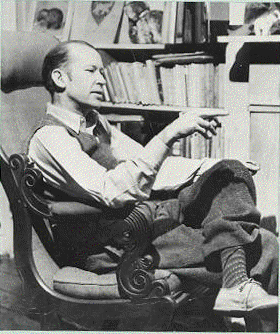
The New Poems are a group
of 22 new poems published at the end of the Collected Poems (New York:
Harcourt, Brace, 1938), which, despite its title, is actually a
volume of selected poems. For a review of Collected Poems, see S. I. Hayakawa, "Is
Indeed 5" [Poetry 52.5 (Aug. 1938):
284-292].
464. [2] "kind)"
YM&WC conflates YMCA, YWCA and W.C., "water-closet"
or toilet [chiefly British].
professor . . . shapley = Harlow Shapley, celebrated
Harvard astronomer who actually compared the
universe to neither a biscuit nor a cookie, but to a watch. In his
popular science text The Universe of Stars (1929), Shapley
wrote, "the whole [Milky Way] is disk-shaped like a watch" (168).
Manuscripts at the Houghton Library at Harvard University [bMS Am
1892.7 (108), folder 4] indicate that Cummings read Shapley and
knew of the watch comparison, so the distortion here is deliberate
ridicule. See also Paul O. Williams, "Cummings' 'kind)'," Explicator
23 (1964) item 4 and Guy Rotella, "Cummings' 'kind)' and
Whitman's Astronomer," Concerning Poetry 18
(1985): 39-46.
466. [4] "(of Ever-Ever Land i speak"
(SP 149)
Barry Marks writes that the last two lines of the poem are a
pastiche of a line from Rudyard Kipling: "A woman is only a woman,
but a good Cigar is a Smoke" (57). The line comes from Kipling's
poem "The
Betrothed," first published in Departmental Ditties and Barrack
Room Ballads (1886). Link: Stephen Scotti
singing his own setting of "(of Ever-Ever Land i
speak"
471. [9] "so little he
is"
A poem about Jimmy
Savo (1896-1960), vaudeville entertainer "whose fluttering
hands strewed the stage with bits of paper in gestures extremely
birdlike" (Norman 146). John T. Ordeman's "Two
Portraits by E. E. Cummings: Jimmy Savo in Poem and Painting,"
Spring 6 (1997): 49-54, unearths more information about
Savo and reproduces an EEC oil painting of the comic actor. Lloyd
Frankenberg's comments on this poem are quite perceptive: "The
interrelationships are so deftly numerous that only a few can be
pointed out. 'So' begins and concludes the poem. The latter 'so'
encloses 'AV' (a root form for 'bird'), thus confirming in Savo's
name the bird-like quality expressed
in the poem. Savo's 'pert' expertness consists in expanding
littleness, but not by blowing up its dimensions. He grOws
in a series of circular elations, as the miracle ('L . . . O') of
a 'wi?ng' causes a bird to grow through space. They grow by what
their motion encloses. Savo is a 'childlost'; yet like a poet
recovers original impulses of living: the child, lost to most of
us, is found in poet and clown. 'AV' may also allude to another of
Savo's expansions, when he suddenly releases a torrent of song in
'River, Stay Away from My Door.' The trailing punctuation at the
end recalls the floating particles of paper Savo can incredibly
cause to flutter off
from his fingers, with infinite lassitude. And of course Savo
began
as a juggler; a precisionist at balance" (157-58).
472. [10] "nor woman"
Nat Henry suggests that the poem depicts "the body of a young girl
violated and left dead in a park." See Henry's "Cummings' 303 (nor
woman)," The Explicator 22 (1963), item #2. Rushworth
Kidder offers a less lurid interpretation: "the 'he' is a bum and
the propped-up bundle is his drunken companion" (Introduction
129). However, it is more likely that this is simply a poem about
a homeless man who died in the snow and cold. He himself is the
"bundle." Note the subject of the next poem, "my speciality is
living said" (CP 473).
474. [12] "The Mind's("
The poem depicts a Hollywood sound-stage. (Cummings visited
Hollywood in 1935.) Lines 10-15 translate to: "And you can tell
Finklestein it stinks. / You ready? All right, let's go. Action! /
Camera. They're tur- / ning." See Kennedy, Dreams 363-369,
Kidder, Introduction 129, and Nat Henry's "Cummings'
305.["The Mind's("] Explicator
20:6 (Feb. 1962), item 49.
484. [22] "you shall
above all things be glad and young."
that you should ever think —Kidder says this line echoes
Peter Quince's confused recitation of the Prologue in the Pyramus
and Thisbe interlude in Shakespeare's A Midsummer Night's
Dream: "That you should think, / we come not to offend / But
with goodwill" (V, i, 109-110).
that way knowledge lies —echoes King Lear's "that way
madness lies" (Lear III, iv, 21; Kidder 131-132).
Back to the list of books
50 Poems (1940)
488. [2] "fl // a / tt /
ene"
This poem depicts coughing men standing "more o / n than in"
their shadows. The doubled letters in the lines depict the
men and their shadows. The men are probably homeless
denizens of the Bowery.
esse = "to be" [Latin].
489. [3] "If you can't eat you got to"
Text
of the poem as first published in Poetry [56.5
(August 1940): 239].
490. [4] "nobody loved this"
A poem about the Cyclops. See Homer's Odyssey,
book nine.
492. [6] "flotsam
and jetsam" (SP 154)
 gentlemen poeds = W.
H. Auden (1907-1973), British-American poet, and Christopher
Isherwood (1904-1986), British-American novelist, who
arrived together in New York in January 1939. On April 6,
1939, Cummings may have attended Auden and Isherwood's
reading at the League of American Writers, a group described
by a biographer of Auden as "one of those left-wing
organizations that were popular in the thirties" (Farnan
18). Ironically, both Auden and Isherwood were moving away
from left-wing politics and towards more personal forms of
belief--Anglicanism and pacifism. And though they were, as
Cummings says, "thoroughly bretish," both became American
citizens in 1946. Carl Van Vechten photographed
Isherwood and Auden on February 6, 1939. gentlemen poeds = W.
H. Auden (1907-1973), British-American poet, and Christopher
Isherwood (1904-1986), British-American novelist, who
arrived together in New York in January 1939. On April 6,
1939, Cummings may have attended Auden and Isherwood's
reading at the League of American Writers, a group described
by a biographer of Auden as "one of those left-wing
organizations that were popular in the thirties" (Farnan
18). Ironically, both Auden and Isherwood were moving away
from left-wing politics and towards more personal forms of
belief--Anglicanism and pacifism. And though they were, as
Cummings says, "thoroughly bretish," both became American
citizens in 1946. Carl Van Vechten photographed
Isherwood and Auden on February 6, 1939.
coeds = male and
female students. In a 1941 letter to Ezra Pound, Cummings
refers to William Carlos Williams as "your excoed Billy the
Medico" (P/C 159).
(neck and senecktie refers to Horace, Odes,
II.14:
Eheu fugaces, Postume, Postume,
labuntur anni nec pietas moram
rugis et instanti senectae
adferet indomitaeque morti:
"Ah, Postumus, Postumus, how fleeting / the swift
years--prayer cannot delay / the furrows of imminent old-age
/ nor hold off unconquerable death." As far as I know,
Norman Friedman was the first to point out the reference to
Horace (Art 52). For an interpretation of this poem,
see Michael Webster's "'hatred bounces'" in Spring 7
(1998).
|
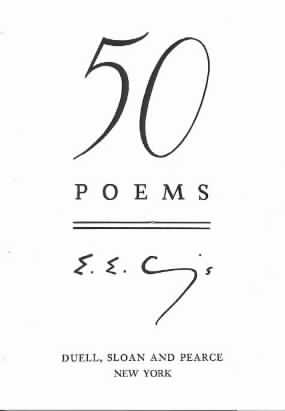
|
494. [8] "the Noster was
a ship of swank" (SP 110;
see Kennedy's note SP 108)
See Luther S. Luedtke, "Cummings' 'the
Noster was a ship of swank'." The Explicator 26
(1968), item #59.
Noster = "Our" [Latin].
mine = besides an explosive device, the possessive pronoun;
also, "mind."
Sum = "I am" [Latin]; also, "some" and "sum," the result of
mathematical calculations.
Ergo = "Therefore" (as in philosopher René Descartes' famous
maxim, "Cogito ergo sum" or "I think, therefore I am").
Pater = "Father" (i.e., God the Father). Pater may
also refer to
English aesthete Walter
Pater (1839-1894). In addition, "when joined to Noster
[Pater] becomes Pater Noster, not only 'our
[Walter] Pater,' 'our [literary] Father,' but also the
Lord's Prayer" (Luedtke).
497. [11] "red-rag and pink-flag "
red-rag and pink-flag = Communists.
blackshirt and brown = Fascists.
Norman Friedman (Art 81) points out that each stanza of the
poem parodies a different nursery rhyme:
Stanza 1:
Hark! Hark! The dogs do bark,
The beggars are coming to town.
Some in rags,
And some in tags,
And one in a velvet gown!
Stanza 2:
Pease porridge hot,
Pease porridge cold,
Pease porridge in the pot
Nine days old.
Some like it hot,
Some like it cold,
Some like it in the pot
Nine days old.
502. ")when what hugs stopping earth than
silent is"
Text
of the poem as first published in Poetry [53.4 (Jan.
1939): 172] (scroll down).
504. [18] "ecco a letter starting'dearest we'"
ecco = "behold" [Italian]
chauvesouris = "bat" [French]
princess selene = the moon.
508. [22] "nouns to nouns"
Text
of the poem as first published in Poetry [53.4 (Jan.
1939): 171-172] (scroll down). (Note that the poem is on two pages.)
509. [23] "a pretty a day"
Possibly
this song was influenced by Shakespeare's
The master, the swabber, the
boatswain, and I,
The gunner and his mate,
Loved Mall, Meg, and Marian, and Margerey,
But none of us cared for Kate.
For she had a tongue with a tang,
Would cry to a sailor “Go hang!”
She loved not the savor of tar nor of pitch;
Yet a tailor might scratch her where e’er she did itch
Then to sea, boys, and let her go
hang!
(The Tempest, Act II,
scene 2)
Link: Text
of the poem as
first published in Poetry [56.5 (August 1940): 236].
511. [25] "as freedom is a breakfastfood"
The Poetry Foundation’s podcast “E. E. Cummings: Essential American Poets”
presents Cummings reading "as freedom is a breakfastfood." This track is from
Cummings' reading at the 92nd Street Y, recorded in
New York City, October 20, 1949. (The
"1959" note on the podcast page is in error.) This same reading is
also available in a You Tube version.
515. [29] "anyone lived in a pretty how town"
Links:
522. [35] "you which could grin three
smiles into a dead"
Text
of the poem as first published in Poetry [56.5
(August 1940): 235].
523. [36] "i say no world"
Text
of the poem as first published in Poetry [56.5
(August 1940): 237-238].
525. [37] "these children singing in sotne
a"
Text
of the poem as first published in Poetry [53.4 (Jan.
1939): 170-171] (scroll down). (Note that the poem is on two
pages.)
529. [41] up into the silence the green"
Text
of the poem as first published in Poetry [53.4 (Jan.
1939): 173] (scroll down).
530. [42] "love is more thicker than
forget"
The Poetry Foundation’s podcast “E. E. Cummings: Essential American
Poets”
presents Cummings reading "love
is more thicker than forget." This track is from Cummings' reading at the 92nd Street Y,
recorded in New York City, October 20, 1949. (The
"1959" note on the podcast page is in error.) This same reading is
also available in a You Tube
version.
Link: Text of "love
is more thicker than forget" as first published in Poetry
[53.4 (Jan. 1939): 175].
531. [43] "hate blows a bubble of despair
into" (SP 70)
The second stanza was probably influenced by these lines from
stanza 12 of Emerson's "The
Sphinx":
Eterne alternation
Now follows, now flies;
And under pain, pleasure,--
Under pleasure, pain lies.
Love works at the centre
532. [44] "air,"
For interpretations of this poem, see Terblanche and Webster,
"Eco-Iconicity in the Poetry and Poem-groups of
E. E. Cummings" (160-164) and Etienne Terblanche, E. E.
Cummings: Poetry and Ecology (72-75) .
534. [46] "grEEn's d"
This poem is apparently about a drunk ("hollow was / young")
who, after rolling or lying in the grass or bushes, gets "Up" in
lines 4-6. His old clothes are covered over "with // sprouts" as he
lurches forward, smiling out of "crumb / ling eye / -holes."
However, in a letter to Norman Friedman, dated June 25, 1955" and
published in Spring 14-15 (2006), EEC
says that the poem is about "The coming of Spring:Nature's
immortality contrasted with Man's birth-to-death existence
(symbolized by a human skull)" ("Letter" 150).
536. [48] "mortals)"
Cummings wrote of the acrobats depicted in this poem that they are
"transformed from 'mortals' to 'im'mortals because they risked
their lives to create something beautiful. Finally they disappear
into the place from which they appeared;just as the last syllable
'(im' of the my poem goes back to the first word 'mortals)'" (Letters
259; see
also Letters 221).
Link: The poem "mortals)"
as first published in Poetry [53.4 (Jan. 1939): 169-170].
(Note that the poem is on two pages.)
Back to the list of books
1 x 1 [One Times One]
(1944)
At right: "Self-portrait by E. E. Cummings"
(back of dust jacket to the 1944 edition of 1 x 1)
543. [III] "it's over a(see just"
(SP 118-119)
Compare and contrast with the Adam and Eve story. Why do
you suppose the poet chose "gravensteins" as the apple
variety rather than, say, "red delicious"?
544. [IV] "of all the blessings which
to man"
its hoi in its polloi "hoi polloi" = "the people" or
"the inhabitants of the polis [city-state]" [Greek]. The
basic meaning here appears to be that the individual,
represented by the definite article hoi, disappears
into the masses (polloi). The reference is somewhat
complex, however, since the Greeks contrasted the people of
the polis, hoi polloi, with the barbarians, hoi
barbaroi. So in that sense hoi polloi may mean
all
the members of the political ethnocentric in-crowd. As a
further irony, we might note that in Greek the definite
article is forced to be plural because it modifies polloi.
The hoi can only "preexist" within its own
multiplicity (polloi).
545. [V] "squints a blond"
blond / job = dyed hair of a blonde woman (cf. "a
dye job" and the slang expression "nut job" for a mentally
disturbed person).
Perhaps the woman is squinting because she is not wearing
her glasses or because her diamond / solitaire
(engagement or wedding ring) is not so big.
guesswho = her husband or fiancé, who is nibbling
(understatement) a gigantic steak ("ton of
torse"--overstatement).
pool / of pink fat / screams = most likely the
screaming face of a child, perhaps the offspring of the
couple in the first two stanzas.
"g / w" = George Washington, probably the
equestrian statue in Union
Square--complete with wig.
|

|
551. [XI] "mr u will not
be missed"
mr u = Louis Untermeyer (1885-1977). Charles Norman quotes
a contributor's note from Secession 2 (July, 1922):
"E. E. Cummings. Candidate for the mayoralty of Paris, the present
literary capital of America. Indorses Secession campaign
against Louis Untermeyer, an anthologist best known for the
omission of William Carlos Williams and Marianne Moore from his Modern
American Poetry." Norman notes that Untermeyer's third
edition (1925) did include poems by Williams, Moore, and Cummings
(179). According to Kennedy, Jean Starr Untermeyer "was more
amused than offended by Cummings' little rhyme about her husband"
(Dreams 405).
In his article "missing mr u (not)" [Spring
10], Philip Gerber notes that the basis for Cummings' comic poem
was probably the song of the Lord High Executioner Ko-Ko
from Gilbert and Sullivan's Mikado:
Ko-Ko: As some day it may happen that a victim
must be found,
I've got a little list--I've got a little list
Of society offenders who might well be underground,
And who never would be missed--who never would be missed!
There's the pestilential nuisances who write for autographs?
All people who have flabby hands and irritating laughs--
They'd none of ‘em be missed--they'd none of 'em be missed!
Here the cast joins in with its refrain of general commendation:
Chorus: He's got 'em on the list—he's got 'em on
the
list;
And they'll none of 'em be missed—they'd none of 'em be missed!
Ko-Ko's "little list" is a lengthy one. It continues:
Then the idiot who praises, with enthusiastic tone,
All centuries but this, and every country but his own;
And the lady from the provinces, who dresses like a guy,
And "who doesn't think she dances, but would rather like to
try";
And that singular anomaly, the lady novelist—
I don't think she'd be missed—I'm sure she'd not be missed!
(Gilbert, Librettos 10)
To all of which the cast assents. No, they'd not be missed. None
of these natural enough targets, those on the remainder of the
list, or even those yet to come, none of them would be missed, not
even a little bit.
—And if the lady novelist, why not the great
anthologist? Indeed, why not? ("missing" 44).
Gerber notes that an avid theatre-goer like Cummings would have had
ample opportunity to see The Mikado: "in 1938 a jazz
production opened on Broadway, and in 1939 audiences enjoyed a
Hollywood moving-picture Mikado in which the popular crooner Kenny
Baker sang the role of its wandering-minstrel hero" ("missing" 40).
For another possible Cummings borrowing from Gilbert and Sullivan,
see "here is little effie's head" (CP 192).
552. [XII] "it was a goodly co"
The company in question is the Ex-Lax
corporation.
bishop budge from kew--An
undated note by Cummings reads as follows:
"No man ever has suffered, or ever will suffer, from living
cleanly; all arguments to the contrary are a mere pretext to cover
immorality" – THE BISHOP OF LONDON [Houghton Library, Harvard
University, call number bMS Am 1823.7 (23), sheet 221]
The bishop in question is Arthur Winnington-Ingram (1858-1946;
Bishop of London from 1901 to 1939). The journal Social
Hygiene [1.3
(Jan. 1917)], which
Cummings' father the social reformer probably owned, quotes
Bishop Ingram:
"There is unfortunately in England a
tendency to regard vice and licentiousness as a necessary evil. I
have heard men who lead perfectly moral lives say they suppose
these things are inevitable. In other words, public opinion has
countenanced prostitution. Men with so-called advanced views
declared that morality and health did not go hand-in-hand. What
utter nonsense! No man ever has suffered or ever will suffer, from
living cleanly; all arguments to the contrary are merely a pretext
to cover immorality." (137)
Social Hygiene quotes the
Bishop's speech from the November 4, 1916 issue of Literary Digest.
fresh complexions being oke / with him)one william shakespeare
broke / the silence of the tomb = probably alluding to some
advertisement for face cream that referred to Morocco's lines
from Shakespeare's The Merchant of Venice: "Mislike me not for my complexion, / The shadowed
livery of the burnished sun" (Act II, scene i).
the god of things like they err = most likely Cummings is
remembering a quote from Rudyard Kipling’s "L'Envoi"
to his collection of poems The Seven
Seas (1896). Sometimes called, after its first
half-line, "When Earth's last picture is painted," the poem imagines
an afterlife for artists. Its third and last stanza reads:
And only the Master shall
praise us, and only the Master shall blame;
And no one shall work for money, and no one shall work for fame,
But each for the joy of the working, and each, in his separate
star,
Shall draw the Thing as he sees It for the God of Things as They
Are!
Cummings may also be referring to a passage from James Joyce's
Ulysses that comes at the end of Stephen's lecture
on Shakespeare:
"We walk through
ourselves, meeting robbers ghosts, giants, old men, young men,
wives, widows, brothers-in-love. But always meeting ourselves. The
playwright who wrote the folio of the world and wrote it
badly (He gave us light first and the sun two days later), the
lord of things as they are whom the most Roman of Catholics call dio boia, hangman god, is doubtless all in all in
all of us . . ." (U 210/213/175).
553. [XII] "plato told"
lao tsze = legendary founder of Taoism, a Chinese
philosophy.
general . . . sherman = Civil War General William
Tecumseh Sherman (1820-1891), famous for his devastating
march to the sea in 1864. At his graduation address at the
Michigan Military Academy in 1879, he is reported to have said:
"War is at best barbarism . . . Its glory is all moonshine. It is
only those who have neither fired a shot nor heard the shrieks and
groans of the wounded who cry aloud for blood, more vengeance,
more desolation. War is hell."
nipponized = "japanized" and refers to the sale of scrap
metal to Japan before World War II. The el refers to an
elevated train or subway line.
554. [XIV] "pity this busy
monster,manunkind,"
The "electrons" are those of an electron microscope, and curving
wherewhen refers to Einstein's theory of curved space-time. LIFE magazine of June 1, 1942
shows three
photos of a razor blade, the first actual size, the second as
magnified by a light microscope, and the third as magnified by an
electron microscope. The captions for the first and third photos
read:
These
three pictures of the same razor-blade edge clearly
illustrate relative powers of the human eye (top), light microscope (middle), and electron
microscope (bottom) (LIFE 11, first picture
caption).
Enlarged 8,500 times by
electron microscope, great peaks and valleys are revealed in blade
edge. Black wedge in central picture indicates the width of
section shown here (LIFE
11, third picture caption).
An undated Cummings landscape painting, "mountains
silhouetted in sky" bears a remarkable resemblance to the
electron microscope photo of the razor blade. No fewer than three Explicator
articles
deal with this poem. They are by John Britton 18 (1959)
item 5, James W. Gargano 20 (1961) item 21, and Nat Henry 27 (1968)
item 68. [See also "Space being(don't forget to
remember)Curved" (CP 317; SP 159-160) and "noone
and a star stand,am to am" (CP 721).]
556. [XVI] "one's not half two. It's
two are halves of one:"
Link: Text
of the poem as it first appeared in Poetry 62.4 (July
1943):
179.
560. [XX] "what if a much of a which of a
wind"
Link: Text
of the poem as it first appeared in Poetry 62.4 (July
1943):
180.
567. [XXVII] "old mr ly"
mr ly . . . man = Frank
Lyman, farmer in Silver Lake, New Hampshire. He
reappears with his son Reg and daughter-in-law Lena in "now comes the good rain farmers pray for(and"
(CP 754).
568. [XXVIII] "rain or hail"
sam = Sam
Ward, handyman and caretaker of EEC's Joy Farm, in Silver
Lake, New Hampshire. See Margaret Foerster, "A Note on Cummings and My Family at Silver
Lake," Spring 6 (1997): 22-24. Ward's letters to the
Cummings family (particularly his use of the lower case "i") may
have influenced EEC. Charles Norman quotes EEC: "I remember once
he wrote: 'we had a Big snow' . . . He'd write 'i'—not 'I'—because
'I' wasn't important to him. Sam Ward's way is the only way.
Instead of being artificial and affected, it's the conventional
way that is artificial and affected"
(309). Kennedy quotes part of a letter from Sam Ward on page
110 of Dreams in the Mirror. For more on Cummings at
Silver Lake and Joy Farm, see Michael Webster's "Silver Lake
Revisited" [EEC Society Blog (24 Aug. 2016)].
Link: Text
of the poem as it first appeared in Poetry 62.4
(July 1943):
181-182. (Note that the poem is on two pages.)
570. [XXX] "Hello is what a mirror says"
Cummings comments: "true wars are never won;since they are
inward, not outward, and necessitate facing oneself" (Letters
247). EEC's other comments (in the same letter) on this poem are
equally illuminating. This poem may refer to these lines in Marianne
Moore's "In Distrust of Merits": "There never was a
war that was / not inward; I must / fight till I have conquered in
myself what / causes war, but I would not believe it. / I inwardly
did nothing. / O Iscariot-like crime!" (Complete Poems
138). Both poems were written during World War II. According to
Firmage (56), Cummings' "Hello is what a mirror says" (CP 570) was
first published in Accent 3.4 (Summer 1943), while
Marianne Moore’s "In Distrust of Merits" was first published in The
Nation 156 (May 1, 1943): 636.
577. [XXXVII] "we love each other very
dearly"
synbeams = a typo for "sunbeams."
In his "Dante and E. E. Cummings," Allan Metcalf contends that
the line "before God wished Himself
into a rose" refers to Dante, Paradiso 23.73-74: "Quivi è
la rosa in che 'l verbo
divino / carne si fece" ("There is the rose [Mary] in which the
divine word / became flesh"). Cummings quotes a similar passage (Paradiso
33.7-9) in nonlecture five (97).
582. [XLII] "might these be thrushes
climbing through almost(do they"
Link: Text
of the poem as it first appeared in Poetry 62.4
(July 1943):
182-183 (scroll down). (Note that the poem is on two pages.)
585. [XLV] "i think you like' "
Narrating a typical Cummings walk around Greenwich Village,
Charles Norman writes: "Turning left on Tenth Street, and headed
for Sixth Avenue . . . [Cummings] passes the florist shop on the
corner where he and the proprietor, Mr. S. Psomas, have often
bowed to each other among the blossoms; for flowers are a
necessity to him, and he thinks his friends--and sometimes
strangers who have been charming or kind--should have them, too" (Magic-Maker
4).
593. [LIII] "o by the by"
The last stanza of this poem surely refers (whether
consciously or unconsciously) to the end of the 1932 song "I've Got the
World on a String" (music by Harold Arlen, lyrics
by Ted Koehler):
Life is a beautiful thing,
As long as I hold the string,
I'd be a silly so-and-so,
If I should ever let go...
I've got the world on a string,
Sittin' on a rainbow,
Got the string around my finger,
What a world, what a life,
I'm in love!
594. [LIV] "if everything happens that can't
be done"
Link: Text
of the poem as it first appeared in Poetry 62.4 (July
1943):
183-184 (scroll down). (Note that the poem is on two pages.)
Back to the list of books
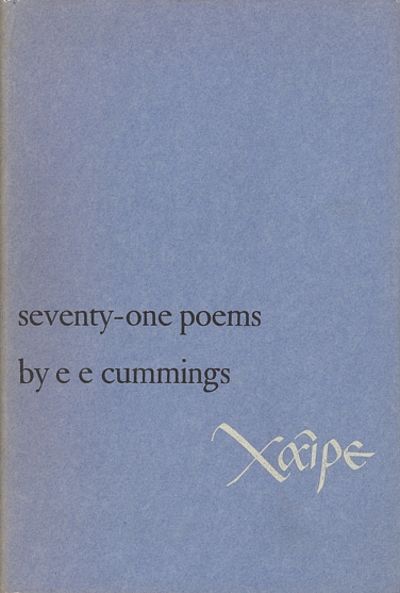
Dust jacket of the first editon of XAIPE
|
XAIPE (1950)
The title: χαίρε = "chaire" =
"rejoice!" or "greetings" in Greek [pronounced "chi - ra"
with an aspirated "h"]. Root-word for English
"charity."
605. [7] "we miss
you,jack--tactfully you(with one cocked"
jack = Peter Monro Jack (1896-1944), book reviewer
for the New York Times. See Pound / Cummings
160-162.
"fert / ig" = "ready" [German].
wallendas = "The Flying Wallendas," a family of
trapeze artists.
606. [8] "o // the
round"
the round / little man = Paul
Rosenfeld (1890-1946), music and literary critic who
wrote several articles on EEC. In his fine portrait of
Rosenfeld, Edmund Wilson wrote: "his affectionate and
generous nature had to spend itself mainly in the sympathy
that he brought to the troubles of his friends, and in
the tireless encouragement of talent" (113).
611. [13] "chas sing does(who"
Cummings comments: "'chas sing' . . . is the name of a
Chinese laundryman on Minetta Lane(maybe Street). This
poem tells you that,in spite of his name, he doesn't
sing(instead,he smiles always a trifle while ironing
nobody knows whose shirt. I can't believe you've
never done any ironing:but,if you have,how on earth can
you possibly fail to enjoy the very distinct pictures of
that remarkable process given to you by the poet's
manipulating of those words which occur in the poem's
parenthesis?!" (Letters 162). Despite EEC's claims
to the contrary, Michael Webster maintains that Mr. Sing does
sing, if only silently through his ironing, imitated
visually in the poem. See his "'singing is silence': Being
and Nothing in the Visual Poetry of E. E. Cummings."
616. [18] "a(ncient)a"
inani = besides its English meaning, the line may
refer to the Latin word inani, meaning "empty" or
"vain." It's also possible that Cummings, the former
classics major, refers here to a famous line in Virgil's Aeneid:
"sic ait atque animum pictura pascit inani" (I,
464), translated by Robert Fitzgerald as "He broke off
[speaking] / To feast his eyes and mind on a mere image"
(20). The empty "image" or "pictura" that Aeneas
looks at is a Carthaginian painting or bas-relief
depicting the fall of Troy. This artwork moves Aeneas to
tears and convinces him that the Carthaginians understand
the lacrimae rerum, the "tears inherent in
things." Perhaps the vain or empty "picture" of a drunk
staggering down "conway / 's // unstreet" reminded EEC of
the Roman view of the vanity of art? William Levitan,
professor of Classics at GVSU, writes, "I think you're
right that Cummings is pointing to this line: remember the
situation is that Aeneas, invisible at the moment, is in a
sense yielding his substance to a visible (but
insubstantial) image."
The drunk is visible, but gripped by the invisible Fist
of Fate, smiling while Aeneas is crying, old while Aeneas
is middle-aged, floating and "weigh / tless" while Aeneas
is carrying the weight of the fall of Troy, his ancestral
gods, and
his mission to found Rome. Both, however, may be said
to be "treadwatering." Aeneas is in a new city, on a new
street, while the old drunk is in Conway, New Hampshire, a
rural place with no art or even what one could call a
street. The old man is already an ancestor, an ancient
"puppet" in the grip of drink, fate, and old age, while
Aeneas is
a sort of puppet of the gods and the ancestors, and of the
Roman imperium.
|
617. [19] "out of the mountain
of his soul comes"
aristide maillols = sculptures by Aristide
Maillol, French sculptor, 1861-1944.
624. [26] "who sharpens every dull"
Norman Friedman notes that this poem is about a neighborhood
scissors and knife grinder, a common site in New York at the time
(Art 89-90). (See the New York Times article, "Bells
Clanging, a Tradesman Comes Home." See also Don Freeman's sketch
of a knife grinder.)
631 [33] "if a cheerfulest
Elephantangel-child should sit"
This poem is among a group of winter / snow / Christmas poems in XAIPE
(numbers 29-34).
Link: Text
of the poem as first published in Poetry [74.4 (July
1949): 187-188] (scroll down). (Note that the poem is on two
pages.)
632. [34] "a thrown a"
Text of "a
thrown a" as first published in Poetry [74.4 (July
1949): 188-189] (scroll down). (Note that the poem is on two
pages.)
X = mystery, unknown, X-factor, something perceived but not
yet labeled.
X = also the Greek letter chi, the first letter in
XAIPE (title of the book), whose meaning is something like
"Greetings!" "Cheers!" and/or "Joy!" and/or "Welcome!"
X = first letter in Greek ΧΡΙΣΤΟΣ or χριστος = Christ =
"anointed."
I, X, A = capitals in stanzas 2, 4, 6.
way / X = Perhaps the Tao is an unknown (master)?
X / -mas)ter- // i = ex-Christmas tree, X [Christ]
mystery?
X / -mas)ter = unknown master; former master?
X / -mas)ter // i = (ex-) Christmas master-y (via i? of i?)
i = poet’s lower-case i persona; the Christmas tree (ter
// i) is a mysterious i [individual, not an "It," as the
capital i in that word also indicates].
glo- = glow. Normalized phrase: "A mysterious wisp
of prettily clinging glory."
ry.pr = symmetry: rx dot xr.
cl(tr)in(ee)gi- = tinsel interlaced in tree branches. (Note
symmetry.)
(tr)in(ee) = E. E. in tree. Also: "i" in tree.
Normalized phrases: "a thrown away It something silvery; bright,
&: A mysterious wisp of prettily clinging glory." And in
parentheses: "(a thrown away Xmas tree)."
635. [37] "F is for foetus(a"
Many have commented that the capital letters in this poem spell
"FDR," the initials of Franklin Delano Roosevelt.
it's / freedom from freedom / the common man wants —a
reference to Franklin Roosevelt's "Four
Freedoms," first enunciated in the State of the Union
address, January 6, 1941. They are: 1) freedom of speech, 2)
freedom of worship, 3) freedom from want, and 4) freedom from
fear. Norman Rockwell painted a popular series of posters
illustrating the freedoms. Cummings may also be referring to Vice
President Henry A. Wallace's famous "common man
speech" (1942), whose actual title is "The Price of
Free World Victory." In the
speech, Wallace warned that the "demagogue is the curse of the
modern world," and that in countries "where the people have had no
long experience in governing themselves on the basis of their own
thinking, it is
easy for demagogues to arise and prostitute the mind of the common
man to their own base ends."
honey swoRkey mollypants = "Honi soit qui mal y pense"
[French] = "Shame to whomever thinks evil of it." The motto of the
order of the Garter, also known as St. George's motto. William
Harmon notes that quite a few "writers in the 1930s and 1940s
played variations" on this motto. Harmon also thinks he remembers
some criticism being leveled at Roosevelt for having one of one of
his sons working at the White House during World War II--to which
someone responded, "Honi soit qui mal y pense" (71). Can anyone
confirm or deny Harmon's memory? See his "Cummings' Caprice in
'F'," Spring 7 (1998): 68-72.
636. [38] "why must itself up every of a park"
"Nothing" . . . "can stand
against the argument of mil / itary necessity" = sentence
quoted from a statement issued by General Dwight D. Eisenhower on
December 29, 1943 but not made public until February 15, 1944:
Today we
are fighting in a country [Italy] which
has contributed a great deal to our cultural inheritance, a
country rich in monuments which by their creation helped and now
in their old age illustrate the growth of the civilization which
is ours. We are bound to respect those monuments so far as war
allows.
If we have to choose between destroying a
famous building and sacrificing our own men, then our men’s lives
count infinitely more and the buildings must go. But the choice is
not always so clear-cut as that. In many cases the monuments can
be spared without any detriment to operational needs.
Nothing can stand against the argument of
military necessity. That is an accepted principle. But the phrase
"military necessity" is sometimes used when it would be more
truthful to speak of military convenience or even personal
convenience. I do not want to cloak slackness or indifference.
(qtd. in Crider 1, 3)
President Franklin Roosevelt first made Eisenhower's statement
public in order to defend the Allied
shelling of the Abbey of Monte Cassino. In a front page
article in the February 16, 1944 New
York Times, John H. Crider reported that "President
Roosevelt explained this afternoon that the shelling of the historic
shrine of Mount Cassino by American forces was made necessary
because the Nazis were using the monastery not only as an
observation post but also to house artillery" (1). History later
proved Roosevelt's statements to be at least somewhat in error:
there was no German artillery in the abbey and the Germans were
actually dug in below the monastery. Moreover, the Germans had been
instrumental in saving many of the monastery's priceless treasures
before the battle.
generalissimo e = General
Dwight D. Eisenhower.
"there is no appeal / from
reason"(freud) = a quote from Sigmund Freud's The Future of an Illusion
(1927): ". . . the 'Credo quia
absurdum' of the early Father of the Church . . . maintains
that religious doctrines are outside the jurisdiction of
reason--are above reason. Their truth must be felt inwardly, and
they need not be comprehended. But this Credo is only of interest as a self-confession. As
an authoritative statement it has no binding force. Am I obliged to
believe every absurdity?
There is no appeal to a court above that of reason. If the truth of
religious doctrines is dependent on an inner experience which bears
witness to that truth, what is one to do about the many people who
do not have
this rare experience?" (35).
"Credo quia absurdum [est]" = "I believe because it is absurd"
[Latin]--phrase attributed to Tertullian (ca. 160-ca.220 A.D.), but
he never wrote it.
639. "whose are these(wraith clinging with a
wraith)"
Link: Text
of the poem as first published in Poetry [70.6 (Sept.
1947): 297].
643. [45] "when your honest redskin toma"
Norman Friedman notes that the punctuation marks in this poem are
meant to be pronounced out loud (Art 115).
647. [49] "this is a rubbish of a human
rind"
In a letter to Norman Friedman, dated "June 25 1955" and published
in Spring 14-15 (2006), Cummings writes this précis of the
poem:
war. (1)a soldier's mangled
corpse;still clutching in half of one hand a photograph of his
girl inscribed,by her,"love". (2)a girl(perhaps the same girl)goes
mad with grief;while the "gadgets" of the war machine "purr" &
the "gangsters"(officers)eat & drink contentedly.
(3)a(Christian)church ruined by(Christian)shell-fire.
(4)somebody's lost dog looking for the(killed?)master he can’t
find anywhere (152)
Link: Text
of the poem as first published in Poetry [70.6
(Sept. 1947): 298].
648. "no time ago"
According to Charles Norman, Cummings wrote
this poem after a late night walk in Greenwich Village. EEC
recalled encountering "a little person who now is dead and who
lived by begging." The "person" was Joe Gould
(Norman, Magic-Maker 174-75).
655. [57] "(im)c-a-t(mo)"
Cummings writes that this poem "tells me in its own vivid way that
an immobile cat suddenly puts on an acrobatic act:& fall-leaps,becoming
drift-whirlfullyfloat-tumblish;& the wanders
away,exactly as if nothing had ever happened" (Letters
268). See also Letters, p. 231. For disscussions of this
poem, see: Michael Webster's "E. E. Cummings and the Reader:
Technique as Critique" (1997), Milton
Cohen's "Disparate Twins: Spontaneity in E. E. Cummings' Poetry
and Painting," Spring 4 (1995), John Pollock's
"Appreciating Cummings' '(im)c-a-t(mo)'." Spring10 (2001),
Aaron Moe's "Autopoiesis
and Cummings' Cat" [Rupkatha
Journal 3.1 (2011)] and pages 124-125 of his Two Converging Motifs: E. E. Cummings'
l!ook. See also "Drafts of
'(im)c-a-t(mo)' (CP 655)" on the EEC Society Blog.
Link: Text of "(im)c-a-t(mo)"
as first published in Poetry [74.4 (July 1949): 191].
656. [58] "after screamgroa"
Cummings notes that this poem is about "a farmer sharpening a
bush-scythe on a grindstone" (Letters 232).
"pud-dih-gud" = "pretty good."
663. [65] "i thank You God for most this
amazing"
Links:
Back to the list of books
95 Poems (1958)
673 [1] "l(a"
Known as "the leaf poem," this text has occasioned much
commentary over the years. In his "Haiku
Sensibilities of E. E. Cummings," Michael Dylan Welch
discusses how the poem renews and remakes Japanese haiku
tradition (114-118). Gudrun Grabher's excellent "I
paint (my poems), therefore i am" [Spring 10
(2001): (48-57)] expands upon Welch's insights, as does
Etienne
Terblanche's groundbreaking "Cummings'
'l(a': Solitude, Solidarity, Wholeness" [Spring 11 (2002):
52-65]. See also Terblanche's E. E. Cummings: Poetry and
Ecology (Amsterdam: Rodopi, 2012. 171-179). In
addition, consult Thomas Dilworth's "Cummings's '1(a'." [Explicator
54.3 (1996): 171-173], Iain
Landles' "An Analysis of
Two Poems
by E. E. Cummings" (37-43), and Martin Heusser's I
Am My Writing:
The Poetry of E. E. Cummings [Tübingen: Stauffenburg
Verlag,
1997]. Heusser considers the leaf poem in chapter 13, "The
Poempicture"
(265-290). The sections on the leaf poem are called "Space:
the Poem and
the Page" (269-272) and "Visual Meaning" (272-277).
Heusser's chapter 2,
"Man, Leaf and Tree: The Self as Multiple Identity" (36-50),
considers
how the leaf imagery in other poems (and manuscripts)
relates to EEC's
notion of multiple selves.
677. [5] "crazy jay
blue)"
crazy jay blue = the
blue jay.
Link: Text of "crazy
jay blue)" [Poetry 76.4 (July 1950): 191-192]
(scroll
down). (Note that the poem is on two pages.)
678. [6] "spirit
colossal"
Charles Norman writes that this poem is about the black-capped
chickadee: "Both the chickadee and phoebe
say 'phoebe,' hence the play on alter ego. But here all
comparisons end, for the phoebe is gross, the chickadee
crisp and bright-eyed; and
'darling' is the correct word" (Magic-Maker
322).
phoebeing alter =
the other bird whose song sounds like "phoebe." (Also: a pun
on "being.")
Link: Text of "spirit
colossal" [Poetry 76.4 (July 1950): 188]
(scroll down).
682. "maggie and millie and mollie and
may"
Links:
685. [13] "So shy
shy shy(and with a"
Allan A. Metcalf makes a persuasive case that this poem
was "inspired in important ways" (381) by Dante's sonnet,
"Tanto gentile e tanto onesta pare" (Vita Nuova,
chapter 26), a poem which Cummings recited in his third
nonlecture. See Metcalf's "Dante and E. E. Cummings."
688.
[16] "in time of daffodils(who know"
This poem may have been influenced by Christina Rossetti's
"Song":
When
I am dead, my dearest,
Sing no sad songs for
me;
Plant thou no roses at my head,
Nor shady cypress
tree:
Be the green grass above me
With showers and
dewdrops wet:
And if thou wilt, remember;
And if thou wilt, forget.
I
shall not see the shadows,
I shall not feel the
rain;
I shall not hear the nightingale
Sing on as if in pain:
And dreaming through the twilight
That doth not rise nor
set,
Haply I may remember;
And haply may forget.
Link:
The vocal group Chanticleer performing Steven Sametz's
choral setting of the poem: "in
time of" (from the CD Colors of Love,
1999).
|
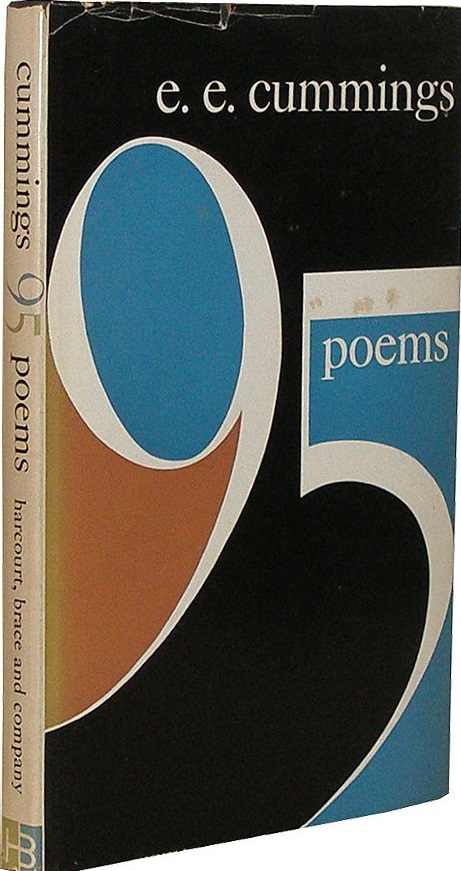
Dust jacket of 95 Poems
|
696. "dim"
Michael Dylan Welch discusses this poem as a haiku in "The Haiku Sensibilities of E. E. Cummings"
(111-112). In "The 'small eye poet' from
Imagism to 'not numerable whom'," Michael Webster notes how
the isolated lower-case "i"
in the first stanza and the four lower-case "e"s in the second
stanza
are emblematic of the poet (112-113).
Link: Text of "dim"
[Poetry 76.4 (July 1950): 187-188] (scroll down). (Note
that the poem is on two pages.)
697. [25] "that melancholy"
"paw?lee" = Polly or Paulie, name of the organ-grinder's
cockatoo. See John Logan's "The Organ Grinder and the Cockatoo," Modern
American Poetry: Essays in Criticism. Ed. Jerome Mazzaro
(New York: David McKay, 1970), pp. 249-271.
Link: Cummings reading "that melancholy" (UBU
web Cummings sound page).
699. [27] "jack's white horse(up" 
jack's white horse —Possibly an illuminated advertisement
for White Horse Scotch Whisky, visible at the end of West Fourth
Street. Or perhaps EEC refers to theWhite Horse Tavern, 567
Hudson Street.
jack may be Peter Monro Jack, a book reviewer, friend of
Cummings, and lover of whiskey. He is the subject of the
sonnet-elegy "we miss you,jack—tactfully you(with
one cocked" (CP 605).
706. [34] "ADHUC SUB JUDICE LIS"
The title quotes line 78 of Horace's Ars Poetica:
"Grammatici certant et adhuc sub judice lis est" which Kidder
translates: "Grammarians dispute, and the case is still before the
courts" (Introduction 206).
707. [35] "so you're hunting for ann well
i'm looking for will"
Two parents dispute about a couple of wayward teenagers, who may
possibly be Ann Hathaway and Will Shakespeare.
In line 23, for "rasberrypatch" read "raspberrypatch"
714. [42] "from spiralling
ecstatically this"
When this poem appeared first in the Atlantic Monthly 198.6 (Dec. 1956), it was
titled "CHRISTMAS POEM" (Firmage 62).
721.[49]
"noone and a star stand,am to am"
millionary wherewhens distant
= many light
years apart. [wherewhens
= "space-time units." See also
"Space being(don't forget to remember)Curved"
(CP 317) and "pity this busy monster,manunkind,"
(CP 554).]
Though this poem concerns a lone man standing "am to am" with a
star, Cummings made quite a few paintings of a lone figure
"worshiping" the moon. For example, compare this poem to "Man in Landscape with Moon" or "Surrealistic Landscape" (both
at SUNY Brockport). The latter is similar to "blue trees."
722. [50] "!/o(rounD)moon,how"
For an account of how Cummings developed this poem through
29 drafts, followed by thirteen suggestions for reading this poem,
see Aaron Moe's "Thirteen Ways of Reading
EEC's R-O-U-N-D MoOn" [Spring 21-22].
Link: Text of "!/o(rounD)moon,how"
[Poetry 76.4 (July 1950): 190] (scroll down).
725. [53] "n // ot eth"
Note also the arithmetic pattern formed by counting letters and
spaces in each line. See John Logan's "The Organ Grinder and the
Cockatoo," pp. 268-269.
726. [54] "ardensteil-henarub-izabeth)"
The first word of the poem combines Helena Rubenstein's and
Elizabeth Arden’s beauty treatments with hens, henna, rubs and
style (Kidder 208).
732. [60] "dive for dreams"
Link: Text of "dive
for dreams" [Poetry 80.3 (June 1952): 125-126] (Note
that the poem is on two pages.)
740. [68] "the(oo)is"
Cummings sees the eyes of a child "who is(reminds me of)myself" (Letters
268). Interested readers should consult Cummings' complete
explication of this poem in the Selected Letters.
745. [73] "let's,from some loud unworld's
most rightful wrong"
Link: Cummings reading "let's,from some loud
unworld's most rightful wrong" (UBU
web Cummings sound page).
750. [78] "all nearness pauses,while a star
can
grow"
Link: Text of "all
nearness pauses" [Poetry 80.3 (June 1952): 126-127]
(scroll down). (Note that the poem is on two pages.)
754. [ 82] "now comes
the good rain farmers pray for(and"
old frank = Frank
Lyman, farmer in Silver Lake, New Hampshire, whose wisdom is
voiced in "old mr ly" (CP 567).
rej and lena = Frank Lyman's son Reg and daughter-in-law
Lena.
For more on Cummings at Silver Lake and Joy Farm, see Michael
Webster's "Silver
Lake Revisited" [EEC Society Blog (24 Aug. 2016)].
Link: A drawing of the Frank Lyman's house and barn: "Frank
Lyman's place."
765. [91] "unlove's the
heavenless hell
and homeless home"
An earlier version of this poem (said by the editors to be from
the 1920s) was published in Etcetera. See "love's
absence is illusion,alias time" (CP 1006).
Link: Text of "unlove's
the heavenless hell and homeless home" [Poetry 80.3
(June 1952): 127] (scroll down).
766. [92] "i carry your heart with me(i
carry it in"
Link: Text of "i
carry your heart" (Poetry Foundation) [Poetry 80.3
(June 1952): 128]
767. Spring!may—
Text of "Spring!may--"
[Poetry 80.3 (June 1952): 128-129] (scroll down). (Note
that the poem is on two pages.)
Back to the list of books
73 Poems (1963)
Rushworth M. Kidder notes: "Unlike earlier volumes, the
contents were not arranged by Cummings but by his
bibliographer, George Firmage. 'In early December 1962,'
Firmage recalls, 'Marion handed me a folder containing
typescripts for 28 hitherto unpublished poems and asked me
to make
fair copies of these as well as any other poems I knew of
that had been published but had not, as yet, been collected
in one of Estlin's books. . . . I made no attempt to imitate
Estlin's previously published volumes in arranging the
. . . poems; I merely tried, as best I could, to find a
pleasing reading order' " (219).
Charles Norman states that in April of
1963, Marion asked him "to edit the poems Cummings had been
putting together before he died" (Poets 304-305). Norman suggested the
title Last Poems
and Marion agreed. Norman writes: "I worked on the
manuscript from April 19 to April 24. It was arranged in a
manner Cummings himself might have followed: three sections
comprising 'Portraits,'
'Impressions,' and 'Sonnets.' Mrs. Cummings sent the
manuscript
to Harcourt, Brace & World" (Poets 305). However, after Marion
disapproved of a new last chapter for Norman's biography of
Cummings, The Magic Maker,
she sent Norman a letter saying that the publisher "had
found it 'too difficult' to set up" the text in Norman's
arrangement, and the book appeared with its present title
and format (Poets
306). According to Norman, Marion especially objected to a
remark Cummings whispered to him in May, 1961 when Marion
was out of the room: "All I ask is one more year" (Poets 301). (See also
Kennedy, Dreams
512, note 15.)
773. [1] "O the sun comes up-up-up in
the opening"
Link: Stephen Scotti singing his own setting of "O the sun comes
up-up-up in the opening"
774. [2] "for any ruffian
of the sky"
your kingbird = the
eastern
kingbird, a "large dark flycatcher" with the
scientific name Tyrannus
tyrannus.
784. [12] "Me up at does"
Etienne Terblanche has pointed out if we read only the
capital letters of this poem--"Me Stare What You"--the
observer (referred
to as "Me" and "You") becomes one with the mouse, asking in
effect,
"what are you looking at?" Notice also how the lower-case
"i" here denotes
the mouse, not the usual Cummings poetic persona—another
conflation of
mouse and observer. See Michael Webster's "The New Nature Poetry and the
Old" (115-117).
790. [18] "nobody could / in
superhuman flights"
wut ektyouelly metus = "what actually matters."
The last line can be translated: "if momma hadn't just
knocked it endwise."
791. [19] "everybody happy?"
WE-WE-WE echoes the counting-toes nursery rhyme "This
little piggy":
This little piggy went to market.
This little piggy stayed home.
This little piggy had roast beef,
This little piggy had none.
And this little piggy cried
"Wee! Wee! Wee!" all the way home.
|
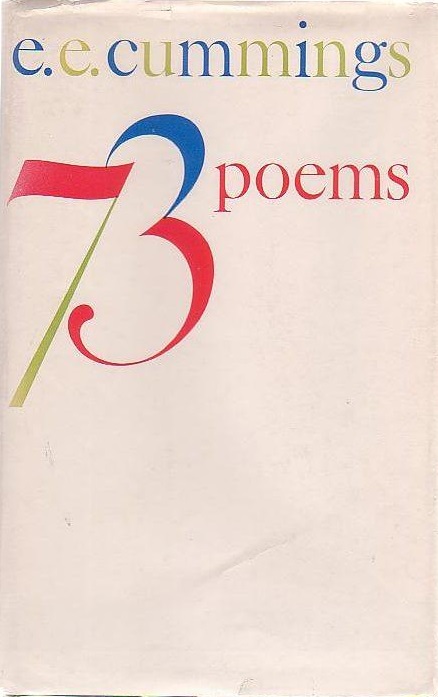
Dust jacket cover of 73 Poems
|
Gary Lane writes that "when we remember that Carlyle spoke of
[Jeremy] Bentham's doctrine as 'pig philosophy,' the second line's
full measure of satire becomes apparent" (91). Kidder
points out that the line "also suggests agreement (oui-oui-oui)" (226).
(if you can't dentham =
play on the cliché "If you can't beat 'em, join 'em." Cummings'
version is "if you can't dent them, bent [bend] them."
bentham = Jeremy Bentham
(1772-1832), Utilitarian philosopher who "claimed that the greatest
happiness of the greatest number was the proper measure of right and
wrong" (Lane 91).
1 law for the lions & / oxen is science) = revision of a
sentence from William Blake's The Marriage of Heaven and Hell:
"One Law for the Lion & Ox is Oppression" (plate 24).
796. “insu nli gh t” [24]
insu = unknown, without
[one's] knowledge [French].
799. [27] "in the heavenly realms of hellas
dwelt"
Cummings retells Homer's story of the affair between the goddess
of love, Aphrodite, and the god of war, Ares. Aphrodite's husband
was Hephaistos, the lame god of fire and the forge. For Homer's
version, see the Odyssey, 8.266-369. For an extensive
reading of the poem as a reaction to and reworking of the
classical tradition and the epic pretensions of John Milton and
William Blake, see Alison Rosenblitt's E. E. Cummings'
Modernism and the Classics (231-244).
800. [28] " 'right here the other night
something"
Charles Norman reports that this poem is a combination of three
incidents that occurred to him over a span of 25 years. In the
first, Norman was about to enter an apartment in Greenwich Village
to survey it as a possible living place when a man in
"a rustling dressing gown" began speaking to him. Thrilled when
Norman mentioned that he wrote poetry, the man exclaimed, "Just
think! . . . a real poet!" and knelt down and kissed the palm of
Norman's hand. Norman fled.
In the second incident, Norman was approached
on 9th Street by a man who asked him, not for money, but for an
overcoat. Norman took off his own coat and gave it to the man. The
third incident occurred "on Seventh Avenue near 13th Street" when
"a well-dressed man asked me for a quarter. It was bitter cold. I
said I did not have any change and handed him a dollar. He stared
at
me in the light of the street lamp; then tears filled his eyes,
and I hurried on" (Poets
307).
803. "POEM(or ‘the divine right of
majorities, that illegitimate offspring of
the divine right of kings’ Homer Lea)"
Homer Lea
(1876-1912)
wrote two books, The Valor
of Ignorance (1909) and The Day of the Saxon (1912), in which he
expounded a social Darwinist vision of the future of the
global military powers, arguing in the former book, for
example, that the United States was vulnerable to a Japanese
invasion of
the west coast. The quote about the "divine right
of majorities" comes from a section of The Valor of Ignorance
that maintains that immigrants who came the United States
after the Civil War would soon be a majority of the
population, yet were too foreign to be "imbued with the true
spirit of American institutions" and thus would lack the
morality and fervor to defend "those primitive rights upon
which the great but fragile edifice of this Republic was
builded" (132). The full sentence reads: "Republics, governed
by the divine right of majorities, that illegitimate offspring
of the divine right of kings, are controlled, not by rural
districts nor sparsely settled states, but by centres of
population, where radiate not alone political predominance,
but the moral and social tendencies of the nation" (132-133).
In his pacifist essay "The
Moral Equivalent of War" (1910), William James briefly
discusses Lea's theories, finding the scenario of
a Japanese invasion "not unplausible," at least to a
militarist mind. But James concludes that however great "Fear"
may be, "it is not, as our military enthusiasts believe and
try to make us believe, the only stimulus
known for awakening the higher ranges of men's spiritual
energy" (328).
Cummings' poem shows no
awareness of the context of this quote, and so far research
has turned up no evidence that EEC owned copies of Lea's book
or of James' essay. (Cummings was certainly no militarist and
no social Darwinist.) Most likely EEC simply saw the quote
somewhere and applied it to his own individualist concerns.
816. [44] "Now i lay(with everywhere around)"
EEC refers to the nursery rhyme, "Now I lay me down to sleep; / I
pray the Lord my
soul to keep, / And if I die before I wake, / I pray the Lord my
soul to take."
820. [48] "t,h;r:u;s,h;e:s"
Robert Wegner sees the punctuation marks in the first line as
"thrushes on the
branch of a tree, clustered perhaps, but at any rate spaced as
separate little beings" (Poetry and Prose 44). Martin
Heusser adds that the punctuation marks may also represent the
"distinctively spotted breast" of the American wood
thrush (258-259). See also Martin Heusser's I Am My
Writing (256-259).
826. [54] "timeless"
In chapter 2 of I Am My Writing, "Man, Leaf and Tree: The
Self as Multiple Identity" (36-50), Martin Heusser examines the
drafts of the poem to consider how its tree and leaf imagery
relates
to EEC's notion of multiple selves. Link: Text of "timeless"
[Poetry 99.2 (Nov. 1961): 71-72] (scroll down). (Note that
the poem is on two pages.)
827. [55] "i / never"
This shape-poem depicts not the nest, but the head of a ruby-throated
hummingbird, seen from above. For discussions of this poem,
see Gudrun Grabher's "I paint (my poems),
therefore i am: The Visibility of Language and Its
Epistemological Implications for the 'i' in
E. E. Cummings' Poetry," Etienne Terblanche's "The Osmotic Mandala: On the Nature of
Boundaries in E. E. Cummings' Poetry," and Michael Webster's
"Magic
Iconism: Defamiliarization, Sympathetic Magic, and Visual Poetry
(Apollinaire and Cummings)."
833. [61] "one"
Martin Heusser notes that his poem is shaped like one half of a
snowflake. See I Am My Writing, pp. 247-248.
839. [67] "enter no(silence is the blood
whose flesh"
o come,terrible anonymity--Milton Cohen suggests that "the
speaker grimly welcomes deathly winter in a distinct echo of the
Lutheran hymn (and Bach chorale) 'Komm, süsser Todt' ('Come, sweet
death')." A partial translation of the German text is available here.
Back to the list of books
Uncollected Poems (1910-1962)
858. "Summer Silence (Spenserian
Stanza)" ["Eruptive lightnings
flutter to and fro"]
First published in The Harvard
Advocate, 95 (7 March 1913). See also Michael Webster's
blog entry, "Cummings
Centennials (1913)."
See Sarah Hopkinson, "The
Early Advocate: e. e cummings."
859. "Sunset" ["Great carnal mountains crouching in the cloud"]
First published in The Harvard
Advocate, 95 (21 March 1913). See also Michael Webster's
blog entry, "Cummings
Centennials (1913)."
See Sarah Hopkinson, "The
Early Advocate: e. e cummings."
863. "Do you remember when the fluttering
dusk,"
First published in The Harvard Monthly 56.4 (June 1913): 128. See
Michael Webster's blog entry, "Cummings Centennials
(1913)."
Link: Text
of the poem as first published (scroll down).
864-65. "Nocturne" ["When the lithe moonlight silently"]
First published in The
Harvard Monthly 58.1 (March 1914): 18-20.
Link: Text
of the poem as first published.
866. "Sonnet" ["For that I have forgot the
world these days,"]
First published in The
Harvard Monthly 58.3 (May 1914): 79.
Link: Text
of the poem as first published.
867. "Night" ["Night, with sunset hauntings;"]
This poem was first
published under the heading "Fancies" in The
Harvard Monthly 59.2 (November 1914): 69-70.
872. "Ballade of Soul" ["Not for the naked
make I this my prayer,"]
First published in The
Harvard Monthly 60.5 (July 1915): 141-142.
Link: Text
of the poem as first published.
874. "Sonnet." ["I dreamed I was among the
conquerors"]
Together with the justly more celebrated "All in green went my love
riding"
(CP 15), this poem was first published in The Harvard Monthly
62.1
(March 1916): 8-9. Alison Rosenblitt writes that this poem written
during
World War I combines "a classically inspired militarism with a
literary aesthetic
that characterized what Cummings later referred to as his 'Keats
period'
" (Modernism 115). The sonnet's aesthetic medievalism shows
that,
as Rosenblitt says (paraphrasing John Dos Passos), "for the Harvard
set,
the literary tradition seemed more alive than the war" (115). (See
Dos Passos'
The
Best Times, page 23.)
Roland = hero of the French medieval epic The Song
of Roland
(c. 1040-1115).
Richard = Richard
the Lionheart
(1157–1199), King of England, Duke of Aquitaine, and miltary
crusader.
Leonidas = Leonidas
I,
Spartan king who, with his force of 300 men, held off the massive
Persian
army at the battle of Thermopylae (480 BC).
Albert = maybe Albert,
first
Duke of Prussia (1490–1568)?
Link: French text (with English translation) of La
Chanson
de Roland.
875. "Hokku" ["I care not greatly"]
First published in The Harvard Monthly 62.2 (April 1916):
55. As Michael Dylan Welch notes in "The Haiku
Sensibilities of E. E. Cummings," the word "hokku" is "a
now-obsolete
synonym for haiku" (108). Each of the three stanzas of this poem
exhibits
the 5-7-5 syllable count of classic haiku, but, as Welch states,
"they all
lack strong images, are too subjective, and do not offer
implication, juxtaposition,
childlike wonder, or [the] sharply focused now-moments" that
characterize
the haiku tradition (108-109).
876. "Belgium"
Published in the New York Post
(16 May 1916), making it Cummings' first publication outside of high
school and college literary magazines. Not listed in Firmage's Bibliography. For more on this
poem, see Kennedy, Dreams
134-135.
877. "W. H. W., Jr. In Memory of
'A House of Pomegranates'."
This poem was first published in The
Harvard Monthly 62.4 (June 1916): 123. Richard S. Kennedy
says this sonnet is about Scofield
Thayer, whom Cummings sometimes called "Willard Huntington
Wright, Jr." A House of Pomegranates
is a book of four fairy tales by Oscar Wilde (Kennedy, Dreams 80). Thayer gave
Cummings a copy of Willard
Huntington Wright's book Modern
Painting (1915), which the early Cummings considered a
kind of oracle on modern art, especially on Cézanne. (See Cohen, PoetandPainter
43,
120-121.) For a satirical poem on Wright, see CP 335. [XXV] "murderfully in midmost o.c.an." [For more on
Thayer, see James Dempsey's The Tortured
Life of Scofield Thayer.]
880-897. FRONT ROUGE / THE RED
FRONT
Cummings translated this poem as a favor to Louis Aragon for helping
him with a visa and introductions for his trip to the Soviet Union,
chronicled in EIMI
(1933). Charles Norman quotes Cummings as saying that the
translation was undertaken "as a friendly gesture of farewell"
(256). EEC's translation was published in Literature
of the World Revolution, the journal of the Revolutionary
Literature Bureau. In EIMI, Cummings comments on translating
Aragon's poem:
Now I am(whose implacably negative
definition of poetry equals: whatever
cannot be translated!)trying less to "translate" an occasionally
not poemless "poem"(mostly a hyper2fisted supergogetting
ultraredblooded certificate of Mme. P.'s soeur's mari's conversion
And How)than to possibly salve my New England conscience,re
Revolutionary Literature Bureau (140/137)
884. "Front Rouge"--For "previère classe" read "première classe"
891. "The Red Front"--For "the stop—there people" read "the
stop-there people" [use a hyphen, not a dash].
893. "The Red Front"--For "thousands of canons" read "thousands of
cannons"
899. "BALLAD OF AN INTELLECTUAL" (SP
155-157; Miscellany 277-279)
This poem parodies the transition that many American intellectuals
made from being supporters of the new modernist art in the 1920s to
being supporters of social revolution and communism in the 1930s.
Some references:
Jerse = James
Joyce (1882-1941), author of Ulysses;
Prused = Marcel
Proust (1871-1922), French author of Remembrance
of Things Past [A la recherche du temps
perdu];
the es of a be = S.O.B.;
Gay Pay Oo = G.P.U., Soviet secret police;
Eddie Gest = Edgar A. Guest (1881-1959), popular
poet;
Mike Gold
(1894-1967), editor of radical newspaper, The New
Masses. Wikipedia notes that "Gold said of Marcel
Proust: 'The worst example and the best of what we do not want to do
is the spectacle of Proust, master-masturbator of the bourgeois
literature'."
904. DOVEGLION
This poem first appeared in Adventures in Value
(1962), opposite Marion Morehouse's photo of José Garcia Villa. A poet and friend of
Cummings, Villa was largely responsible for the special Cummings
issue of Harvard
Wake (1946). "Doveglion" was a pseudomyn of Villa's,
combining "dove," "eagle" and "lion." See John Edwin Cowen's article
"Doveglion—The E. E. Cummings and José Garcia
Villa Connection" in Spring
10. Villa's poems have been collected and edited by John Edwin Cowen
in the volume Doveglion (Penguin,
2008).
 |
Etcetera (First
collected in Firmage, George James and Richard S. Kennedy,
eds. Etcetera: The Unpublished Poems of E. E. Cummings.
New York: Liveright, 1983. At left: cover of the first
paperback edition.)
908. "THE PAPER PALACE" [Etcetera
4]
In line six, for "either" read "ether"
912. "FAME SPEAKS" [Etcetera
9]
In line 12, for “more” read "nor" [So the sentence reads:
"The sweets / Of earth I know not,nor the pains . . ."] (See
Kennedy, Dreams
76.)
913. "HELEN" [Etcetera
10]
from some sty // Leers even now—After quoting the
ending of "come,gaze with me upon this dome" (CP 272) ["the
son of man goes forth to war / with trumpets clap and
syphilis"], Alison Rosenblitt comments: "Cummings' early
Harvard poetry does not have this same sarcastic bite, but
the realism about sex in warfare is already anticipated in
Helen's leer" ("a twilight" 247).
925. "T.A.M. Sailed July, 1914"
[Etcetera 23]
T.A.M. = "Theodore A. Miller, Cummings' Greek teacher
and his closest friend during the first two years of
college; the occasion was his departure on a trip to Europe"
(Firmage and Kennedy 1). (See also Kennedy, Dreams
54-55.)
926. "S.F.D. In Memory of Claude
o'Dreams" [Etcetera 24]
S.F.D. = friend and mentor S.
Foster Damon (1893-1971). Cummings told Charles
Norman: "Practically everything I know about painting and
poetry came to me though Damon" (Magic-Maker 38).
Claude o'Dreams = Claude Debussy, French composer.
(See Kennedy, Dreams 78-79.)
928. "S. T." ["O friend who
hast attained thyself in her"] [Etcetera 26]
S. T. = friend, mentor, and patron, Scofield
Thayer. The poem was sent to Thayer and Elaine Orr
during their honeymoon (Kennedy 190). On September 13, 1916,
Thayer wrote to Cummings: "The poem is really corking . . .
and
Elaine and I thank you from the bottom of our heart. It
is not to have lived in vain, to have occasioned beauty"
(qtd. in Kennedy 191). Thayer singled out for special praise
the lines "Whose smiling is the swiftly singular / Adventure
of one inadvertent star, / (With angels previously a
loiterer,)." See Cummings'
wedding poem for the couple, "Epithalamion"
(CP
3-7). See also "conversation with my friend is particularly"
(CP 96), "what is strictly fiercely and wholly dies" (CP
345),
and "W. H. W., Jr. In Memory of 'A House of Pomegranates' "
(CP
877). For more on Thayer's views of Cummings' poetry, see
James Dempsey's The Tortured Life of Scofield Thayer
(65-67).
|
933. "The awful darkness of the
town" [Etcetera 33]
In line 26, for "in to see Nichol,and devour" read "in to see
Nicho',and devour" [based on the name "Nicho' " which appears in
lines 11, 29, and 36 of "one April dusk the" (CP 84).]
958. sometime,perhaps in Paris we will"
[Etcetera 62]
Royce's hair: refers to Josiah Royce
(1855–1916), Professor of Philosophy at Harvard College, who taught
the young Estlin Cummings to appreciate the love sonnets of Dante
Gabriel Rossetti (see Kennedy, Dreams 68 and six
29-30). See also "curtains part" (CP 230).
Old Man Emerson = Ralph Waldo Emerson (1803-1882), poet and
sage. See Emerson's advice against travelling in "Self-Reliance":
"Travelling is a fool's paradise. Our first journeys discover to us
the indifference of places. At home I dream that at Naples, at Rome,
I can be intoxicated with beauty, and lose my sadness. I pack my
trunk, embrace my friends, embark on the sea, and at last wake up in
Naples, and there beside me is the stern fact, the sad self,
unrelenting, identical, that I fled from" (288).
Frank Harris
(1856-1931), writer and editor who privately published his memoirs,
My
Life and Loves, in four volumes between 1922 and 1927.
959. "chérie/ the very,picturesque,last
Day" [Etcetera 63] (SP 65-6)
Paolo —an allusion to Dante, Inferno V.74-142.
Paolo fell in love with Francesca, his sister-in-law. Both were
murdered by Francesca's husband, who caught them in the act.
966. "the comedian stands on a corner,the
sky is" [Etcetera 73]
,letergo/ Professor! = instruction given by a vaudeville or
burlesque performer to the piano player or conductor, who was
often called "professor." See Him,
Act I, scene iv (20) as well as the end of Act II, scene xiii
(74).
986. " 'out of
the pants which cover me" [Etcetera 95]
The first four lines parody the first stanza of William
Ernest Henley's "Invictus"
(1888):
Out
of the night that covers me,
Black
as the Pit from pole to pole,
I
thank
whatever gods may be
For
my unconquerable soul.
A little Porter = recalls T. S. Eliot's The Waste Land, lines 196-98:
But
at
my back from time to time I hear
The sound of horns and motors, which shall bring
Sweeney to Mrs. Porter in the spring.
the University of Pennsylvania = Ezra
Pound's alma mater.
"I grow old,I grow old // I shall
tell the tailor what he should be told." = parody of lines
120-121 of T. S. Eliot's "The
Love Song of J. Alfred Prufrock" (1915): "I grow old ... I
grow old ... / I shall wear the bottoms of my trousers rolled."
Lars Porcelain = probably
refers to Thomas Babington Macaulay's "Horatius":
Lars Porsena of Closium
By the Nine Gods he swore
That the great house of Tarquin
Should suffer wrong no more.
(See also Selected
Letters, page 93.)
Eheu fugaces Postume —refers to Horace, Odes,
II.14:
Eheu
fugaces, Postume, Postume,
labuntur anni nec pietas moram
rugis et instanti senectae
adferet
indomitaeque morti:
"Ah, Postumus,
Postumus, how fleeting / the swift years—prayer cannot delay / the
furrows of imminent old-age / nor hold off unconquerable death."
(See notes to CP 234 and CP 492.)
what daisy knew = conflates two Henry James
titles, Daisy Miller and What Maisie
Knew. Another James title follows shortly: The Turn of the Screw.
all men kill —from the last stanza of Oscar
Wilde's Ballad of Reading Gaol:
And all men kill the thing they
love,
By all let this be heard,
Some do it with a bitter look,
Some with a flattering word,
The coward does it with a kiss,
The brave man with a sword.
987. "pound pound pound" [Etcetera
96]
This poem refers to or parodies at least five other poems: Alfred,
Lord Tennyson's "Break,
Break, Break" (1842) and
"Tears,
Idle Tears" (1847), Henry Wadsworth Longfellow's "The
Skeleton in Armor" (1840), T. S. Eliot's "Sweeney
Among the Nightingales" (1919), and John Keats' "Ode to
a Nightingale" (1819). For another version of stanza one, see
Pound / Cummings 329.
pound . . . oh P = the poet Ezra
Pound.
grey corona = Pound's typewriter.
I would that my tongue could utter
= from
the first stanza of "Break,
Break, Break":
Break, break, break,
On thy cold gray stones, O Sea!
And I would that my tongue could utter
The thoughts that arise in me.
Alfred Noise = Alfred Noyes
(1880-1958), British poet, author of "Barrel Organ" and "The
Highwayman."
Speak, speak . . . From
the first stanza of Henry Wadsworth Longfellow's "The
Skeleton in Armor" (1840):
Speak! speak! thou fearful guest!
Who, with thy hollow breast
Still in rude armor drest,
Comest to daunt me!
Wrapt not in Eastern balms,
But with thy fleshless palms
Stretched, as if asking alms,
Why dost thou haunt me?”
Perhaps also these lines are a conflation of T. S. Eliot's The Waste Land, lines 69-73 and 111-114:
There
I saw one I knew, and stopped him, crying 'Stetson!
'You who were with me in the ships at Mylae!
'That corpse you planted last year in your garden,
'Has it begun to sprout? Will it bloom this year?
'Or has the sudden frost disturbed its bed?
'My
nerves are bad to-night. Yes, bad. Stay with me.
'Speak to me. Why do you never speak? Speak.
'What are you thinking of? What thinking? What?
'I never know what you are thinking. Think.'
child of Homer
—Pound's father was named Homer. Of course, Cummings also refers
to the author of the Odyssey. The opening portion
of book
11 of the Odyssey is translated in Pound's Canto
I.
The Dial Cantos —According to Nicholas Joost,
Pound contributed versions of Cantos 4 (June, 1920), 5, 6, and 7
(August, 1921), 8 (May, 1922), 22 (February, 1928), and part of
Canto 27 (January, 1928) to The Dial (Joost 172).
Tears,idle Tears! = a reference to Tennyson's
poem, but also to T. S. Eliot, since Cummings was in the
habit of calling him "Tears Eliot."
the stiff dishonoured nightingales = parody of the
last lines of T. S. Eliot's "Sweeney
Among the Nightingales" (1919):
The
nightingales are singing near
The Convent of the Sacred Heart,
And sang within the
bloody wood
When Agamemnon cried aloud,
And let their liquid siftings fall
To stain the stiff dishonored shroud.
fled is that music
=
part of the last line of John Keats' "Ode
to a Nightingale"
(1819):
Was
it
a vision, or a waking dream?
Fled is that music:—Do I wake or sleep?
990.
"When parsing warmths of dusk construe" [Etcetera
98]
In line 7, for "Ellided" read "Elided."
996. "taxis toot whirl .
. ." [
Etcetera 104]
In line 5, for "web" read "wet"—[So the line reads: "bowls or
somethings by the wet curb and carefully spring is"]
1006. "love's absence is
illusion,alias time" [
Etcetera 113]
Cummings revised the first two lines of this poem and published it
as poem 91 of
95 Poems, "
unlove's the
heavenless hell and homeless home" (CP 765).
1007. "Float" [
Etcetera 114]
Khoury's—the editors of
Etcetera note that this
poem gives us "a glimpse of
the Syrian restaurant Khoury's, on Washington Street, where
Cummings delighted in the baba gahnouj and stuffed vine leaves"
(91). (See Kennedy,
Dreams 164.)
1013. "lively and loathsome moe’s
respectably dead" [
Etcetera 122]
Although the editors of
Etcetera say that this poem is "an
elegy for [Cummings’] friend,
Henry
Allen Moe, head of the Guggenheim foundation" (117), this
identification is most likely in error, since Moe died in 1975,
long after the poem was written. In addition, Henry Allen Moe was
from Minnesota, so his accent would not correspond to the New York
patois that Cummings renders in dialect spelling. And we can
hardly imagine the head of the Guggenheim Foundation being as
ruthless as the person described in line 11: “nobody doublecrossed
him and lived.”
"this-iz-un a chuf-tran-zish n" = “this is in a tough
transition.”
"meye sel-veye-wuz poor" = "myself, I was poor."
"sew-lawn-gooi eyel bih-seen-gyoo" = "so long, good[bye],
I'll be seeing you."
1016. "the phonograph may(if it likes)be prophe"
[
Etcetera 125]
Sapphics
quite dissimilar unto A.Swin / burne's--"Sapphics" are
poems written in the sapphic meter, first used extensively by the
Greek poet
Sappho
(c. 615-570 BC). Cummings quotes
the first line of Sappho's "
Hymn
to Aphrodite" in
i: six
nonlectures (51): "On the throne of many hues, deathless
Aphrodite" (Rayor 51). For a short discussion of
sapphic meter, see also Elizabeth Vandiver's translation: "
Hymn
to Aphrodite." Nineteenth century British poet
Algernon
Charles Swinburne (1837-1909) imitated Sappho's meter in his
poem "
Sapphics."
Citing articles by Sebastian Knowles and Thomas Rice, Alison
Rosenblitt points out that "the image used by the Victor Talking
Machine Company would have been widely readable to an earlier
audience as the image of a dog listening to the voice – not just
of his master – but specifically of his dead master, drawing on
the sentimental Victorian genre of the pet mourning his master at
the graveside" ("Pretentious" 184). For a detailed interpretation
of this poem, its classical and popular sources, and its
commentary on Ezra Pound, see Rosenblitt's "Pretentious Scansion,
Fascist Aesthetics, and a Father-complex for Joyce: E. E. Cummings
on Sapphics and Ezra Pound." For images and very detailed
information on the Victor-Victrola see
http://www.victor-victrola.com/.
1019. April"/ this
letter's dated/ "23, [
Etcetera
128]
Joe . . . Gould = Greenwich Village bohemian, subject of
the poems
"little joe gould
has lost his teeth and doesn't know where" (CP 410)
and
"no time ago" (CP
648). Joe Gould offers his views on a different topic in "as joe
gould says in" (CP 700). For more on Joe Gould, s
ee Sewell Chan's "Revisiting
Joe Gould's Secret" and Joshua Prager's article in Vanity
Fair, "The
Patron and the Panhandler" (on Gould and his mysterious patron), and Jill Lepore's
New Yorker
piece "
Joe
Gould's Teeth: The Long-lost Story of the Longest Book Ever
Written," which re-examines Joe Gould's life and
Oral History
in the light of letters and other archival documents.
1040. "G/ ra/ D/ ua" [
Etcetera
148]
The last four lines appear differently in the 1983
Etcetera:
N
o
W
.
This arrangement is preferable because it mirrors the stairstep
arrangement of the first four lines and because it is more
consistent with Cummings' usual practice.
1048. BALLADE "does something lie who'd
rather stand" [
Etcetera 156]
august sixth = the atomic bomb was dropped on Hiroshima on
August 6, 1945.
a greengrocer = President Harry S. Truman (1884-1972).
See also "quick i the death of thing" (CP 634).
Works Cited
- Alkalay-Gut, Karen. "Sex and the Single
Engine: E. E. Cummings' Experiment in Metaphoric
Equation," Journal of Modern Literature 20 (1996):
254-258.
- Ahearn, Barry, ed. Pound / Cummings: The Correspondence
of Ezra Pound and E. E. Cummings. Ann Arbor: U of Michigan
P, 1996. Abbreviated P/C.
- Alfandary, Isabelle. E. E. Cummings, ou la minuscule
lyrique. Paris: Belin, 2002.
- Allen, Frederick Lewis. Only Yesterday: An Informal
History of the Nineteen-Twenties. 1931. New York: Harper
& Row / Perennial, 1964.
- Aucassin
& Nicolete. Done into English by Andrew Lang.
Portland, Maine: T. B. Mosher, 1909.
- Badger, Reid. A Life in Ragtime: A Biography of James
Reese Europe. New York: Oxford UP, 1995.
- Baker, Sheridan. "Cummings and Catullus." Modern Language
Notes 74 (1959): 231- 234.
- Barton, Cynthia. "Cummings' MEMORABILIA." The Explicator
22.4 (Dec.1963), item 26.
- Baum, S. V., ed. ΕΣΤΙ:eec:
E. E. Cummings and the Critics. East Lansing: Michigan
State UP, 1962.
- Brauer, George C. "Cummings' (one!)." Explicator 16 (1957/1958),
item 14.
- Britton, John. "Cummings' Pity This Busy Monster,Manunkind." Explicator 18 (Oct. 1959),
item 5.
- Buck, R. A. "When Syntax Leads a Rondo
with a Paintbrush: The Aesthetics of E. E. Cummings' 'in
Just-' Revisited." Spring: The Journal of
the E. E. Cummings Society 18 (2011): 134-159.
- Carr, Arthur. "Cummings' 'Anyone Lived in a Pretty How Town'."
Explicator 11.2 (Nov. 1952): item 6.
- Chan, Sewell.
"Revisiting
Joe Gould's Secret." New York Times City
Room: Blogging from the Five Boroughs (17 Aug.
2007). Web.
- Chott, Larry. "The Sight of Sound:
Cummings' 'oil
tel duh woil doi sez'," Spring 6
(1997): 45-48.
- Cohen, Milton. A. "Cummings and Freud." American
Literature 55 (1983): 591-610.
- ---. PoetandPainter: The Aesthetics of E. E. Cummings's
Early Work. Detroit: Wayne State UP, 1987.
- ---. “E. E. Cummings: Modernist Painter and Poet.” Smithsonian Studies in American
Art 4.2 (Spring, 1990): 54-74.
- ---. "The Dial's 'White-Haired
Boy': E. E. Cummings as Dial Artist, Poet, and
Essayist." Spring 1 (1992): 8-27.
- ---. "Disparate Twins: Spontaneity in E. E. Cummings' Poetry
and Painting," Spring: The Journal of the E. E.
Cummings Society 4 (1995): 83-94.
- ---. “ ‘The Lily Maid of Astolat’:
Elaine Orr’s Presence in E. E. Cummings’ Poems and John Dos
Passos’ Prose.” Spring:
The Journal of the E. E. Cummings Society 12 (2003):
139-149.
- Collier, James Lincoln. "'B' [William
Slater Brown]." Spring 6 (1997): 128-152.
- Cowen, John Edwin. "Doveglion—The E. E.
Cummings and José Garcia Villa Connection." Spring 10
(2000): 102-109.
- Cowley, Malcolm. Exile's Return. 1934. 2nd ed. New
York: Viking, 1951.
- ---. "Cummings: One Man Alone." Yale Review 62 (1973):
332-354. Rpt. in Rotella, Critical Essays. 215-232
- Crider, John H. “President Upholds Shelling of Abbey.” New York Times (16 Feb.
1944): A1, 3.
- Crowder, Richard. "Cummings' 48." ["floatfloafloflf"] The
Explicator 16 (Jan. 1957), item 41.
- Cummings, E. E. Complete
Poems, 1904-1962. New York: Liveright, 1994.
Abbreviated CP.
- ---. Selected
Letters of E. E. Cummings. Ed. F.W. Dupee and George
Stade. New York: HBJ, 1969.
- ---. "Letter to Norman Friedman, June 25, 1955." Spring:
The Journal of the E. E. Cummings Society 14-15 (2006):
147-155.
- ---. The Enormous Room: A
typescript edition with drawings by the author. Ed. George
James Firmage. New York: Liveright, 1978.
- ---. Him. New York: Boni and
Liveright, 1927. Reprinted. New York: Liveright, 1955, 1970.
- ---. EIMI. New York:
Covici, Friede, 1933. Reprinted. New York: William Sloane, 1949.
Reprinted with an introduction by EEC, New York: Grove Press,
1958.
- ---. EIMI. 1933. Ed. George
James Firmage. New
York: Liveright, 2007.
- ---. i: six nonlectures.
Cambridge: Harvard UP, 1953.
- ---. E. E. Cummings: A
Miscellany Revised. Ed. George J. Firmage. New York:
October House, 1965.
- ---. Selected Poems. Ed. Richard S. Kennedy. New
York: Liveright, 1994. Abbreviated SP.
- Cureton, Richard D.. "Visual Form in E. E. Cummings' No
Thanks." Word & Image 2 (1986): 245-77.
- ---. "Cummings and Temporality." Spring:
The Journal of the
E. E. Cummings Society New Series 16 (Fall 2007): 20-39.
[Temporal poetics analysis of "somewhere i have never
travelled,gladly beyond" (CP 367).]
- Daniels, Jonathan. The Time Between the Wars: Armistice to
Pearl Harbor. Garden City: Doubleday, 1966.
- Davis, William V. "Cummings' 'All in Green Went My Love
Riding'." Concerning Poetry 2 (1970): 65-67.
- ---. "Cummings' 'next to of course god america i'." Concerning
Poetry 3.1 (1970): 14-15.
- Dayton. Tim. " 'Wristers Etcetera':
Cummings, the Great War, and Discursive Struggle." Spring:
The Journal of the E. E. Cummings Society 17 (2010):
116-139.
- Demarcq, Jacques. "Un tournant." [Afterword] No Thanks.
By E. E. Cummings. Trans. Jacques Demarcq. Caen, France: Nous,
2011. 97-137.
- Dempsey, James. The Tortured Life of Scofield Thayer.
Gainesville: UP of Florida, 2014.
- Dilworth, Thomas. "Cummings's 'Buffalo Bill 's’." Explicator
53.3 (Spring, 1995): 174-175.
- ---. "Cummings's '1(a'." Explicator 54.3 (1996):
171-3.
- Dos Passos, John. The
Best Times: An Informal Memoir. New York: New
American Library, 1966.
- Eastman, Max. "Bull in the Afternoon." Rev. Death in the Afternoon. New Republic 7 June 1933:
94-97.
- Eddy,
Arthur Jerome. Cubists
and Post-Impressionism. 1914. Rev. ed. Chicago: A. C. McClurg,
1919.
- Everson, Edith. "E. E. Cummings' Concept of Death." Journal
of Modern Literature 7 (1979): 243-254.
- ---. "Cummings' 'that which we who're alive in spite of
mirrors'." The Explicator 32.7 (March 1974), item 55.
- Farnan, Dorothy. Auden in
Love. New York: Simon & Schuster, 1984.
- Faville, Curtis. "Believe
You Me Crocodile—Eigner Cummings The Typewriter & A
Poem." The Compass Rose.
Compass Rose Books. 19 April 2010. Web. 11 December 2010.
- Finn, H. Seth. "Cummings' 'MEMORABILIA'." Explicator
29.5 (Jan. 1971): item 42.
- Firmage, George J. E. E.
Cummings: A Bibliography. Middletown, Con.: Wesleyan
UP, 1960. [Descriptive list of publications by
Cummings.]
- Firmage, George James and Richard S. Kennedy, eds. Etcetera:
The Unpublished Poems of E. E. Cummings. New York:
Liveright, 1983.
- ---. Afterword. is 5.
The Cummings Typescript Editions. By E. E. Cummings. Ed. George
James Firmage. New York: Liveright, 1985. no pagination.
- Foerster, Margaret. "A Note on
Cummings and My Family at Silver Lake." Spring 6
(1997): 22-24.
- Frankenberg, Lloyd. "Cummings Times One." Pleasure Dome:
on reading moderen poetry. New York: Houghton Mifflin,
1949. 157-194. Rpt. in Baum, ed. Cummings and the Critics.
144-69.
- Freud, Sigmund. The Future
of an Illusion. 1928. Trans. James Strachey. New York:
Norton, 1975.
- Friedman, Norman. E. E. Cummings: The Art of His Poetry.
Baltimore: Johns Hopkins UP, 1960.
- ---. E. E. Cummings: The Growth of a Writer.
Carbondale: Southern Illinois UP, 1964.
- ---. "For the Record." Spring: The Journal of the E. E. Cummings Society 3
(1994): 124-128.
- ---. (Re) Valuing Cummings: further essays on the poet,
1962-1993. Gainesville: University P of Florida,
1996.
- Frosch, Thomas R. "Eros and Ambiguity in "All in
green went my love riding'." Spring: The Journal of the E.
E.
Cummings Society 11 (2002): 66-70.
- Gargano, James W. "Cummings' Pity This Busy
Monster,Manunkind." Explicator
20.3 (Nov. 1961), item 21.
- Gerber, Phillip L. "E. E. Cummings's Season of the Censor." Contemporary
Literature 19 (1988): 177-200.
- ---. "missing mr u (not)." Spring 10 (October 2001):
70-101.
- Gilbert. Sandra and Gubar, Susan. No Man's Land: The Place
of the Woman Writer in the Twentieth Century. Volume 1: The
War of the Words. New Haven, Yale UP, 1988.
- Gill, John Freeman. "Bells
Clanging, a Tradesman Comes Home." New York Times
(8 January 2006). Web.
- Gill, John M. "(Re)Valuing 'anyone'." Spring: The Journal
of the E. E. Cummings Society 8 (1999): 78-86.
- Gillyboeuf, Thierry. "About
Two French Verses in The Enormous Room." Spring:
The Journal of the E. E. Cummings Society 8 (1999):
67-69.
- ---. "The Famous Doctor Who
Inserts Monkeyglands in Millionaires." Spring:
The Journal of the E. E. Cummings Society 9 (2000):
44-45.
- ---. "The Symbol of Rain in Cummings' Poetry." Spring: The
Journal of the E. E. Cummings Society 8 (1999): 87-94.
- Gould, Joseph. "Excerpts
from Joe Gould's Oral History of the Contemporary World."
Ed. O. Nenslo. Kooks Museum (n.d., before 2005) [Also at
the Internet
Archive.] Web. [Reprints "Social Position," "Insanity,"
"Freedom," "Marriage," and "Civilization."]
- Grabher, Gudrun. "I paint (my poems),
therefore i am: The Visibility of Language and Its
Epistemological Implications for the ‘i’ in E.E. Cummings'
Poetry." Spring: The Journal
of the E. E. Cummings Society 10 (2001): 48-57.
- Haines, George. ": : 2 : 1 The World and E. E. Cummings." Sewanee
Review 59.2 (Spring 1951): 206-227. Rpt. in E. E.
Cummings: A Collection of Critical Essays. Ed. Norman
Friedman. Englewood Cliffs: Prentice-Hall, 1972. 15-30.
- Harmon, William. "Cummings' Caprice in 'F'." Spring: The Journal of the E. E.
Cummings Society 7 (1998): 68-72.
- Hayakawa, S. I. "Is
Indeed 5."
Rev. of Collected Poems
by E. E. Cummings. Poetry
52.5 (Aug. 1938): 284-292.
- Henry, Nat. "Cummings' 275." ["go(perpe)go"] The Explicator 20.8 (April
1962), item 63.
- ---. "Cummings' 262." ["sh estiffl"] The Explicator 21.9 (May 1963), item 72.
- ---. "Cummings' 303 (nor woman)." The Explicator 22.1 (Sept. 1963), item 2.
- ---. "Cummings' 305.["The Mind's("] Explicator 20.6 (Feb. 1962), item 49.
- ---. "Cummings' Pity This Busy
Monster,Manunkind." Explicator 27.9 (May
1969), item 68.
- Heusser, Martin. I
Am My Writing: The Poetry of E. E. Cummings. Tübingen:
Stauffenburg Verlag, 1997.
- Hopkinson, Sarah. "The
Early Advocate: e. e. cummings." Notes from 21
South Street. The Harvard Advocate [Blog]. 17 Oct.
2012. Web.
- Huang-Tiller, Gillian. "The
Modernist Sonnet and the Pre-Postmodern Consciousness: The
Question of Meta-Genre in E. E. Cummings' W [ViVa]
(1931)." Spring: The Journal of the E. E. Cummings Society
14-15 (2006): 156-177.
- ---. "One Art: Intuition and
Typography in E. E. Cummings' Original Analysis of
'r-p-o-p-h-e-s-s-a-g-r' (1935)." Spring: The Journal
of the E. E. Cummings Society 20 (2013): 110-115.
- Hutchinson, Charles and Peter Miller. "Joe
Gould's Secret History: The Diary of a Legendary Village
Bohemian Surfaces at NYU." Village Voice (4 April 2000).
Print and Web.
- James, William. "The Moral Equivalent of War." Essays on Faith and Morals.
Ed. Ralph Barton Perry. New York: Longmans, Green, 1943, 1949.
Rpt. Cleveland and New York: World / Meridian, 1962. 311-328.
- Joost, Nicholas. Scofield
Thayer and The Dial: An Illustrated History.
Carbondale: Southern Illinois UP, 1964.
- Jumper, Will C. "Cummings' All in Green Went My Love Riding."
Explicator 26.1 (Sept. 1967): item 6.
- Kennedy, Richard S. Dreams in the Mirror: A Biography of
E. E. Cummings. New York: Liveright, 1980.
- ---. "Cummings' Cradle Song for Ernest Hemingway." Spring Old Series 2.4 (Oct.
1982): 5-7.
- ---. E. E. Cummings
Revisited. New York: Twayne, 1994. [Twayne's United
States Authors Series No. 637.]
- Kilby, Clyde S. "Cummings' MEMORABILIA." The Explicator
12 (1953), item 15.
- Kilyovski, Vakrilen. "The Nude, the
Grasshopper, and the Poet-Painter: A Reading of E. E.
Cummings' 'r-p-o-p-h-e-s-s-a-g-r'." Spring: The
Journal of the E. E. Cummings Society 20 (2013):
99-109.
- Kipling, Rudyard. "The
Betrothed" in Departmental
Ditties and Barrack Room Ballads. 1886. Project
Gutenberg. Web.
- Kidder, Rushworth M. E. E. Cummings: An Introduction to
the Poetry. New York: Columbia UP, 1979.
- ---. " 'Buffalo Bill 's'—an Early Cummings Manuscript." Harvard
Library Bulletin 14 (October 1976): 373-380.
- Knowles, Sebastian D. G. "Death by Gramophone." Journal of Modern Literature
27.1-2 (2003): 1-13.
- Laertius, Diogenes. Lives
of the Philosophers. Trans. A. Robert Caponegri.
Chicago: Gateway /
Regnery, 1969.
- Landles, Iain. "An
Analysis of Two Poems by E.
E. Cummings." Spring 10 (2001):
31-43. [Analyzes “in
Just-” (31-37) and “l(a” (37-43).]
- Lane, Gary. I Am: A Study
of E. E. Cummings' Poems. Lawrence: UP of Kansas, 1976.
- Lea, Homer. The Valor of
Ignorance, with specially prepared maps. New York and
London: Harper, 1909.
- Lennard, John. But I Digress: The Exploitation of
Parentheses in English Printed Verse. Oxford: Clarendon /
Oxford UP, 1991.
- Lepore, Jill. "Joe
Gould's Teeth: The Long-lost Story of the Longest Book
Ever Written." The New Yorker (27 July 2015): 48-59.
Print and Web.
[Article re-examining Joe Gould’s life and Oral History
in the light of letters and other archival documents.]
- ---. Joe Gould's Teeth. New York: Knopf, May 17, 2016.
[Book based on her New Yorker article.]
- Levin, Gerald. "Cummings' Poem (Love's function. . . )." Explicator 17 (1958/1959),
item 18.
- Logan, John. "The Organ Grinder and the Cockatoo: An
Introduction to E. E. Cummings." Modern American Poetry:
Essays in Criticism. Ed. Jerome Mazzaro. New York:
David McKay, 1970. 249-271.
- Luedtke, Luther S. "Cummings' ‘the Noster was a ship of
swank’." The Explicator 26.7 (March 1968), item #59.
- Marks, Barry A. E. E. Cummings. New York: Twayne,
1964. [Twayne's United States Authors Series.]
- McIlvaine, Robert M. "Cummings' 'brIght.'" The Explicator
30.1 (Sept. 1971), item 6.
- Metcalf, Allan A. "Dante and E. E. Cummings." Comparative
Literature Studies 7 (1970): 374-386.
- Miller, Lewis H. "Advertising in Poetry: A Reading of E. E.
Cummings' 'Poem, or Beauty Hurts Mr. Vinal'," Word & Image 2 (1986):
349-362.
- ---. "Sex on Wheels: A Reading of 'she
being Brand / -new'," Spring
6
(1997): 55-69.
- Mitchell, Joseph. Joe Gould's Secret. 1965. Rpt. in Up
in the Old Hotel and Other Stories. New York: Random /
Vintage, 1993.
- Moe, Aaron. "Autopoiesis
and Cummings' Cat." Rupkatha
Journal on Interdisciplinary Studies in Humanities 3.1
(2011): 110-120. Web.
- ---. "Two
Converging Motifs: E. E. Cummings' l!ook." Spring:
The Journal of the E. E. Cummings Society 18 (2011):
118-133.
- ---. Zoopoetics: Animals and the Making of Poetry.
Lanham, MD: Lexington Books, 2014.
- ---. "Thirteen Ways of Reading EEC's
R-O-U-N-D MoOn: And the Making of a Poem." Spring: The
Journal of the E. E. Cummings Society 21-22 (2014-2015):
199-211. Print and Web.
- Moller, Helen C. Dancing
with Helen Moller: Her Own Statement of Her Philosophy,
and Practice, and Teaching Formed Upon the Classic Greek
Model, and Adapted to Meet the Aesthetic and Hygienic Needs of
To-day. Ed. Curtis Dunham. Intro. Ivan Narodny. New York:
John
Lane, 1918. Web. [Hathi Trust]
- Monroe, Harriet. "Down
East." Poetry: A Magazine of Verse 8.2
(May 1916): 85–9.
- Morris, Ann R. "Cummings' 'a man who had fallen among
thieves'." Explicator 43.3 (Spring 1985): 37-39.
- Nänny, Max. "Iconic Dimensions in Poetry." On Poetry and
Poetics. Ed. Richard Waswo. Tübingen: Gunter Narr Verlag,
1985. [Swiss Papers in English Language and Literature 2 (1985):
111-35.] [See On
"r-p-o-p-h-e-s-s-a-g-r" at the MAPS site.]
- Norman, Charles. E. E.
Cummings, The Magic-Maker. 3rd ed. Boston: Little,
Brown, 1972.
- ---. Poets & People.
Indianapolis & New York: Bobbs-Merrill, 1972.
- Olsen, Taimi. " 'Krazies...of
indescribable beauty': George Herriman’s 'Krazy Kat' and
E. E. Cummings." Spring: The Journal of the E.
E. Cummings Society 14-15 (2005-2006): 220-232.
- Ordeman, John T. "Two Portraits by E.
E. Cummings: Jimmy Savo in Poem and Painting." Spring:
The Journal of the E. E. Cummings Society 6 (1997):
49-54.
- Pollock, John. "Appreciating Cummings' '(im)c-a-t(mo)'." Spring: The Journal of the E. E.
Cummings Society 10 (October 2001): 44-47.
- Prager, Joshua. "The
Patron and the Panhandler." Vanity Fair (11 Feb.
2014): Print and Web. [Article on Joe Gould and the identity of
his mysterious patron.]
- Quinn, D. Michael. Same-Sex Dynamics Among
Nineteenth-Century Americans: A Mormon Example. Urbana /
Chicago: U of Illinois P, 1996.
- Rayor, Diane, ed. and trans. Sappho's Lyre. Berkeley: U of California P,
1991.
- Read, Donald R. "E. E. Cummings: The Lay of the Duckbilled
Platitude." Satire Newsletter 3 (1965): 30-33.
- Rice, Thomas J. "His Master’s Voice and Joyce." Cultural
Studies of James Joyce [European
Joyce Studies 15]. Ed. R. B. Kershner.
Amsterdam and New York: Rodopi, 2003. 149-66.
- Riding, Laura and Robert Graves. "Modernist Poetry and the
Plain Reader's Rights." A Survey of Modernist Poetry.
1927. Rpt. in S. V. Baum, ed. ΕΣΤΙ:eec: E. E. Cummings and
the Critics. East Lansing: Michigan State UP, 1962. 34-43.
- Robey, Cora. "Cummings' All in Green Went My Love Riding." Explicator
27.1 (Sept. 1968): item 2.
- Rosenblitt, J. Alison. E. E. Cummings' Modernism and the
Classics: Each Imperishable Stanza. Oxford / New York:
Oxford UP, 2016.
- ---. "E. E.
Cummings' 'All
in green went my love riding'." EEC Society Blog
(16 October 2017), n.p. Web.
- ---. "Pretentious Scansion, Fascist Aesthetics, and a
Father-complex for Joyce: E. E. Cummings on Sapphics and Ezra
Pound." Cambridge Classical
Journal (December 2013): 178-198.
- ---. " 'a twilight smelling of Vergil': E.E. Cummings,
Classics, and the Great War." Greece & Rome 61.2
(October 2014): 242-260.
- Rosenblitt, Jennifer [Alison]. "Fellows
Find: The goat-footed paganism of E. E. Cummings." Ransom
Center
Magazine (8 June 2016): n.p. Web.
- Rotella, Guy, ed. Critical Essays on E. E. Cummings.
Boston: G.K. Hall, 1984.
- ---. "Cummings' 'kind)' and Whitman's Astronomer." Concerning Poetry. 18
(1985): 39-46.
- Rumble, Walker. "The Persian
Typesetter: S. A. Jacobs, E. E. Cummings, and the Golden Eagle
Press." Spring: The Journal of the E. E. Cummings
Society 20 (2013): 37-45.
- ---. "Reclaiming S. A. Jacobs: Polytype, Golden
Eagle, and Typographic Modernism." American Printing
History Association (20 March 2014). Web.
- Rus, Louis C. "Cummings' '(one!)'." Explicator
15 (Jan. 1956), item 40.
- Sanders, Barry. "Cummings' All in Green Went My Love Riding."
Explicator 25.3 (Nov. 1966): item 23
- Sawyer-Lauçanno, Christopher. E. E. Cummings: A Biography.
Naperville, IL: Sourcebooks, 2004.
- Schroeder, Fred E. H. "Obscenity and Its Function in the
Poetry of E. E. Cummings." Sewanee Review 73 (1965):
469-468.
- Social Hygiene. Vol.
III. New York: The American Social Hygiene Association /
Baltimore: Waverly P, 1917.
- Seldes, Gilbert. The
Seven Lively Arts. New York: Harper &
Brothers, 1924. Rpt. with an introduction by Michael Kammen.
Mineola, New York: Dover, 2001.
- Steegmuller, Francis. Cocteau. 1970. 2nd ed. Boston:
Godine, 1986.
- Stevens, Peter. “Sam
Ward.” Cummings at Silver Lake, Friends of Madison
Library, April 2015. Web.
- Stovall, Tyler. Paris Noir: African Americans in the City
of Light.
New York: Houghton Mifflin, 1996.
- Tashjian, Dickran. "E. E. Cummings and Dada Formalism." Skyscraper
Primitives: Dada and the American Avant-Garde, 1910-1925.
Middletown CT: Wesleyan UP, 1975. 165-87.
- Terblanche, Etienne. "The Osmotic
Mandala: On the Nature of Boundaries in E. E. Cummings' Poetry."
Spring 10 (2001): 9-22.
- ---. "Cummings' 'l(a': Solitude,
Solidarity, Wholeness." Spring
11 (2002): 52-65.
- ---. E.
E. Cummings: Poetry and Ecology. Amsterdam: Rodopi,
2012.
- ---. "Is There a Hero in this Poem? E. E. Cummings's 'Buffalo
Bill 's / defunct'." The Explicator 70.4 (Dec. 2012):
304-307.
- ---.
"Oscillating Center and Frame in E. E. Cummings's 'in Just- /
spring'." The Explicator 73.2 (2015): 105-108.
- ---. " 'The plum survives its poems:" Meditative Space in the
Poetry of E. E. Cummings and Wallace Stevens." Spring: The
Journal of the E. E. Cummings Society 21-22
(2014-2015): 161-181.
- Terblanche, Etienne and Michael Webster. "Eco-Iconicity in the
Poetry and Poem-groups of E. E. Cummings." Insistent Images:
Iconicity in Language and Literature 5. Eds. Elzbieta
Tabakowska, Christina Ljungberg, and Olga Fischer. Amsterdam:
Benjamins, 2007. 155-172.
- "TOBACCO:
The Controversial Princess" Time Magazine (11 April 1960). Web.
- Tisserand, Michael. Krazy:
George Herriman, A Life in Black and White. New
York: Harper, 2016.
- Vowles, Richard B. "Cummings' 'Space being . . . Curved'." Explicator
9.1 (Jan. 1950), item 3.
- Villon, François. The Poems of François Villon. Trans.
and ed. Galway Kinnell. Boston: Houghton Mifflin, 1977.
- Vitruvius. The Ten Books on
Architecture. Trans. Morris Hickey Morgan. Cambridge:
Harvard UP, 1914. Rpt. New York: Dover, 1960.
- Watson, Hildegarde Lasell. The Edge of the Woods: A Memoir.
Lunenburg, VT: Stinehour Press, 1979.
- Webster, Michael. Reading
Visual Poetry after Futurism: Marinetti,
Apollinaire, Schwitters, Cummings. New York: Peter
Lang, 1995.
- ---. "E. E. Cummings and the Reader: Technique as Critique." Interart Poetics: Essays on the
Interrelations of the Arts and Media. Ed. Ulla-Britta
Lagerroth, Hans Lund, and Erik Hedling. Amsterdam: Rodopi, 1997.
223-232.
- ---. "E. E. Cummings." A Companion to Modernist Poetry.
Ed. David Chinitz and Gail McDonald. Chichester, U.K. / Malden,
MA: Wiley-Blackwell, 2014. 494-504.
- ---. " 'hatred bounces': Satire and Prejudice in the Poetry of
E. E. Cummings." Spring
7 (1998): 23-38.
- ---. " 'singing is silence': Being and Nothing in the Visual
Poetry of E. E. Cummings." Form
Miming Meaning: Iconicity in Language and Literature.
Ed. Olga Fischer and Max Nänny. Amsterdam and Philadelphia, John
Benjamins, 1999. 199-214.
- ---. "Magic
Iconism: Defamiliarization, Sympathetic Magic, and Visual
Poetry (Apollinaire and Cummings)." European
Journal of English Studies, 5 (2001): 97-113.
- ---. "E. E. Cummings: The New
Nature Poetry and the Old." Spring: The Journal of the
E. E. Cummings Society 9 (2000): 109-124.
- ---. "Notes for Cummings: A Resource
for Students and Teachers." Spring: The Journal of the
E. E. Cummings Society 17 (2010): 96-105.
- ---. "Plotting the Evolution of a
r-p-o-p-h-e-s-s-a-g-r." Spring: The Journal of the E.
E. Cummings
Society 20 (2013): 116-143.
- ---. "Silver
Lake Revisited" EEC Society Blog (24 Aug. 2016)
Web. Print version: "Silver
Lake Revisited." Spring: The Journal of the E.
E. Cummings Society 21-22 (2014-2015): 10-21.
- ---. "The 'small eye poet'
from Imagism to 'not numerable whom'." Spring: The
Journal of
the E. E. Cummings Society 21-22 (2014-2015): 106-118.
- Wegner, Robert E. The Poetry and Prose of E. E. Cummings.
New York: Harcourt, Brace & World, 1965.
- ---. "Where are the Yeggs of Yesteryear?" Spring:
The Journal of the E. E. Cummings Society 5 (1996): 55-58.
- ---. "A Visit with E. E. Cummings." Spring: The
Journal of the E. E. Cummings Society 5 (1996): 59-70
- Welch, Michael Dylan. "The Haiku
Sensibilities of E. E. Cummings." Spring: The Journal
of the E. E. Cummings Society. New Series 4 (1995):
95-120.
- Whicher, Stephen E. "Cummings' What If a Much of a Which of a
Wind." Explicator 12
(1953/1954), item 14.
- Wickes, George. Americans in Paris. Garden City:
Doubleday /
Paris Review Press, 1969.
- Williams, Paul O. "Cummings' 'kind)'." Explicator 23.1
(Sept. 1964) item 4.
- Wilson, Edmund. "Paul
Rosenfeld: Three Phases: Portrait of a Humanist Man of Letters."
Commentary 5 (Feb. 1948): 111-118. Rpt. Classics and Commercials: A Literary Chronicle of the
Forties. New York: Farrar, Straus, 1951. 503-520.
- Wittels, Fritz. Critique of
Love. New York: Macaulay, 1929.
- Wolff, Geoffrey. Black Sun: The Brief Transit and Violent
Eclipse of Harry Crosby. New York: Random House, 1976.
Rpt. New York: NYRB Classics, 2003.
- Wright,
Willard Huntington. Modern
Painting: Its Tendency and Meaning. New York: John
Lane, 1915.
- Yablon, Alys. " 'myself is sculptor of / your body's
idiom': Representations of Women in Cummings’ Love
Poetry." Spring: The Journal of the E. E. Cummings
Society. New Series 7 (1998): 39-67.
LINKS:
Back to:
 Cummings Archive
[A digital archive of some of Cummings' drafts]
Cummings Archive
[A digital archive of some of Cummings' drafts]